Concrete Yardage Calculator
The arithmetic is the easy part. Length times width times depth, divided by 27, and you have your cubic yards. The reason real pours come up short is that the number under the slab is not the number on the plan: ACI 117-10 lets the graded base beneath a slab-on-ground sit three quarters of an inch low, which on a nominal 4 inch slab is 18.75 percent more concrete than you calculated, with nobody doing anything wrong. This concrete yard calculator converts your dimensions into cubic yards, cubic feet and cubic meters, and the rest of the page is about the gap between that figure and what the truck has to bring.
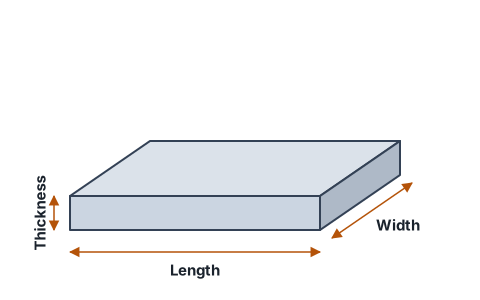
How to use this calculator
- Measure the length, width, and depth of the area to be poured.
- Enter each value and select the matching unit. You can mix feet for the plan and inches for the depth.
- If the pour is pitched for drainage, put the shallow depth in the first depth field and the deep end in depth at the far end. The calculator averages them, which is the correct treatment for a tapered slab.
- Add a waste allowance, then read the cubic yards figure. That is what ready-mix is sold by.
The formula
Concrete yardage is volume converted into cubic yards. Multiply the three dimensions in feet for cubic feet, then divide by 27, because a cubic yard is 3 × 3 × 3 = 27 cubic feet:
Cubic yards = (Length ft × Width ft × Depth ft) ÷ 27
Worked example. A 20 ft × 12 ft pad at 5 inches deep: 5 ÷ 12 = 0.417 ft, so 20 × 12 × 0.417 = 100 cubic feet. Divide by 27 to get 3.70 cubic yards. With 10% waste that is 4.07, and because suppliers sell in quarter yards you would be billed for 4.25.
Working the other way is just as useful. One cubic yard covers 324 ÷ thickness in inches square feet, which gives 81 sq ft at 4 inches, 64.8 at 5 inches, 54 at 6 inches and 40.5 at 8 inches. Concrete Network calls 81 the magic number for precisely this reason: divide your square footage by 81 and you have your yards at 4 inches. For the full method with inch-to-foot conversions and how to check a contractor's figure, read how much concrete do I need. For anything that is not a rectangle, concrete yardage by shape has the formulas for footings, columns, circles and walls.
Concrete yardage chart by slab size
Net yards is the plan volume. Order yards is that figure plus 10 percent, rounded up to the next quarter yard with a one yard floor, which is how suppliers actually bill. Both columns are in cubic yards.
| Slab | Area | 4 in net | 4 in order | 5 in net | 5 in order | 6 in net | 6 in order |
|---|---|---|---|---|---|---|---|
| 4 × 4 | 16 sq ft | 0.20 | 1.00 | 0.25 | 1.00 | 0.30 | 1.00 |
| 8 × 8 | 64 sq ft | 0.79 | 1.00 | 0.99 | 1.25 | 1.19 | 1.50 |
| 10 × 10 | 100 sq ft | 1.23 | 1.50 | 1.54 | 1.75 | 1.85 | 2.25 |
| 10 × 12 | 120 sq ft | 1.48 | 1.75 | 1.85 | 2.25 | 2.22 | 2.50 |
| 12 × 12 | 144 sq ft | 1.78 | 2.00 | 2.22 | 2.50 | 2.67 | 3.00 |
| 12 × 20 | 240 sq ft | 2.96 | 3.50 | 3.70 | 4.25 | 4.44 | 5.00 |
| 12 × 24 | 288 sq ft | 3.56 | 4.00 | 4.44 | 5.00 | 5.33 | 6.00 |
| 16 × 20 | 320 sq ft | 3.95 | 4.50 | 4.94 | 5.50 | 5.93 | 6.75 |
| 20 × 20 | 400 sq ft | 4.94 | 5.50 | 6.17 | 7.00 | 7.41 | 8.25 |
| 24 × 24 | 576 sq ft | 7.11 | 8.00 | 8.89 | 10.00 | 10.67 | 11.75 |
| 30 × 40 | 1,200 sq ft | 14.81 | 16.50 | 18.52 | 20.50 | 22.22 | 24.50 |
The quarter yard is not a convention we invented for the table. Duke City Redi-Mix in New Mexico publishes "we sell concrete in quarter yard increments with a one yard minimum order"; Marshall Concrete Products in Minnesota says "we sell concrete in quarter yard increments"; and Schmitz Ready Mix in Wisconsin tells you to "round up to the nearest quarter yard." Three suppliers in three states, same increment. Nothing in ASTM C94 sets one, so it is a commercial term rather than a standard, but it is close to universal.
Why the formula is not the answer: the subgrade
Every calculator on the internet, including this one, computes the volume of the slab you drew. The concrete fills the hole you dug, and those are different objects.
ACI 117-10, Specification for Tolerances for Concrete Construction, is where the gap is written down. Clause 4.4.5 sets the tolerance on the "fine grade of soil immediately below slabs-on-ground" at plus or minus three quarters of an inch. A base graded to the low limit of that tolerance is fully in specification, and it holds three quarters of an inch of extra concrete across the whole slab.
| Grade runs low by | Actual slab | Volume vs plan |
|---|---|---|
| 1/8 in | 4.125 in | +3.1% |
| 1/4 in | 4.25 in | +6.3% |
| 3/8 in | 4.375 in | +9.4% |
| 1/2 in | 4.5 in | +12.5% |
| 3/4 in (the ACI 117 limit) | 4.75 in | +18.8% |
| 3/4 in low and top of slab 3/4 in high | 5.5 in | +37.5% |
NRMCA states the first row independently and arrives at the same place: in CIP 8, Discrepancies in Yield, "a 1/8-inch difference in a 4-inch thick slab would mean a shortage of 3 percent or 1 yd³ in a 32-yd³ order." Kim Basham, writing for ForConstructionPros, gives the same relationship as a rate you can carry in your head: for every 1/8 inch the grade is low, the volume increases about 0.39 cubic yards per 1,000 square feet. One inch of extra average thickness over 1,000 square feet is 3.09 cubic yards.
The last row of that table is the one worth arguing about. Clause 4.4.5 and clause 4.4.1, which sets the top-of-slab elevation tolerance, are separate clauses, and each independently allows three quarters of an inch in the expensive direction. Clause 4.5.4 then sets a minus tolerance on slab thickness and no plus tolerance at all. So a slab 1.5 inches thicker than specified can be fully within the standard, and that is 37.5 percent more concrete, roughly four times the maximum overage anyone recommends. The clause numbers and values are quoted; the stacking of the two tolerances is our arithmetic, not an ACI claim, and a specifier paying attention would catch it. Clause 4.5.4.5 adds a final insult: a core more than three quarters of an inch thicker than specified "shall be assumed to have a thickness 3/4 in. more than the specified thickness." You buy the concrete, the acceptance standard declines to credit it.
For context on how loose that is, highway work is held tighter. Colorado DOT's 2023 specification allows aggregate base to vary no more than half an inch under a 10 foot straightedge, and Michigan DOT flags base variations greater than half an inch for the engineer's attention. A residential patio is graded to a looser tolerance than a highway base course.
The waste allowance is a premium, not a correction
The calculator defaults to 10 percent. That is defensible, but it is worth knowing exactly where it sits, because the industry does not agree with itself.
The only standards-adjacent figure comes from NRMCA CIP 8, and the exact wording matters: estimate waste, additional thickness, form deflection and other contingencies, and "order more than the original volume estimate by at least 4 to 10 percent." Those two words make 10 the top of a floor rather than a ceiling. Beyond that it is suppliers, and they scatter:
| Publisher | State | Recommended overage |
|---|---|---|
| NRMCA CIP 8 | national | at least 4 to 10% |
| Rocket Concrete | NC | 4 to 8% |
| Concrete Network | national | add 1/4 in to thickness (6.25% at 4 in) |
| Marshall Concrete | MN | 5 to 10% |
| Duke City Redi-Mix | NM | 10% |
| Schmitz Ready Mix | WI | 10 to 15% |
Six publishers, central tendency around 6 to 8 percent. Ten percent is the top of NRMCA's range, the top of Marshall's, the bottom of Schmitz's, above the whole of Rocket's, and 60 percent above what Concrete Network actually quantifies. Conservative, not average.
Here is the part that reframes the field's name. NRMCA's own research on crushed returned concrete states that "2% to 10% (average of 5%) of the estimated 455 million cubic yards of ready mixed concrete produced in the USA" is returned to the concrete plant. The allowance NRMCA recommends and the volume NRMCA measures coming home in the drum are the same range. Add CIP 8's separate finding that hardened volume is about 2 percent less than fresh, and 5 plus 2 is 7, the middle of the recommended 4 to 10. The three figures are internally consistent and they all say the same thing: most of the overage never gets used.
Actual spillage is far smaller than the field implies. The Mineral Products Association's 2023 wastage desk study, the only measured study we could find anywhere, puts ready-mix wastage at "typically between 1 and 2%," with one supplier reporting return rates of about 1.25 percent. That is a UK study and its baseline is a UK sector declaration, so treat the number as indicative rather than American. But if true waste is one to three percent, then seven of the ten points in a 10 percent allowance are not waste at all. They are the subgrade. The field is named after the smallest thing it covers.
And the allowance should not be a flat percentage, because subgrade error is measured in inches, not percent. At the same three-quarter-inch ACI tolerance, the required allowance falls as the pour gets thicker: 18.8 percent on a 4 inch patio, 15 percent at 5 inches, 12.5 percent on a 6 inch driveway, 9.4 percent at 8 inches and 6.3 percent on a 12 inch footing. A flat 10 percent is simultaneously too thin for flatwork on a hand-graded base and generous for a formed footing on firm ground. This is almost certainly why NRMCA publishes a range instead of a number.
What the quarter yard does to your 10 percent
The waste field is not the last thing that happens to your number. The order is rounded up to the next quarter yard, with a one yard floor at most plants, and on small pours that rounding is larger than the allowance it follows.
| Slab | Net yards | Plus 10% | Billed | Over net |
|---|---|---|---|---|
| 8 × 8 | 0.790 | 0.869 | 1.00 (minimum) | +26.6% |
| 10 × 10 | 1.235 | 1.358 | 1.50 | +21.5% |
| 12 × 12 | 1.778 | 1.956 | 2.00 | +12.5% |
| 12 × 20 | 2.963 | 3.259 | 3.50 | +18.1% |
| 20 × 20 | 4.938 | 5.432 | 5.50 | +11.4% |
| 24 × 24 | 7.111 | 7.822 | 8.00 | +12.5% |
Real delivered overage on residential slabs is 11 to 27 percent, never the nominal 10, and it bites hardest on the smallest pours. If you are pouring under a yard, the minimum order and the short load fee dominate everything else on this page; concrete pad cost has the supplier-by-supplier figures, and they are worse than most people expect.
The forms are not the problem
ASTM C94, the ready-mix purchase standard, lists the reasons hardened volume can look short: "waste and spillage, over-excavation, spreading forms, some loss of entrained air, or settlement of wet mixtures, none of which are the responsibility of the producer." Over-excavation and spreading forms sit side by side as though they were comparable. On flatwork they are not close.
ACI 347 gives lateral form pressure as p = wh, pressure equals unit weight times height. At the bottom edge of a 4 inch slab form that is 150 lb/ft³ × 0.333 ft = 50 lb per square foot, falling to zero at the top, which is 8.3 lb along each linear foot of form. For comparison, the same formula on an 8 foot wall gives 1,200 lb/ft², twenty-four times as much. A 2 × 4 edge form on stakes at 4 foot centers deflects well under a sixteenth of an inch under that load.
Take the most generous bow any published specification permits, Ohio DOT's quarter inch in 10 feet on the vertical face of a paving side form, and apply it to all four edges of a 10 × 10 pad at 4 inches. The extra volume is about 0.56 percent. Against the subgrade's 18.8 percent, that is roughly thirty-four times less. Anyone who has been told to over-order because the forms bow has been handed the wall-pour reason for a flatwork problem.
What coming up short actually costs: thirty minutes
Ordering light does not cost you the price of another half yard. It costs you a joint, and possibly the slab.
ACI publishes no clock. ACI 302.1R says that if placement is interrupted long enough for the concrete to harden, a construction joint should be used, and ACI 224.3R says a joint is required if placement stops "longer than the initial setting time." Neither gives a number. Initial set, per NRMCA TIP 14, is a penetration resistance of 500 psi, and "3 to 5 hours for a concrete mixture in the laboratory is considered reasonable."
Four specifications in two countries ignore that and converge on thirty minutes:
- Wisconsin DATCP, the cleanest wording of the four: "allow no more than 30 minutes between truckloads of concrete during placement."
- Ohio DOT requires a construction joint when work is suspended for more than 30 minutes.
- Michigan DOT says no more than 30 minutes should elapse between layers of concrete, and requires an end-of-pour joint for interruptions longer than 60 minutes measured from batching.
- The UK Specification for Highway Works, clause 1710, allows no fresh concrete against concrete in position more than 30 minutes without a joint.
The specifications are conservative by a factor of six to ten against the material's own set time, and they are right to be, because what fails is the top inch rather than the bulk. The surface of the previous load stiffens and loses its bleed water long before anything underneath it sets. That is also why none of the four carries a temperature table even though every one of them tightens in hot weather, and why Sakrete's figure for a hand-mixed pour, "approximately one hour to mix and place all of your materials to avoid cold joints," is in the same territory for the same reason.
The money side is published too, and it is not a discount for a top-up. Duke City Redi-Mix states it plainly: "if you do not order enough and need another load the short load fees will apply just like it is a new order." An emergency second truck is a brand new order with a fresh fee, not an adjustment. The dollar figures live on concrete price per yard and ready mix delivery.
Sloped and uneven pours
A slab pitched for drainage is not a box, it is a wedge, and its volume is the length times the width times the average of the two depths. That is the average end area method used in highway earthwork, reduced to its simplest case, and it is what the second depth field on this calculator does.
The volume consequence is larger than people expect, because sloping the top surface while leaving the base flat adds half the total fall to the average thickness no matter how thick the slab is. At the trade's usual quarter inch per foot, on a nominal 4 inch slab held at 4 inches on the low side, that is 31 percent more concrete over a 10 foot run, 50 percent over 16 feet and 62 percent over 20 feet. The alternative is to pitch the base and hold the slab at a constant thickness, which costs excavation instead of concrete, and that is what most published field practice actually does.
Which way to build it, how much fall a slab needs in the first place, and the awkward fact that the trade's minimum drainage slope and the ADA cross slope maximum are the same number are all on the concrete slope calculator. For a driveway with an apron that thickens, the driveway calculator carries the same two-depth field with the mix and base defaults for vehicle loads.
Yards to bags, and yards to ingredients
Every bag yield published by Quikrete and Sakrete works out to exactly 0.0075 cubic feet per pound, so the bag counts per yard are clean divisors of 27. The two brands' Quikrete and Sakrete data sheets agree exactly at 40, 60 and 80 lb and differ only at 90 lb, where Quikrete publishes 0.675 cubic feet and Sakrete 0.66.
| Bag | Published yield | Bags per cubic yard (before waste) |
|---|---|---|
| 40 lb | 0.30 cu ft | 90 |
| 50 lb (Quikrete only) | 0.375 cu ft | 72 |
| 60 lb | 0.45 cu ft | 60 |
| 80 lb | 0.60 cu ft | 45 |
| 90 lb | 0.675 / 0.66 cu ft | 40 / 41 |
No standard pallet makes a cubic yard. A 42-bag pallet of 80 lb mix is 25.2 cubic feet, which is 0.93 yards, and the other sizes land between 0.88 and 0.93. The one exception is Sakrete Maximizer at a full cubic foot per 80 lb bag. How many bags of concrete in a yard has the pallet counts and the crossover point where bags stop being cheaper, and the bag calculator works it from your dimensions.
Mixing from raw materials instead, Quikrete's own Portland cement data sheet says "five to six 94 lb bags of QUIKRETE Portland Cement is typically used with appropriate proportions of sand and gravel to produce 1 yd³," on a 1 part cement to 2 parts sand to 3 parts gravel recipe. That is 470 to 564 lb of cement per yard, and at the water-cement ratios in ACI 211.1 it needs roughly 32 gallons of water. The mix calculator works the proportions both ways and explains why no standards body attaches a psi to a volume ratio.
Yards to weight, and what you can actually haul
One cubic yard of fresh normal weight concrete is about 4,050 lb reinforced, or 3,890 to 3,920 lb plain. Cured concrete is roughly 2 percent lighter, because most of the mix water is chemically bound and never leaves. The weight calculator carries the full sourcing.
That figure is the reason the hauling question has a surprising answer. Ford publishes a best-in-class maximum available payload of 2,440 lb for the 2026 F-150, and 1,775 lb for the 2.7L EcoBoost configuration. Chevrolet publishes 2,260 lb for the Silverado 1500.
| Vehicle | Max payload | Concrete | Cubic feet |
|---|---|---|---|
| Nominal "half ton" (1,000 lb) | 1,000 lb | 0.25 yd | 6.7 |
| F-150, 2.7L EcoBoost | 1,775 lb | 0.44 yd | 11.8 |
| Silverado 1500, max config | 2,260 lb | 0.56 yd | 15.1 |
| F-150, best-in-class max config | 2,440 lb | 0.60 yd | 16.3 |
| Same, minus a driver and passenger | 2,080 lb | 0.51 yd | 13.9 |
The bed is nowhere near the constraint. An F-150's short 5.5 foot box holds 52.8 cubic feet, which is 1.96 cubic yards, and filled level with concrete that is 7,920 lb, more than three times the truck's best-case payload. The 8 foot box holds 2.87 yards, which filled would be 11,610 lb, over the truck's entire gross weight rating. At the payload limit you have filled just under a third of the shortest bed. The axles run out long before the box does.
Trailers do not rescue it. Big Tex publishes cargo capacity rather than only gross rating, and its 2,995 lb single-axle utility trailers, the ubiquitous 5 × 10 kind, carry 1,515 to 2,332 lb, which is 0.37 to 0.58 cubic yards. A 7,000 lb tandem carries about 1.3 yards. Nothing under a 10,000 lb gross rating legally carries two yards. Add tongue weight at the usual 10 to 15 percent and a maxed half-ton towing a maxed single-axle trailer tops out around one cubic yard with nobody in the passenger seat.
Two consequences worth knowing. First, you can legally haul more concrete as bags than as wet mix, because the water is not in the truck: 2,440 lb of dry mix is 30 × 80 lb bags, which make 0.68 yards, about 13 percent more than the 0.60 you could carry wet. A full 42-bag pallet, though, is 3,360 lb, which is 1.38 times that payload, so the pallet still cannot go in the truck. Second, a standard contractor wheelbarrow is 6 cubic feet, and 6 cubic feet of concrete weighs 900 lb, which is why nobody fills one. At a practical half load you are making nine trips per cubic yard.
The mixer truck has the same problem in larger units. PCA's figures put productive payload at 18,000 lb of a 40,000 lb limit, the other 30,000 being the truck itself, and that is about 4.4 cubic yards of legal payload on a drum rated for 9 to 12. How many yards in a truck of concrete works through it.
Converting yards into the other numbers you need
From square footage. Square feet is an area and yards is a volume, so the conversion needs a thickness before it means anything. The square footage calculator takes an area and a thickness, and how many square feet in a yard of concrete has the coverage table in both directions.
To dollars. Concrete price per yard has current delivered prices by mix strength and the fee schedule that catches people out. The cost calculator prices your own dimensions, and slab cost and driveway cost are the project-specific versions.
To a shape that is not a rectangle. Footings, sonotubes and columns, walls, stairs and curb and gutter each have their own geometry, and yardage by shape gives the formulas if you want to do it by hand.
Backwards, from a yard. What is a yard of concrete covers what one yard looks like on the ground, why the yard is defined at the chute rather than in the batch computer, and the difference between a cubic yard, a square yard and a yard.
Frequently asked questions
How do I calculate concrete yardage?
Measure length, width, and depth in feet, multiply them for cubic feet, then divide by 27 to get cubic yards. This concrete yardage calculator does the conversion and the rounding for you, and adds the waste allowance.
How many cubic feet are in a cubic yard of concrete?
There are 27 cubic feet in one cubic yard. A cubic yard is a cube three feet on each side, so 3 × 3 × 3 = 27 cubic feet.
How much area does a yard of concrete cover?
Divide 324 by the thickness in inches. That gives 81 square feet at 4 inches, 64.8 at 5 inches, 54 at 6 inches and 40.5 at 8 inches. Concrete Network calls 81 "the magic number" for exactly this reason.
How much extra concrete should I order?
NRMCA says to order "at least 4 to 10 percent" more than the plan volume. Suppliers publish anything from 4 to 15 percent. Ten percent is the top of the standards-adjacent range rather than its middle, and most of it covers the subgrade rather than spillage.
Should I round concrete yardage up?
You do not get the choice. Suppliers in New Mexico, Minnesota and Wisconsin all publish that they sell in quarter-yard increments, usually with a one yard floor, so your order is rounded up to the next quarter yard whatever you ask for.
Why did my pour come up short when the math was right?
Almost always the subgrade. ACI 117-10 lets the fine grade under a slab sit three quarters of an inch low, which on a nominal 4 inch slab is 18.75 percent more concrete than the plan says, with nobody doing anything wrong.
How much concrete can I haul in a pickup?
About half a cubic yard. One cubic yard of fresh concrete weighs roughly 4,050 lb, and Ford publishes a best-in-class maximum payload of 2,440 lb for the 2026 F-150, which works out to 0.60 cubic yards. The bed is not the limit; the axles are.