Concrete Square Footage Calculator
This calculator turns a known floor area into concrete. Enter the square footage and the thickness and it returns cubic yards, cubic feet, weight and bag counts. Use it when you already have the area of a slab, patio or sidewalk and just need the volume, rather than measuring length and width again.
How to use this calculator
- Enter the area and pick square feet, yards, or meters.
- Enter the thickness of the slab.
- Add a waste allowance.
- Read the cubic yards for ready-mix or the bag count for hand mixing.
The formula
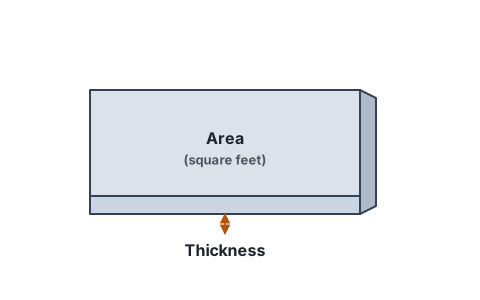
When you already know the area, volume is area times thickness. Convert the thickness to feet and divide by 27 for cubic yards:
Cubic yards = (Area ft² × Thickness ft) ÷ 27
Worked example. 100 square feet at 4 inches: 4 inches is 0.333 ft, so 100 × 0.333 = 33.3 cubic feet, which is 1.23 cubic yards, or about 56 × 80 lb bags.
Square feet is not an amount of concrete
This is the mistake behind most wrong orders, and it is worth being blunt about. Square footage is an area. Concrete fills a box underneath it. Until you name a thickness there is nothing to multiply by, so the question "how much concrete for 500 square feet" has no single answer.
Watch how much the thickness moves it on the same 500 square foot area:
| Thickness | Cubic feet | Cubic yards | 80 lb bags (before waste) |
|---|---|---|---|
| 2 in | 83.3 | 3.09 | 139 |
| 4 in | 166.7 | 6.17 | 278 |
| 5 in | 208.3 | 7.72 | 347 |
| 6 in | 250.0 | 9.26 | 417 |
Going from 4 to 6 inches on the same patio is three more cubic yards, which is most of another truck. The area did not change at all.
The reverse trips people up just as often: one cubic yard covers about 81 square feet at 4 inches, 54 at 6 inches, and 324 at 1 inch. Same yard, three different answers. Concrete coverage has the full chart by thickness and the tolerances that make the real number run higher than the arithmetic.
Common areas at 4 inches
Four inches is the standard for patios, walkways and shed pads. Here is the arithmetic already done, with a 10 percent allowance in the last column.
| Area | Cubic yards | Order with 10% | 80 lb bags (before waste) |
|---|---|---|---|
| 100 sq ft | 1.23 | 1.36 | 56 |
| 200 sq ft | 2.47 | 2.72 | 112 |
| 300 sq ft | 3.70 | 4.07 | 167 |
| 400 sq ft | 4.94 | 5.43 | 223 |
| 500 sq ft | 6.17 | 6.79 | 278 |
| 1,000 sq ft | 12.35 | 13.58 | 556 |
The bag counts are the net figure. The calculator adds your waste allowance on top, so it will return a higher count than the table. Note too where the bag column stops being realistic. Past about a cubic yard, 45 bags is most of a day of mixing and costs more than delivered concrete, so anything from 200 square feet up is truck territory. Bags of concrete per yard works through that crossover with real short-load fees.
Measuring an area that is not a rectangle
Most real pours are not rectangles, and the fix is simpler than the geometry suggests: break the shape into rectangles, work out each one, and add them. The calculator takes the total.
- An L shape. Split it into two rectangles with one straight cut. Measure each and add. The only thing to watch is not counting the corner square twice.
- A circle or round pad. Area is π × radius², so a 10 ft diameter pad is 3.1416 × 5² = 78.5 square feet.
- A triangle. Half the base times the height.
- Anything curved or irregular. Overlay rectangles that cover it, accept that you are rounding up, and treat the overage as part of the waste allowance rather than on top of it.
Measure to the outside of the forms, not to the string line, and measure the actual dimensions rather than the ones on the plan. For shapes the site handles directly, the slab calculator takes length and width, and yardage by shape has the formula for footings, columns, circles and steps.
Where area times thickness gets you into trouble
The formula assumes a slab of uniform thickness sitting on flat ground. Three common cases break that assumption, and all three break it in the same direction, which is that you need more concrete than the arithmetic says.
- A thickened edge. Many slabs are deepened around the perimeter, often to 8 or 12 inches. That extra concrete is invisible to an area calculation. Work the edge as a separate footing and add it.
- A sloped pour. Driveways and garage floors are pitched for drainage, so the thickness is not constant. Use the average of the two thicknesses, which the driveway calculator and the slope calculator both do for you when you enter both.
- The subgrade. This is the big one and it is invisible on paper. ACI's tolerance allows a fine-graded subgrade to sit three quarters of an inch out either way, and every eighth of an inch it runs low costs about 0.39 cubic yards per 1,000 square feet. A nominally 4 inch slab on an in-tolerance subgrade can genuinely need 15 percent more concrete than the plan.
That last point is why the waste allowance is not padding. The industry's published range is 4 to 10 percent above the plan quantity, and a hand-graded subgrade belongs at the top of it.
Cost from square footage
The cost panel prices the concrete from your volume. For a rough figure before you measure anything, installed concrete flatwork runs about $6 to $12 per square foot for a plain finish, of which the concrete itself is only around $2: one cubic yard covers 81 square feet at 4 inches, and the ready-mix industry's own benchmarking puts the average selling price at $160 per cubic yard.
The rest is base, forms, reinforcement, labor and finish. For the breakdown see concrete cost per square foot, and for a slab priced line by line, the concrete slab cost calculator.
If you do not have the area yet
This calculator starts from a known area. If you are measuring from scratch, these start from dimensions instead: the concrete slab calculator for a rectangular slab, the pad calculator for AC, shed and hot tub pads, the sidewalk calculator for a walkway with its jointing and forms, the floor calculator for interior slabs, and the yardage calculator for the general case.
Working in bags rather than yards? The concrete bag calculator returns the count in every bag size.
Frequently asked questions
How do I calculate concrete from square footage?
Multiply the area in square feet by the thickness in feet to get cubic feet, then divide by 27 for cubic yards. Enter the area directly when you already know it.
How much concrete do I need for 100 square feet?
100 square feet at 4 inches thick is about 1.23 cubic yards (33.3 cubic feet), or roughly 56 × 80 lb bags.
How much concrete for a sidewalk?
A 3 ft wide, 30 ft long walk at 4 inches thick is 90 square feet, or about 1.1 cubic yards. Sidewalks are usually poured 4 inches thick.
How many square feet does a yard of concrete cover?
One cubic yard covers about 81 square feet at 4 inches, 65 at 5 inches, and 54 at 6 inches thick.
How much concrete do I need for 500 square feet?
Depends entirely on the thickness, which is why the question has no single answer. At 4 inches it is 6.17 cubic yards, at 5 inches 7.72, and at 6 inches 9.26. Going from 4 to 6 inches on the same area is three more cubic yards, most of another truck, without the area changing at all.
How do I measure an area that is not a rectangle?
Break it into rectangles, work out each one and add them, then enter the total. An L shape splits with one straight cut, just do not count the corner twice. A circle is π × radius², so a 10 ft round pad is 78.5 square feet. For anything curved, overlay rectangles that cover it and treat the rounding up as part of the waste allowance rather than on top of it.
Why does the calculator say I need more concrete than I measured?
Because area times thickness assumes a uniform slab on flat ground, and three things break that. A thickened edge is concrete an area calculation cannot see. A sloped pour has no single thickness. And the subgrade is rarely where the plan says: ACI allows a fine-graded subgrade to sit three quarters of an inch out either way, and every eighth of an inch it runs low costs about 0.39 cubic yards per 1,000 square feet. The published order allowance is 4 to 10 percent for exactly this reason.