Self-Leveling Concrete Calculator
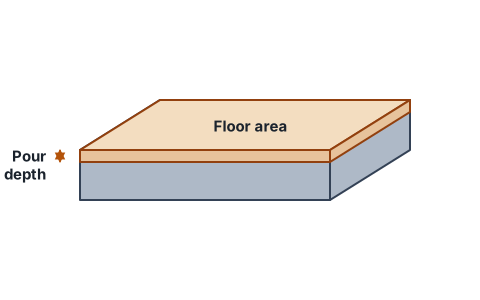
This self leveling concrete calculator tells you how many bags of floor leveler to buy. Enter the floor area and the average pour depth, pick your product from the 16 in the list, and it gives you the bag count from that product's published coverage with waste added. It also shows the volume of fill and warns you if your depth is more than the product can take in one pour.
How much a bag of self-leveler covers
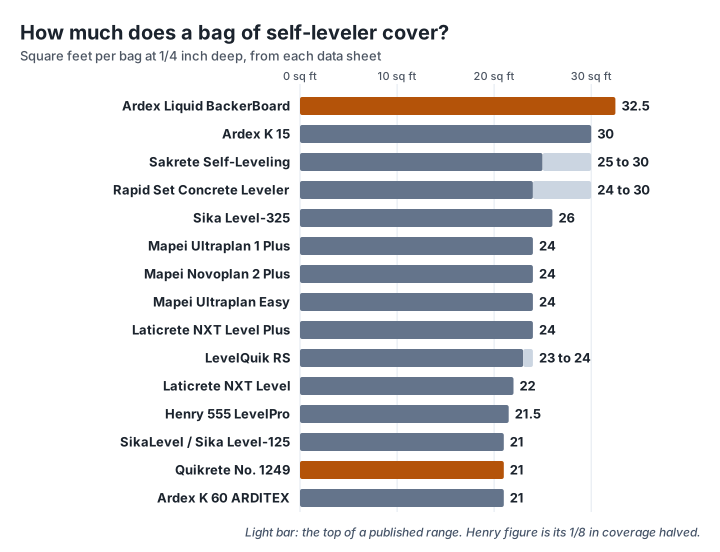
Most 50 lb bags cover 21 to 32.5 square feet at 1/4 inch, so the product you pick changes the bag count more than anything else. In a 200 sq ft room that's 10 bags of Quikrete No. 1249 or 7 of Ardex Liquid BackerBoard.
Coverage halves every time the depth doubles. Here's what that looks like for three common coverage ratings:
| Depth | Rated 21 sq ft | Rated 24 sq ft | Rated 32.5 sq ft |
|---|---|---|---|
| 1/8 in | 42 | 48 | 65 |
| 1/4 in | 21 | 24 | 32.5 |
| 3/8 in | 14 | 16 | 21.7 |
| 1/2 in | 10.5 | 12 | 16.3 |
| 3/4 in | 7 | 8 | 10.8 |
| 1 in | 5.3 | 6 | 8.1 |
How the calculator works
Self-levelers are sold by coverage, not by volume, so the math runs off square feet per bag:
Coverage at your depth = rated coverage × (0.25 ÷ your depth in inches)
Bags = area ÷ coverage at your depth, rounded up
Example: 200 sq ft at 1/2 inch with a bag rated 21 sq ft. Coverage drops to 10.5 sq ft, so 200 ÷ 10.5 = 19.05, which is 20 bags before waste. Keep the 10 percent waste setting, since a leveler can't be topped up once it starts to skin over.
Pouring a real slab instead of leveling a floor? Use the concrete slab calculator or the concrete bag calculator, and our guide to how a slab is built from the base up covers thickness and reinforcement.
Measuring the average depth
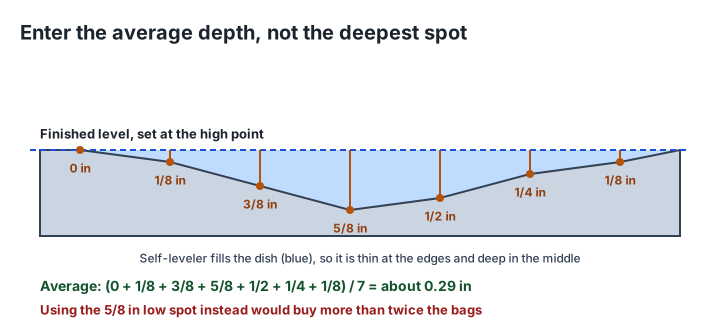
- Find the floor's high point with a long straightedge or a laser. That sets the finished level.
- Measure down to the floor every 2 feet or so, across the whole room.
- Add the readings and divide by how many you took. That's the depth to enter.
Under 1/8 inch on average, you're skim coating, and a trowel-on patch is cheaper. Over an inch, check your product's maximum pour below. The floor leveling guide covers grinding and patching before you pour.
Check the maximum pour depth
The most a product can take in one pour runs from 5/8 inch (standard Quikrete No. 1249) to 3 inches (Laticrete NXT Level and Sika Level-325). The Fast-Setting version of Quikrete No. 1249 goes to 1-1/2 inches, so two bags with nearly the same name behave very differently. The full list is below. Enter a depth over your product's limit and the calculator tells you how many pours it takes.
Coverage, maximum pour and walk-on time for all 16 products
| Product | Bag | At 1/4 in | Max single pour | Walk on |
|---|---|---|---|---|
| Ardex Liquid BackerBoard | 50 lb | 32.5 sq ft | 1-1/4 in | 2 to 3 hr |
| Ardex K 15 | 55 lb | 30 sq ft | 1-1/2 in, 5 in with aggregate | 2 to 3 hr |
| Sakrete Self-Leveling Underlayment | 50 lb | 25 to 30 sq ft | 1 in | Not published |
| Rapid Set Concrete Leveler | 50 lb | 24 to 30 sq ft | 2 in, 5 in with pea gravel | 2 to 4 hr |
| Sika Level-325 | 55 lb | 26 sq ft | 3 in, 4 in extended | 4 hr |
| Mapei Ultraplan 1 Plus | 50 lb | 24 sq ft | 1-1/2 in | 2 to 3 hr |
| Mapei Novoplan 2 Plus | 50 lb | 24 sq ft | 1 in | 2 to 3 hr |
| Mapei Ultraplan Easy | 50 lb | 24 sq ft | 2 in | 2 to 3 hr |
| Laticrete NXT Level Plus | 55 lb | 24 sq ft | 2 in | 2 to 3 hr |
| LevelQuik RS | 50 lb | 23 to 24 sq ft | 1-1/2 in | 2 to 4 hr |
| Laticrete NXT Level | 50 lb | 22 sq ft | 3 in | 2 to 3 hr |
| SikaLevel / Sika Level-125 | 50 lb | 21 sq ft | 2 in, 3 in extended | 2 to 3 hr |
| Quikrete No. 1249 | 50 lb | 21 sq ft | 5/8 in | Not published |
| Quikrete No. 1249 Fast-Setting | 50 lb | 21 sq ft | 1-1/2 in | 6 hr |
| Henry 555 LevelPro | 40 lb | 43 sq ft at 1/8 in | 1-1/2 in, 5 in with aggregate | 2 to 3 hr |
| Ardex K 60 ARDITEX | 35 lb plus 1 gal liquid | 21 sq ft per unit | 1/2 in, 1/4 in over wood | 2 to 3 hr |
All figures are from each manufacturer's data sheet. Where a product gives a range, the calculator orders against the low end.
Add primer to your list
Almost every leveler needs a primer, and it's sold separately. Laticrete's substrate guide warns that poor priming "will result in pinholes and poor bond strength and may cause self-leveling products to debond." The only common exceptions are Ardex K 60 ARDITEX, and Laticrete NXT Level Plus or Mapei Ultraplan Easy over the membranes their makers name. On wood, primer usually goes on undiluted.
Frequently asked questions
How many bags of self-leveler do I need?
Divide the floor area by your product’s coverage at your pour depth. At a quarter inch, published coverage runs from 21 square feet per 50 lb bag (Quikrete No. 1249, Sika Level-125) to 32.5 (Ardex Liquid BackerBoard), so a 200 square foot room takes 10 bags of one and 7 of the other. Pick your product in the calculator above and it uses that figure.
How much does a bag of self-leveler cover?
Between 21 and 32.5 square feet at a quarter inch for a 50 lb bag, depending on the product, because lightweight formulations cover far more floor per pound. Coverage scales inversely with depth: the same bag covers twice the area at an eighth of an inch and half of it at half an inch.
How thick can self-leveling concrete be poured?
It depends on the product, and the range is wide. Quikrete No. 1249 caps at 5/8 inch per pour, Sakrete and Mapei Novoplan at 1 inch, most of the field at 1-1/2 to 2 inches, and Laticrete NXT Level pours up to 3 inches in one lift. Several products reach 4 or 5 inches only by adding aggregate, which changes the coverage math.
Does self-leveling underlayment need primer?
Almost always, and manufacturers are blunt about it. Laticrete states that poor priming causes pinholes, poor bond strength and possible debonding. The only common exemptions are Ardex K 60 ARDITEX, Laticrete NXT Level Plus over STRATA_MAT or STRATA_HEAT, and Mapei Ultraplan Easy over named membranes.
Is LevelQuik RS the same as Quikrete self-leveler?
No. LevelQuik RS is a CUSTOM Building Products product, and CUSTOM is corporately a QUIKRETE company, which is where the confusion starts. It covers 23 to 24 square feet per 50 lb bag and pours to 1-1/2 inches. Quikrete No. 1249 covers 21 square feet and caps at 5/8 inch per pour. Different bags, different numbers.
Can self-leveling underlayment go over plywood?
Most can, with conditions, but not all. Ardex K 15 and Rapid Set Concrete Leveler do not list wood at all. Sika wants two layers of plywood totalling 1-1/4 inches. Quikrete, Sakrete and Laticrete generally require metal lath over wood, with Laticrete NXT Level Plus the exception. Primer goes on wood undiluted.