Concrete Bag Calculator
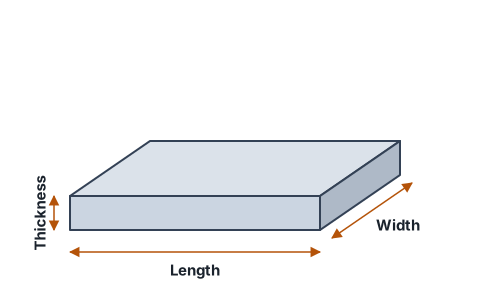
This concrete bag calculator tells you how many bags of premixed concrete to buy for a slab, pad or footing. Enter the length, width and thickness and pick a waste allowance, and it gives you the count in 80, 60 and 40 lb bags. You also get the volume in cubic yards and cubic feet, so you can see when a ready-mix truck makes more sense.
How much concrete one bag makes
80 lb bag
0.60 ft³
per bag
- Per yard
- 45 bags
- At 4 in
- 1.8 sq ft
60 lb bag
0.45 ft³
per bag
- Per yard
- 60 bags
- At 4 in
- 1.35 sq ft
50 lb bag
0.375 ft³
per bag
- Per yard
- 72 bags
- At 4 in
- 1.1 sq ft
40 lb bag
0.30 ft³
per bag
- Per yard
- 90 bags
- At 4 in
- 0.9 sq ft
These are the yields on the QUIKRETE Concrete Mix and Sakrete High-Strength data sheets, and the calculator uses the 80, 60 and 40 lb figures. A 90 lb bag yields 0.675 ft³ (Quikrete) or 0.66 ft³ (Sakrete), about 40 or 41 bags per yard. One exception: Sakrete Maximizer yields 0.92 ft³ per 80 lb bag, so only 30 bags make a yard. Count it with the Sakrete calculator.
The formula
Bags = length × width × thickness (ft³) × 1.10 waste ÷ bag yield (ft³), rounded up
Example: a 6 × 4 ft pad, 4 inches thick
- Volume: 6 × 4 × 0.333 ft = 8 ft³; plus 10 percent waste = 8.8 ft³
- 80 lb bags: 8.8 ÷ 0.60 = 14.7, so 15 bags
- 60 lb bags: 8.8 ÷ 0.45 = 19.6, so 20 bags
- 40 lb bags: 8.8 ÷ 0.30 = 29.3, so 30 bags
Keep the 10 percent: Sakrete's estimating guide says "it's always a good idea to add 10% to every estimate." Bags are sold whole, and running short mid-pour is worse than one spare.
Bags for common slab sizes
| Slab | Volume | 80 lb | 60 lb | 40 lb |
|---|---|---|---|---|
| 4 × 4 ft | 5.3 ft³ | 10 | 14 | 20 |
| 8 × 8 ft | 21.3 ft³ | 40 | 53 | 79 |
| 10 × 10 ft | 33.3 ft³ | 62 | 82 | 123 |
| 10 × 12 ft | 40 ft³ | 74 | 98 | 147 |
Concrete bag coverage chart
One bag covers less ground the thicker you pour. Coverage is the bag yield divided by the thickness in feet.
| Bag | 2 in | 3 in | 4 in | 6 in |
|---|---|---|---|---|
| 40 lb | 1.8 | 1.2 | 0.9 | 0.6 |
| 50 lb | 2.25 | 1.5 | 1.1 | 0.75 |
| 60 lb | 2.7 | 1.8 | 1.35 | 0.9 |
| 80 lb | 3.6 | 2.4 | 1.8 | 1.2 |
| 90 lb (0.675 ft³) | 4.05 | 2.7 | 2.0 | 1.35 |
Cubic yards to bags
| Concrete | 80 lb | 60 lb | 40 lb | Weight, about |
|---|---|---|---|---|
| 1/2 yd³ | 23 | 30 | 45 | 1,800 lb |
| 1 yd³ | 45 | 60 | 90 | 3,600 lb |
| 1 1/2 yd³ | 68 | 90 | 135 | 5,400 lb |
| 2 yd³ | 90 | 120 | 180 | 7,200 lb |
| 3 yd³ | 135 | 180 | 270 | 10,800 lb |
| 4 yd³ | 180 | 240 | 360 | 14,400 lb |
Whatever size you buy, a cubic yard is about 3,600 lb of bags to lift and mix. Past a yard or so, price a truck with the concrete cost calculator and the concrete estimate guide. A pour that has to go in all at once is a truck job at any size. More in bags of concrete per yard.
Which bag to buy
Bag size
80 lb means the fewest bags to open. 60 and 40 lb are easier to lift and suit repairs, tight access or mixing in a bucket. 90 lb Quikrete is regional only.
Strength
Standard mixes like QUIKRETE Concrete Mix and Sakrete High-Strength are rated 4,000 psi at 28 days. QUIKRETE 5000 is 5,000 psi and Maximizer 5,500. See concrete psi. If you already know which Quikrete mix you're buying, the Quikrete bag calculator counts bags for that exact product.
Not concrete mix
Portland cement alone is just the binder (use the mix calculator). Sand/topping mix is for layers ½ to 2 inches. Mortar is for block, so use the mortar calculator.
Setting posts? The fence post calculator sizes the hole, and pouring the mix in dry is approved for setting posts with fast-setting mix (Quikrete and Sakrete Fast-Setting), which is not the same as dry pouring a slab. For round piers use the Sonotube calculator, and for Quikrete-specific yields see Quikrete bag yield.
Frequently asked questions
How many bags of concrete do I need?
Work out the volume in cubic feet, add 10 percent, and divide by the bag yield: 0.60 cubic feet for an 80 lb bag, 0.45 for a 60 lb bag and 0.30 for a 40 lb bag. Round up to whole bags.
How many 80 lb bags of concrete make a yard?
45 bags. A cubic yard is 27 cubic feet and an 80 lb bag yields about 0.60 cubic feet, so 27 ÷ 0.60 = 45. It takes 60 bags of 60 lb or 90 bags of 40 lb.
How much does a bag of concrete cover?
At 4 inches thick, an 80 lb bag covers about 1.8 square feet, a 60 lb bag 1.35 and a 40 lb bag 0.9. At 2 inches the coverage doubles, so an 80 lb bag covers about 3.6 square feet.
How many bags of concrete for a 10x10 slab?
At 4 inches thick, a 10 by 10 slab is 33.3 cubic feet. With 10 percent for waste that is 62 bags of 80 lb, 82 bags of 60 lb or 123 bags of 40 lb.
How many bags of concrete are in 2 yards?
90 bags of 80 lb, 120 of 60 lb or 180 of 40 lb, before any waste allowance. That is about 7,200 lb of bags, so price a ready-mix delivery before you commit.
How many 90 lb bags of concrete make a yard?
About 40 bags of 90 lb QUIKRETE Concrete Mix, which yields 0.675 cubic feet per bag, or 41 bags of 90 lb Sakrete High-Strength at 0.66 cubic feet. Quikrete sells the 90 lb bag in some regions only.