Concrete Wall Calculator
This concrete wall calculator works out how much concrete a poured wall takes. Enter the wall's length, height and thickness and pick a waste allowance, and it returns the volume in cubic yards, cubic feet and cubic meters, the amount to order with waste, and the bag count for 80, 60 and 40 lb bags. It also gives the wall's weight in pounds, US tons and kilograms, so you can see whether bags are realistic or it's a ready-mix job.
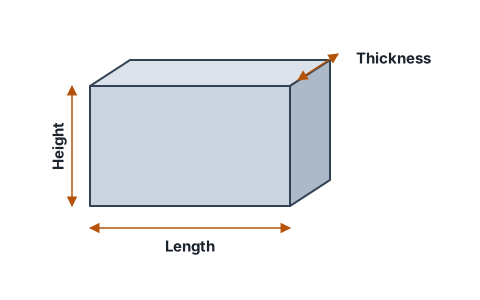
How to calculate concrete for a wall
Multiply length by height by thickness, all in feet, and divide by 27 to get cubic yards.
Cubic yards = length ft × height ft × thickness ft ÷ 27
Using the calculator
- Measure the wall. Length along the wall, and height from the top of the footing to the top of the wall, in feet, inches, yards or meters.
- Enter the thickness. Most house foundation walls are 8 inches. Inches, feet and centimeters all work.
- Pick a waste allowance. The default is 10 percent, for spillage, form bulge and an uneven footing top.
- Subtract big openings. Work out each large window or door opening the same way (width × height × thickness) and take it off the total. Small ones fall inside the waste allowance.
Worked example. A wall 20 ft long, 8 ft tall and 8 in thick is 20 × 8 × (8 ÷ 12) = 106.67 cu ft, or 3.95 cu yd (3.02 m³). With 10 percent waste, order 4.35 cu yd: 196 bags at 80 lb, 261 at 60 lb or 392 at 40 lb. The wall weighs 16,000 lb, or 8 US tons.
Building with block instead? A masonry wall needs a block count plus grout for the filled cores, so use the concrete block calculator. The footing under the wall is its own pour; size it with the concrete footing calculator.
Concrete per foot of wall, and what it weighs
A cubic yard of concrete builds about 5 feet of an 8 inch by 8 ft wall, and every foot of that wall weighs 800 lb.
8 in × 8 ft wall
19.8 yd³
per 100 linear ft. 5.33 cu ft and 800 lb per foot.
8 in × 9 ft wall
22.2 yd³
per 100 linear ft. 6.00 cu ft and 900 lb per foot.
10 in × 9 ft wall
27.8 yd³
per 100 linear ft. 7.50 cu ft and 1,125 lb per foot.
10 in × 10 ft wall
30.9 yd³
per 100 linear ft. 8.33 cu ft and 1,250 lb per foot.
Weights use 150 lb per cubic foot, the reinforced concrete unit weight the calculator uses and the one in Missouri DOT's bridge design guide. For another density, the concrete weight calculator takes any volume.
Concrete and weight for 7 common wall sizes
| Wall | Cu ft per ft | Lb per ft | Cu yd per 100 ft | Ft of wall per cu yd |
|---|---|---|---|---|
| 8 in × 8 ft | 5.33 | 800 | 19.8 | 5.1 |
| 8 in × 9 ft | 6.00 | 900 | 22.2 | 4.5 |
| 8 in × 10 ft | 6.67 | 1,000 | 24.7 | 4.1 |
| 10 in × 8 ft | 6.67 | 1,000 | 24.7 | 4.1 |
| 10 in × 9 ft | 7.50 | 1,125 | 27.8 | 3.6 |
| 10 in × 10 ft | 8.33 | 1,250 | 30.9 | 3.2 |
| 12 in × 10 ft | 10.00 | 1,500 | 37.0 | 2.7 |
A cubic yard is 45 bags of 80 lb (0.6 cu ft each), so 100 ft of 8 in by 8 ft wall is about 890 bags before waste.
That mass is also why a poured wall blocks noise well: an 8 inch reinforced wall carries 100 lb on every square foot of face, against about 1.6 lb for half inch drywall. Gaps, openings and whatever is built onto it still let sound through, so check how much sound concrete actually stops before counting on it.
How thick should a foundation wall be?
Plan on 8 inches for a poured house foundation wall; the IRC then sets the steel from the wall's height, the depth of backfill and the soil class.
Typical wall
8 in
Nominal. A foundation wall can't be thinner than the wall it carries (IRC R404.1.5.2).
As built
7-1/2 in
Still a legal 8 in wall: IRC Table R608.3 allows up to 1/2 in under nominal and 1/4 in over.
Engineer needed
Over 48 in
Of unbalanced backfill without lateral support at top or bottom, or any groundwater pressure (IRC R404.1.1).
Minimum strength
2,500 psi
For walls not exposed to weather; 3,000 psi for exposed walls in moderate or severe weathering areas (IRC Table R402.2).
In Seismic Design Categories D0 to D2, a plain (unreinforced) concrete foundation wall must be at least 7.5 inches thick, or 6 inches if it's no taller than 4 ft 6 in (IRC R404.1.4.2). For what the psi numbers mean, see concrete PSI ratings.
States amend these sections: Minnesota adds its own foundation wall tables, for one. Check with your building department before you set the forms.
What is a stem wall?
A stem wall is a short foundation wall poured on top of a separate footing, raising the floor or slab above the ground. Because it's poured after the footing, there's a construction joint between the two, and IRC R403.1.3.1 requires a No. 4 vertical bar at no more than 4 ft on center across it in Seismic Design Categories D0 to D2, with a standard hook 3 in clear of the bottom of the footing and at least 14 in up into the wall.
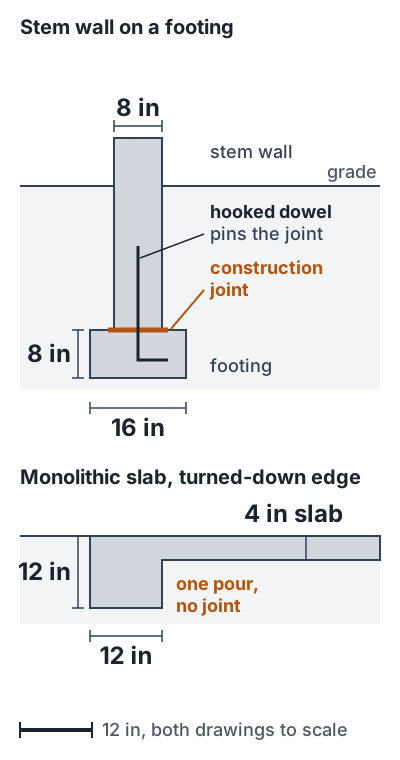
A slab cast monolithically with a turned-down edge (IRC R403.1.3.3) has no joint to pin. Count a stem wall's footing as its own pour: a 16 by 8 inch footing holds 3.3 cubic yards per 100 linear feet. A 3 ft tall, 8 inch stem wall on that footing totals 2.9 cu ft per foot, or 10.7 cubic yards per 100 linear feet (7.4 for the wall, 3.3 for the footing).
- Footing size for your soil and number of stories: the IRC footing width table.
- Lot slopes along the wall: stepped footings for sloped lots.
- Wall holds back soil on one side: retaining wall footings.
What the concrete in a wall costs
At $160 per cubic yard delivered, the concrete for a poured wall runs $31.60 to $44.44 per linear foot at common sizes.
8 in × 8 ft wall
$31.60
5.33 cu ft of concrete per foot.
8 in × 9 ft wall
$35.56
6.00 cu ft of concrete per foot.
10 in × 9 ft wall
$44.44
7.50 cu ft of concrete per foot.
The material alone runs about $125 a yard before delivery. Orders under 10 yards usually carry a short-load fee of about $30 on every yard in the load, so a single short wall pays more per yard.
Concrete is the cheap part of a finished wall. In Montana DOT's 2025 weighted average bid prices, structural concrete for highway structures, placed and finished, averaged $1,165.83 per cubic yard across 1,940 cubic yards, about seven times the delivered price; the bid price covers forms, labor and placing as well as the concrete.
For a whole foundation, see concrete foundation cost. To price any volume with your local rate, use the concrete cost calculator.
How fast can you pour a concrete wall?
As fast as your forms' rated pressure allows: at 70°F a 9 ft wall stays at 1,050 lb/ft² or less up to 7 ft of rise per hour, but at 50°F it reaches full liquid pressure, 1,350 lb/ft² (150 lb per sq ft per foot of depth), at about 6.7 ft per hour. Pour slowly in warm weather and the bottom stiffens first, so the forms see less.
Under 7 ft/hr (walls to 14 ft): p = 150 + 9,000R ÷ T
7 to 15 ft/hr (or taller walls under 7): p = 150 + 43,400 ÷ T + 2,800R ÷ T
Over 15 ft/hr: p = 150 × height
R is the pour rate in feet of height per hour and T the concrete temperature in °F. These are the wall equations in ACI 347R-14, for slump of 7 in or less and vibration no deeper than 4 ft, with a 600 lb/ft² floor and full liquid head as the cap.
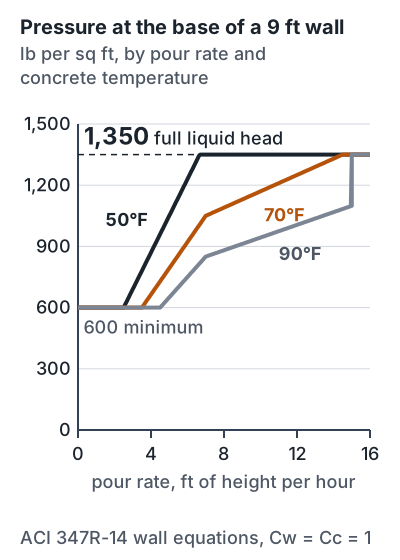
A retarder multiplies design pressure by 1.2 with straight portland cement and 1.4 with a blended cement; blends with 70 percent or more slag or 40 percent or more fly ash take 1.4, or 1.5 with a retarder. Pumping in from the bottom of the form calls for full head plus at least 25 percent.
Design pressure at the base of a 9 ft wall, by pour rate
| Pour rate | 50°F | 70°F | 90°F |
|---|---|---|---|
| 2 ft/hr | 600 | 600 | 600 |
| 4 ft/hr | 870 | 664 | 600 |
| 6 ft/hr | 1,230 | 921 | 750 |
| 7 ft/hr | 1,350 | 1,050 | 850 |
| 10 ft/hr | 1,350 | 1,170 | 943 |
| 15 ft/hr | 1,350 | 1,350 | 1,099 |
| Over 15 ft/hr | 1,350 | 1,350 | 1,350 |
How fast one truck raises an 8 inch wall
One cubic yard fills 40.5 sq ft of 8 inch wall face, so a 10 cu yd truck raises the wall by a set height on a given perimeter.
| Perimeter | Wall rises | Rate if placed in 30 min | Rate if placed in 15 min |
|---|---|---|---|
| 100 linear ft | 4.1 ft | 8.1 ft/hr | 16.2 ft/hr |
| 140 linear ft | 2.9 ft | 5.8 ft/hr | 11.6 ft/hr |
| 200 linear ft | 2.0 ft | 4.1 ft/hr | 8.1 ft/hr |
Pouring in cold weather? See cold weather concrete for protecting the wall once it's placed.
Frequently asked questions
How much concrete do I need for a foundation wall?
An 8 inch thick wall 8 ft tall takes 5.33 cubic feet per linear foot, about 2 cubic yards for every 10 feet of wall. For any size, multiply length × height × thickness in feet, divide by 27, and add 5 to 10 percent for waste.
How thick should a poured foundation wall be?
Most house foundation walls are 8 inches nominal, and IRC Table R608.3 lets one measure as little as 7-1/2 inches as built. Once a wall holds back more than 48 inches of unbalanced backfill without lateral support at the top or bottom, or faces groundwater pressure, IRC R404.1.1 requires an engineered design.
What is a stem wall?
A stem wall is a short foundation wall poured on a separate footing, which leaves a construction joint between the two pours. In Seismic Design Categories D0 to D2, IRC R403.1.3.1 pins that joint with hooked No. 4 bars no more than 4 ft apart; a monolithic slab with a turned-down edge has no joint.
How many bags of concrete do I need for a wall?
Each cubic yard takes 45 bags of 80 lb, 60 of 60 lb or 90 of 40 lb. A 20 ft wall, 8 ft tall and 8 in thick, needs 196 bags of 80 lb with 10 percent waste, which is why most walls are poured from a ready-mix truck.
Should I subtract window and door openings?
Subtract large openings such as basement doors and egress windows: width × height × wall thickness for each one. Small openings fit inside a 5 to 10 percent waste allowance, so leave them in.
How fast can you pour a concrete wall?
Above 15 ft of rise per hour, ACI 347R-14 has the forms designed for full liquid head, 150 lb per square foot per foot of depth. In 50°F concrete a 9 ft wall reaches full head at only about 6.7 ft per hour, so slow down or use forms rated for the full pressure.