Concrete Pad Calculator
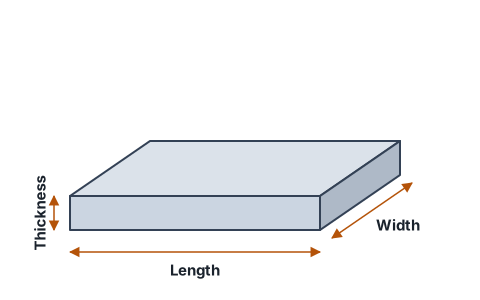
This concrete pad calculator works out the concrete for a small pad under an AC unit, generator, hot tub, shed or trash bins. Pick square or round, enter the length and width or the diameter and the thickness, and it returns cubic yards, cubic feet, weight and the number of 40, 60 and 80 lb bags, with an optional waste allowance. A round pad also gets the length of edge form you need, and an optional panel estimates the cost.
How to use the calculator
- Pick square or round. A round pad suits a fire pit, a tank or a tree surround.
- Enter the size: the equipment footprint plus the margin or clearances its maker asks for (see the table below).
- Set the thickness. Four inches covers most static pads.
- Keep the 10 percent waste, then read the bag count or the cubic yards for ordering.
Square pad: yd³ = length × width × thickness (ft) ÷ 27
Round pad: yd³ = π × radius² × thickness (ft) ÷ 27
Example: a 4 × 3 ft AC pad, 4 inches thick
4 × 3 × 0.333 = 4 ft³, or 0.15 yd³. At 0.60 ft³ per 80 lb bag that's 7 bags, or 8 with 10 percent waste.
Example: a 6 ft round pad, 4 inches thick
π × 3² = 28.3 sq ft, × 0.333 = 9.4 ft³, or 0.35 yd³: 16 bags of 80 lb mix, or 18 with waste. A 6 ft square pad takes 12 ft³, so going round saves about 21 percent. That's the ratio of π to 4, and it holds at any size.
How big should the pad be?
Size it from the equipment, not a stock number. What the makers actually ask for:
| Pad for | Size | What's asked for |
|---|---|---|
| AC condenser or heat pump | Unit base plus the clearances in its manual | Solid, level, not tied to the house foundation; at least 3 in above grade under the IRC |
| Home standby generator | 3 in longer and wider than the unit on all sides | Gravel, an approved composite pad or a concrete pad; level within 1/2 in |
| Hot tub | The spa footprint | Reinforced concrete at least 4 in thick, carrying 120 lb per sq ft or more |
| Shed | The shed footprint | See the shed slab guide |
AC condensers
Goodman's condensing unit installation instructions (IO-258U) want "a solid, level foundation that will not shift or settle," and say the slab "should not be in contact with or be an integral part of the building foundation," to cut sound transmission. The 2021 IRC, section M1305.1.3.1 as adopted in Seattle's residential code, says equipment supported from the ground "shall be level and firmly supported on a concrete slab or other approved material extending not less than 3 inches (76 mm) above the adjoining ground." Clearances vary by model, so measure the unit and read its manual.
Generators
Generac doesn't require concrete. Its support guidance accepts compacted pea gravel or crushed stone about 5 inches deep, an approved composite pad or a concrete pad, sized about 3 inches longer and wider than the generator on all sides and level within 1/2 inch. Local code decides whether a base is required.
Hot tubs
Caldera Spas' installation prep guide asks for "a reinforced concrete slab that is at least 4 inches thick, which can support at least 120 pounds per square foot," and notes a filled spa can weigh 2,000 to nearly 8,000 lb. More in the hot tub pad guide.
How thick should a concrete pad be?
Four inches for anything that just sits there. ACI's parking lot guide, ACI 330R-08, says "as a practical matter, there is no benefit in building slabs less than 4 in. (100 mm) thick." Generac's gravel base for a generator is about 5 inches deep.
Once a vehicle crosses it, it's a driveway, not a pad: size it with the driveway calculator, and see how thick a slab should be. On soft or filled ground, fix the base first, because extra concrete won't make up for a pad that settles.
Does a small pad need rebar?
Usually not. ACI 330R-08 says distributed steel "has no useful effect on the load-carrying capacity or thickness" of a slab on ground, and says it may be needed where joints are spaced more than 30 times the slab thickness. For a 4 inch pad that's 10 feet, so a pad smaller than that in both directions is inside the range where steel isn't needed for that reason.
The exception is a hot tub, where spa makers like Caldera ask for reinforced concrete. If you do add steel, keep it off the ground: the IRC rule for floor slabs holds it between the center and the upper third of the thickness, and the rebar calculator counts the bars.
Other small pads
- Trash and recycling bins: measure the bins and leave room to open the lids.
- Grills and fire pits: the round option in the calculator fits well.
- Basketball hoops and mailboxes: these need a post hole, not a pad. Use the fence post concrete calculator.
- Piers under a tank or deck: use the sonotube calculator or the footing calculator.
Bigger than a pad? Use the slab calculator. To weigh bags against a truck, see the bag calculator and ready-mix delivery and short loads.
Frequently asked questions
How thick should a concrete pad be?
Four inches is the usual thickness for a pad under equipment, a shed or a hot tub. ACI 330R-08 says there is no practical benefit in building slabs less than 4 inches thick, and hot tub makers such as Caldera ask for at least 4 inches of reinforced concrete. If a vehicle will drive on it, size it as a driveway instead.
How much concrete do I need for a 10 by 10 pad?
A 10 × 10 ft pad at 4 inches thick is 33.3 cubic feet, or 1.23 cubic yards. That's 56 bags of 80 lb mix before waste, or 62 with 10 percent added. At 6 inches it takes 1.85 cubic yards.
How much concrete for an AC or generator pad?
A 4 × 3 ft AC pad at 4 inches needs 4 cubic feet, about 0.15 cubic yards, which is 7 bags of 80 lb mix or 8 with 10 percent waste. Generac asks for a base about 3 inches longer and wider than the generator on all sides, so a generator measuring 48 × 25 inches needs a 54 × 31 inch pad: about 0.14 cubic yards at 4 inches.
Does a small concrete pad need rebar?
Usually not. ACI 330R-08 says distributed steel has "no useful effect on the load-carrying capacity or thickness" of a slab on ground, and that it may be needed where joints are more than 30 times the thickness apart, which is 10 feet for a 4 inch pad. Hot tubs are the exception, because spa makers ask for reinforced concrete.
Should an AC pad touch the house foundation?
No. Goodman's installation instructions say the condenser slab "should not be in contact with or be an integral part of the building foundation," to reduce sound transmission into the house. Leave a gap between the pad and the wall.
How much concrete is in a round pad?
Multiply pi by the radius squared, then by the thickness. A 6 ft round pad at 4 inches is 28.3 square feet and 9.4 cubic feet, or 0.35 cubic yards: 16 bags of 80 lb mix before waste. That's about 21 percent less than a 6 ft square pad.