Sonotube Concrete Calculator and Size Chart
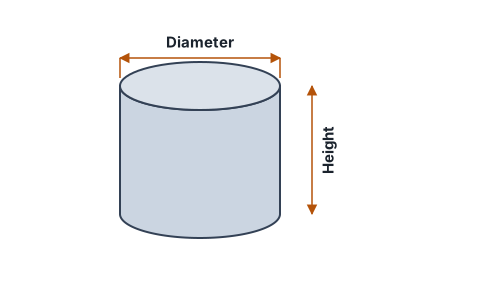
This Sonotube concrete calculator gives you the volume of a cylindrical form tube in cubic yards, cubic feet and bags, and it will add the pad or the bell at the base, which is where a third of the concrete usually goes. It also shows what the labeled diameter really means, because the size printed on a form tube is a minimum and not an exact figure.
Concrete per foot of tube, by diameter
A tube is a cylinder, so the volume per linear foot only depends on the diameter. Work out the per-foot figure once and you can do the rest in your head on site.
| Diameter (in) | Cu ft per ft | Cu yd per ft | 80 lb bags per ft | Cu ft for 4 ft | 80 lb bags for 4 ft |
|---|---|---|---|---|---|
| 6 | 0.196 | 0.0073 | 0.33 | 0.79 | 2 |
| 8 | 0.349 | 0.0129 | 0.58 | 1.40 | 3 |
| 10 | 0.545 | 0.0202 | 0.91 | 2.18 | 4 |
| 12 | 0.785 | 0.0291 | 1.31 | 3.14 | 6 |
| 14 | 1.069 | 0.0396 | 1.78 | 4.28 | 8 |
| 16 | 1.396 | 0.0517 | 2.33 | 5.59 | 10 |
| 18 | 1.767 | 0.0654 | 2.95 | 7.07 | 12 |
| 20 | 2.182 | 0.0808 | 3.64 | 8.73 | 15 |
| 24 | 3.142 | 0.1164 | 5.24 | 12.57 | 21 |
| 30 | 4.909 | 0.1818 | 8.18 | 19.63 | 33 |
| 36 | 7.069 | 0.2618 | 11.78 | 28.27 | 48 |
The bag counts assume 0.6 cubic feet per 80 lb bag, which is the figure both major bagged-concrete makers publish: Quikrete Concrete Mix No. 1101 states 0.30, 0.375, 0.45 and 0.60 cubic feet for the 40, 50, 60 and 80 lb bags, and Sakrete High-Strength agrees.
Here is a small thing that tells you the table is right. Quikrete and Sakrete both print their own bag tables for their tubes, and every cell in both of them is exactly the cylinder volume divided by the bag yield, rounded up to a whole bag. Quikrete's QUIK-TUBE sheet says a 12 inch tube 4 feet deep takes 6 bags of 80 lb. So does the row above. Two consequences worth knowing: both manufacturers treat the labeled diameter as the inside diameter, and if a calculator rounds up to whole bags it will match their printed literature cell for cell. Sonoco, incidentally, publishes no volume table at all for Sonotube, so do not trust one that claims to be theirs.
A form tube shows up on a lot of jobs, and the same arithmetic covers all of them: deck and porch piers, fence and mailbox posts, sign bases, the footings under a propane tank, lally column bases, and the pads under a pergola. Pouring a run of piers is usually one line on a bigger estimate, and the concrete estimate guide covers totalling yards, bags and cost across a whole project.
What size tube do you actually need?
Most people pick a tube by what looks about right, or by what the store had. The code picks it by how much weight the post carries and how much the soil can take. Those two answers are often not the same, and it is worth knowing which one you are on.
IRC Table R507.3.1 sizes deck footings by tributary area and soil bearing capacity. Take an ordinary case: a post carrying 40 square feet of deck on 2,000 psf soil. The table asks for a 14 inch round footing. A 12 inch tube gives 0.79 square feet of bearing, which at 2,000 psf carries 1,571 pounds, and that bay puts 2,000 pounds on the post. The tube alone does not make it. On weaker 1,500 psf clay the same bay wants 16 inches.
That is the honest answer to why bell forms and footing pads exist, and it is a lot more useful than the usual advice to make it a bit bigger than you think. Our deck footing size calculator reads the whole table, works the tributary area out of your spans, and tells you whether the tube you have in mind carries the load on its own.
Two caveats on the small end. A 6 inch tube sits below the 7 inch minimum square in every cell of the code table, so it is a post base and a sign base, not a deck footing. And the tube diameter is not the only constraint: three inches of cover is required for concrete cast against the ground, which matters if there is any steel in the pier, and we come back to that below.
The printed size is a floor, not a measurement
This is the single most important thing on the page for anybody ordering concrete, and it comes straight from Sonoco's own FAQ:
“Will the tube be an exact 24" in diameter? Sonotube diameters are 'nominal,' meaning the inside diameter will be at least the stated diameter, but could be as much as 1" larger than the stated diameter.” Sonotube Frequently Asked Questions
The tolerance is one-sided. The tube will not be smaller than the label, and it may be up to an inch bigger. Since volume goes with the square of the diameter, that is not a rounding error. A 12 inch tube at 13 inches actual takes 17 percent more concrete. A 6 inch tube at 7 inches takes 36 percent more. The calculator above shows both figures, so you can see the range rather than a single number that might be the bottom of it.
This is also a better reason to buy a margin than the usual flat ten percent for waste. On a run of small piers the diameter tolerance can be a bigger effect than spillage and over-excavation put together.
Sakrete states its tolerance differently and symmetrically, at plus or minus half an inch, so a Sakrete tube can run under the label as well as over. Sonoco's retail Builder's Tube brochure puts it bluntly: “Diameter sizes are nominal. If critical, you need to measure.”
Two related mistakes. Measuring the outside of the tube overstates the volume by two wall thicknesses. And Sonoco does not publish wall thickness at all, anywhere: the FAQ says only that “the wall thickness varies by product type and diameter, and is designed according to their intended purpose.” Every per-diameter wall thickness table you will find online is somebody's guess. Measure the tube in front of you if it matters.
Sonotube sizes: what is made, and what you can buy
The gap between the two is wide, and it catches people planning a job around a size that is a special order.
What Sonoco makes. The Sonotube Round line runs 6 to 36 inches inside diameter in two inch steps, sixteen sizes in all, standard length 12 feet with custom lengths to order. So 22, 26, 28, 32 and 34 inch tubes exist too, even though nobody lists them. Sonotube Commercial goes from 6 to 60 inches in 12 and 20 foot lengths. Finish Free runs 12 to 48 inches. Builder's Tube, the retail line, is 6, 8, 10 and 12 inches in 4, 8 and 12 foot lengths.
What is on the shelf. Home Depot carries Quikrete and Sakrete tubes in 8, 10 and 12 inch by 48 inch, and its pick-up-today filter often comes back with only the 8 and the 12. Lowe's carries Sakrete in 8, 10, 12, 14 and 16 inch, all 48 inches long. Menards is the one big box that stocks genuine Sonotube, and carries it up to 30 inch by 12 foot.
The practical summary: below 16 inches and under 4 feet long, it is a shelf item. Anything wider or longer is a lumberyard or concrete-supply order, and worth phoning ahead about before you dig.
Sonotube is a brand, and here are the others
Sonotube has gone the way of Dumpster and Sharpie: people use it as a generic, and say they are going to sonotube the deck. It is not generic. Sonoco's own brochure carries the notice: “Sonotube, Sonovoid, RainGuard, Builder's Tube, Duraglas, StripCord, BlastMaster and FinishFree are registered trademarks of Sonoco.” The company lists it among its principal trademarks in its SEC filings too.
The generic term is concrete form tube. The products you will actually meet:
| Brand | Manufacturer | Where you find it |
|---|---|---|
| Sonotube | Sonoco Products Company | Menards, lumberyards, concrete supply |
| QUIK-TUBE | The Quikrete Companies | Home Depot |
| Sakrete Form Tubes | Sakrete of North America | Home Depot, Lowe's |
There is a mild irony in this. The brand most people name is the one Home Depot does not stock: its tubes are Quikrete and Sakrete. If you bought a form tube at a big box in the last few years, it probably was not a Sonotube. This calculator works for any of them, because a cylinder is a cylinder.
If you are filling the tube with bagged mix, our Quikrete calculator and Sakrete calculator handle the bag counts by product, and the Sakrete versus Quikrete comparison covers the differences that matter.
How deep does the pier go?
Two numbers, and only one of them is national. IRC R403.1.4 sets the floor: “Exterior footings shall be placed not less than 12 inches (305 mm) below the undisturbed ground surface.” R507.3.2 repeats it for decks specifically. Then R403.1.4.1 requires frost protection, by extending below the frost line in Table R301.2(1), building a frost-protected shallow foundation, following ASCE 32, or bearing on solid rock. And: “Footings shall not bear on frozen soil unless the frozen condition is permanent.”
Your frost line is not in the model code. Table R301.2(1) is printed blank for each jurisdiction to fill in when it adopts, which is why national advice on pier depth is worthless and a phone call to your building department is not. Seattle enters 12 inches. Massachusetts enters 48.
There is a real exception for decks, and it is in the code text: “Decks not supported by a dwelling need not be provided with footings that extend below the frost line.” Not supported by a dwelling means genuinely freestanding, with no ledger and no hold-downs to the house. The 2021 deck section reaches the same result through the opening clause of R507.3.3, which conditions frost protection on the deck being “attached to a frost-protected structure”.
What there is no rule about: a depth to diameter ratio. People repeat one, usually three times the diameter, and it is not in the IRC. We checked Chapter 4 and Section R507 and found no pier embedment depth and no ratio beyond the twelve inches and the frost line. The only embedment figure in the deck section is R507.4.1's twelve inches of post embedment for lateral restraint, which is a different thing entirely. Ratios do exist in IBC Chapter 18, which governs piles and caissons and has nothing to do with a residential deck pier, and conflating the two is a common mistake.
The pad or bell at the base
No code requires a spread footing under a pier. What the code requires is enough bearing area, which is not the same thing: IRC R403.1.1 says “the size of footings supporting piers and columns shall be based on the tributary load and allowable soil pressure in accordance with Table R401.4.1.” A bare cylinder is perfectly legal if its own base area satisfies the check. It usually does not, per the numbers above, which is why the pad exists.
The calculator handles three shapes at the base, and the difference between them is worth understanding before you order:
- A round pad is a prism: area times thickness. A 24 inch round pad 8 inches thick is 2.09 cubic feet.
- A square pad of the same nominal width holds more, by the ratio of a square to its inscribed circle, about 27 percent. A 24 inch square pad 8 inches thick is 2.67 cubic feet.
- A bell is a flared form that tapers from the base up to the tube, so it is a frustum rather than a prism. A 24 inch bell to a 12 inch tube over 8 inches holds about 1.22 cubic feet, well under half the square pad. If you order concrete for a bell as though it were a pad, you will have a lot left over.
The rule that catches people is the projection limit in the same sentence of R403.1.1: “Footing projections, P, shall be not less than 2 inches and shall not exceed the thickness of the footing.” Both halves matter. The pad must stand out at least two inches past the tube, and no further than it is thick. A 36 inch pad under a 12 inch tube projects 12 inches, so it has to be 12 inches thick. The calculator checks this and tells you the thickness you need if you have it wrong.
Manufactured bell forms. Bigfoot Systems is the one with a current code report, ICC-ES ESR-2148, reissued December 2025 and covering the 2015 through 2024 IBC and IRC. The BF20 takes 6 and 8 inch tubes on a 20 inch base, the BF24 takes 8 and 10 on 24 inches, the BF28 takes 10 and 12 on 28 inches, and the BF36 takes 12 through 18 on 36 inches. The report calls for at least 3,000 psi concrete, three quarter inch maximum aggregate, a 3 to 4 inch slump, bearing on level undisturbed soil or 4 to 6 inches of compacted crushed stone, and backfill in 8 to 12 inch compacted lifts.
One line in that report is widely misread, so here it is straight: “The design of concrete footings, piers, columns, and pedestals is beyond the scope of this report.” The evaluation report says the form is an acceptable form. It does not verify that a BF24 carries your deck. Sizing is still on you, or on your designer, which brings you back to the table.
Square Foot, by Sound Footings, is the square-pad equivalent, in 22, 28 and 32 inch models. Its specification dates to 2004 and cites a legacy ICBO report, ER-6073, from a body that was folded into the ICC in 2003, so treat its code-compliance claim as stale and prefer the live report if an inspector asks.
If you would rather pour a slab than a run of piers, the pad calculator covers that, and the footing calculator handles a continuous footing. If the base of the pier flares out instead of sitting on a flat pad, that is the tapered shape, and averaging the top and bottom areas to estimate it orders too much concrete every time.
Bracing, pour rate and vibration
Sonoco rates its forms in feet of full liquid head, never in psi. Sonotube Round is “designed for 12' of full liquid head”; Commercial and Finish Free are designed for 20 feet. Those numbers are the form's whole standard length, which is the point: within its own length the form takes a full column of wet concrete.
Bracing, in Sonoco's words: “The tube must be securely braced at the top and bottom to hold it in position as well as making sure it will not bend or break in the middle. Generally, lengths up to 12' are usually only braced at the top and bottom. Lengths over 12' usually require additional bracing in the middle of the form.” The retail products are more conservative and assume you have no scaffolding: Builder's Tube says that if the tube extends more than 2 feet above the ground line, add a collar or wooden frame and side braces. Quikrete's instruction is to dig the hole twice the tube diameter and backfill around the outside to hold it.
Two places the sources genuinely disagree, and we are not going to paper over either. On pour rate, the Round and Finish Free brochures say do not exceed ACI-recommended pour rates, while the FAQ says a standard 12 foot Round is “designed to be filled in a single lift with no pour rate restriction”. The reconciliation is probably that within its rated length the pour rate never becomes the governing limit; over 20 feet the Commercial brochure asks for 20 feet per hour. If you are pouring tall columns, ask Sonoco rather than a web page.
On vibration, the split is between the professional and the retail product, and it is worth a moment because getting it wrong ruins the pour. The Round and Commercial forms say “concrete must be vibrated during pour”, and the CSI specification adds: do not touch the interior surface of the forms with the vibrator, and do not vibrate from the outside. But Builder's Tube says it “should not be used with mechanical vibrators”, and Quikrete's sheet says to rod the concrete and, in capitals, not to use a mechanical vibrator. So: the pro form requires vibration and the homeowner form prohibits it. With a retail tube, work a length of rebar up and down to chase the air pockets out instead.
One more from the FAQ, for anybody working in the wet: the forms “should not be used in standing water”, though RainGuard-treated tubes will take wet weather for up to 24 hours, and Commercial for up to 72. That tells you something about the material. Cardboard forms are not a long-term water management product; they are a form.
Do you have to strip the tube off?
Below grade, generally no, and Sonoco says so outright:
“Removal of the form is general practice for exposed column surfaces. In applications below grade, there is no specific need to strip the form unless it is required by local building code.” Sonotube FAQ
Where you do want it off, because the pier will be seen, the timing is a minimum of 24 hours and a maximum of five days after placing, per Sonoco's CSI specification; the brochures put the easiest window at 24 to 48 hours. Cut it down vertically with a knife or a saw. Sakrete says its tubes can be removed after a minimum of 48 hours, permissively. Quikrete's sheet gives no removal instruction at all, which tells you what it expects.
There is a real contradiction inside a single Sonoco document and we will report it rather than resolve it. The 2016 Builder's Tube brochure says the forms “are designed to be left in place” and, further down, “remove the forms as soon as possible after a 24-hour curing period.” The charitable reading is that the retail product is engineered to be abandoned in the ground and the removal instruction is about whatever sticks up where you will see it.
The one code-document requirement we could find to remove anything is specific to Bigfoot installations: ESR-2148 permits the tube and the footing form to remain in place, with the upper 12 inches of tube removed below finished grade.
On rot, moisture and whether an abandoned tube hurts the pier: nobody authoritative has said. Sonoco makes no claim about long-term below-grade behavior, and we found no code body or standard that addresses it either. The claims circulating, that the cardboard wicks water, that it rots away in a season and so does not matter, that it traps moisture against the concrete, or that it gives frost a grip on the pier, are forum material. What can be said with sources is narrower and more useful: the concrete is the structure, the tube is a form, and the manufacturer explicitly does not require you to strip it below grade.
Does a pier need rebar?
For a deck, the IRC does not ask for any. Section R507 contains no reinforcement requirement for footings or piers at all. The only footing steel the code mandates is R403.1.3, which applies in Seismic Design Categories D0, D1 and D2, and some states delete it outright in adoption.
There is a useful dividing line in the ACI definitions, though. A pedestal is an upright compression member whose unsupported height is no more than three times its average least lateral dimension, and a plain unreinforced pedestal is an accepted element. Past that ratio you have a column, and column rules apply. A 12 inch tube standing 4 feet clear is a height to diameter ratio of 4, so it is a column, not a pedestal. Most of a buried pier is laterally supported by the soil around it, so in practice this bites on tall exposed piers rather than short buried ones.
Where it gets physically awkward is cover. ACI's own guidance is unambiguous: Table 20.5.1.3.1 of ACI 318-19 requires three inches of specified cover for concrete cast against and permanently in contact with ground, and ACI names uncased caissons among the elements it covers, which is exactly a form-tube pier. Three inches on each side of a 12 inch pier leaves a 6 inch circle for the cage. In an 8 inch tube there is no cover to be had at all. That is a far better answer than a vague instruction to drop a couple of bars in.
We are deliberately not publishing a minimum steel ratio or bar count for a column. ACI 318 is a purchase-only standard and the free full-text copies floating around are unauthorized, so the honest position is that the longitudinal steel minimum and the tie spacing are an engineering determination or a look at a bought copy of §10.6.1.1 and §10.7.3.1. Anybody quoting you a figure from a blog is guessing. Our rebar calculator handles the spacing, laps and cost side for slabs and footings where the numbers are publishable.
At the top of the pier, what sets the finished height is usually the connector rather than any code number. Simpson's ABU and ABW post bases, covered by ICC-ES ESR-1622, carry a standoff base that lifts the wood post an inch above the concrete, which is what lets untreated wood meet separation requirements and why the pier wants to finish above grade with somewhere for water to go. The report requires a minimum 3,000 psi concrete and, like the Bigfoot one, states that the design of the anchor bolts and the concrete support is outside its scope. Simpson publishes no minimum pier diameter, so the real constraint is anchor embedment and edge distance.
The formula, if you want to check the arithmetic
A tube is a cylinder, so the volume is π times the radius squared times the height. The radius is half the diameter. Multiply by the number of tubes:
Cubic feet = π × (Diameter ft ÷ 2)² × Height ft × Tubes
Worked example. A 12 inch tube, which is 1 foot across and so has a half foot radius, standing 4 feet: 3.1416 × 0.5² × 4 = 3.14 cubic feet, about 0.12 cubic yards, or 6 bags of 80 lb. Four such piers need about 12.6 cubic feet. Add a 24 inch round pad 8 inches thick under each and you add 2.09 cubic feet per pier, which is two thirds again on top of the tube: that is the part people leave out of the order.
A bell is a frustum rather than a cylinder, so its volume is (π × h ÷ 12) × (D² + D×d + d²), where D is the base diameter and d is the tube diameter, all in feet. The calculator does this for you, and the reason it matters is that a bell holds roughly half what a pad of the same width does.
Setting a fence or mailbox post in a plain dug hole rather than a tube? The fence post calculator works the annulus around the post instead, and how deep should a fence post be covers how deep and wide that hole wants to be. For the volume of anything round that is not a pier, including a circular slab, the yardage calculator covers every shape, and yardage by shape has the formula for each one with a worked example.
Frequently asked questions
How much concrete does a Sonotube hold?
It depends only on the diameter, so work out the per-foot figure once. A 6 inch tube holds 0.196 cubic feet per foot of length, an 8 inch holds 0.349, a 10 inch 0.545, a 12 inch 0.785, a 16 inch 1.396 and a 24 inch 3.142. Multiply by the length in feet and by the number of piers.
How many bags of concrete for a 12 inch Sonotube?
Six 80 lb bags for a 4 foot pier, or eight 60 lb bags. That matches the table Quikrete prints on its own QUIK-TUBE data sheet cell for cell, because both are the cylinder volume divided by the 0.6 cubic feet an 80 lb bag yields, rounded up to whole bags.
What sizes do Sonotubes come in?
Sonotube Round is made in sixteen inside diameters, 6 to 36 inches in two inch steps, 12 feet long as standard. Commercial runs 6 to 60 inches in 12 and 20 foot lengths. What you can buy is narrower: big box stores stock 8, 10 and 12 inch tubes and mostly in 4 foot lengths, with Lowe's adding 14 and 16. Anything wider or longer is a supply-yard order.
Is the printed size the inside or the outside diameter?
Inside, and it is a minimum rather than a measurement. Sonoco's FAQ says the diameters are nominal, meaning the inside diameter "will be at least the stated diameter, but could be as much as 1 inch larger". Since volume goes with the square of the diameter, a 12 inch tube can take 17 percent more concrete than the arithmetic says, and a 6 inch tube 36 percent more.
What wall thickness is a Sonotube?
Sonoco does not publish it. The FAQ says only that the wall thickness "varies by product type and diameter, and is designed according to their intended purpose", and no table exists in any of their brochures or in the CSI specification. Every per-diameter wall thickness table online is somebody's guess. Measure the tube you have.
Is a 12 inch Sonotube big enough for a deck footing?
On its own, usually not. A 12 inch tube gives 0.79 square feet of bearing, which carries 1,571 pounds at 2,000 psf soil, and an ordinary 40 square foot deck bay puts 2,000 pounds on the post. IRC Table R507.3.1 asks for a 14 inch round footing there. That is what bell forms and footing pads are for.
How deep should a Sonotube pier go?
At least 12 inches below undisturbed ground under IRC R403.1.4, and below the frost line unless the deck is genuinely freestanding. Your frost depth is a local number: Table R301.2(1) is printed blank for each jurisdiction to fill in. There is no depth to diameter ratio in the IRC, despite how often one gets repeated.
Do you have to remove the tube after the pour?
Not below grade. Sonoco: "Removal of the form is general practice for exposed column surfaces. In applications below grade, there is no specific need to strip the form unless it is required by local building code." Where you do want it off, strip between 24 hours and five days after placing.
Does a Sonotube pier need rebar?
Not by the IRC. Section R507 has no reinforcement requirement for deck footings or piers, and the only footing steel the code mandates is R403.1.3 in Seismic Design Categories D0 through D2. If you do put steel in, remember ACI requires 3 inches of cover against ground, which leaves a 6 inch circle inside a 12 inch pier and nothing at all inside an 8 inch one.
What is a Sonotube?
A waxed cardboard tube used as a one-time form for round concrete columns, piers and footings. Sonotube is a registered trademark of Sonoco, not a generic term: the generic is "concrete form tube". Quikrete's version is QUIK-TUBE and Sakrete's is simply Form Tubes, and Home Depot stocks those two rather than Sonoco's. This calculator works for any of them.