Crushed Concrete Calculator
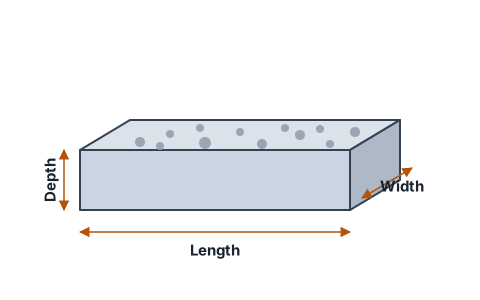
This crushed concrete calculator tells you how many tons of crushed concrete to order for a driveway, path or slab base. Enter the length, width and finished depth, and it gives you the tons plus the volume in cubic yards and cubic feet. It uses 1.6 tons per cubic yard for compacted crushed concrete, and you can change that if your supplier gives you a tested figure.
How to use this calculator
- Enter the length and width of the area.
- Enter the finished, compacted depth, not the loose depth you'll spread.
- Leave the density at 1.6 unless your supplier quotes an in-place figure for its own material.
- Add about 10 percent to the tons for waste. The calculator doesn't add it for you.
Tons = length (ft) × width (ft) × depth (ft) ÷ 27 × 1.6
Example: a 30 × 10 ft path, 4 inches deep
30 × 10 × 0.333 = 100 cubic feet, or 3.70 cubic yards. × 1.6 = 5.9 tons, or about 6.5 tons with 10 percent waste. The same job at 1.4 tons per yard, a common rule of thumb, comes to 5.2 tons, which is why it's worth knowing where that number comes from (below).
How much does a yard of crushed concrete weigh?
Loose on the pile
1.35 tons
per cubic yard
- Pounds
- 2,700 lb
- Per ft³
- 100 lb
- 1 ton
- 0.74 yd³
Compacted in the base
1.6 tons
per cubic yard
- Pounds
- 3,200 lb
- Per ft³
- about 119 lb
- 1 ton
- 0.63 yd³
Both come from Nebraska DOT's estimating guide, which lists "Stockpiled crushed concrete = 1.35 Tn/yd3" and an in-place weight of 0.190 tons per square yard for 4 inches plus 1/4 inch of trimming. That second figure works out to 1.61 tons per cubic yard; the 1.6 is our arithmetic, not a number Nebraska prints. Use the compacted figure when you've measured a finished base, and the loose figure when you're filling a space with uncompacted material.
| Material | Loose (tons/yd³) | Compacted (tons/yd³) |
|---|---|---|
| Crushed concrete (Nebraska DOT) | 1.35 | about 1.6 |
| Crushed surfacing base course (WSDOT) | 1.48 | 1.85 |
The quarried row is from WSDOT Design Manual exhibit 620-1, which notes "Weights shown are dry weights and corrections are required for water contents." A wet pile weighs more per yard, and you pay for the water.
Why not 1.4 tons per yard?
A common rule of thumb is 1.4 tons per yard, the factor used in FHWA's Western Federal Lands estimating handbook. Applied to a finished crushed concrete base, it's wrong in two ways:
- It's a loose figure. The handbook says to "Multiply the compacted volume by 1.33" for swell first, then "Convert to tons by multiplying by 1.4 tons/cuyd." Multiplying a finished base straight by 1.4 skips the swell step.
- It's for quarried stone. The handbook says the factor "applies to aggregate with a specific gravity of around 2.70." FHWA's recycled materials guidelines put processed coarse recycled concrete at 2.0 to 2.5. Scaling 1.4 by 2.0 to 2.5 over 2.70, as the handbook allows, gives a loose factor of about 1.04 to 1.30.
If you measured a finished base, use about 1.6, which the calculator already does. If your supplier quotes a figure, ask whether it's off the pile or in place, and use theirs.
How many tons by area and depth
| Area | 4 in deep | 6 in deep | 8 in deep |
|---|---|---|---|
| 100 sq ft | 2.0 tons | 3.0 tons | 4.0 tons |
| 200 sq ft | 4.0 tons | 5.9 tons | 7.9 tons |
| 300 sq ft | 5.9 tons | 8.9 tons | 11.9 tons |
| 500 sq ft | 9.9 tons | 14.8 tons | 19.8 tons |
| 800 sq ft | 15.8 tons | 23.7 tons | 31.6 tons |
| 1,000 sq ft | 19.8 tons | 29.6 tons | 39.5 tons |
Under a slab: 4 inches
The International Residential Code's slab section (R506) calls for "a 4-inch-thick (102 mm) base course" of sand, gravel, crushed stone, crushed concrete or slag where the slab is below grade, and waives it on well-drained Group I soils. For quarried stone under a slab, use the gravel calculator.
Driveways: check local rules
Driveway base depth is set locally. Union County, Ohio, for example, lists three minimums for a residential drive: 2 inches of asphalt over 6 inches of crushed aggregate base, an "8” crushed aggregate base," or 6 inches of concrete. The driveway calculator sizes base and slab together.
Compact it in layers
The depth you enter is the compacted depth, so spread a little proud and compact in layers. FHWA says "the same methods and equipment used to place and compact conventional aggregate" work for recycled concrete.
Crushed concrete vs gravel
Crushed concrete, or recycled concrete aggregate, is old concrete crushed and screened back to a graded aggregate. FHWA's recycled concrete aggregate guide reports unbound base as the "predominant use." Compared with quarried stone:
- A ton covers more ground. FHWA's granular base guidance says its "lower compacted unit weight" gives a higher yield per ton.
- It soaks up more water. The old mortar on each particle is porous. FHWA's guidelines put fine recycled concrete at 4 to 8 percent absorption, against 2 percent or less for fine natural aggregate.
- Watch it near drains and water. Its runoff is alkaline, and FHWA reports precipitates that have "clogged subdrains and blinded geotextile filters" on some projects. Some jurisdictions require stockpiles to be kept away from watercourses.
FHWA says properly processed material has "generally demonstrated satisfactory performance in granular base applications." For a drainage layer or an interior slab base, the gravel calculator covers stone choices.
What crushed concrete costs
The site's default is $35 a ton picked up; edit the price to match your local yard. Ask the yard about delivery charges and any minimum load. For the whole job, the driveway cost calculator puts the base inside a full estimate.
Frequently asked questions
How do I calculate crushed concrete?
Multiply length by width by compacted depth in feet, divide by 27 for cubic yards, then multiply by 1.6 to get tons of compacted base. Add about 10 percent for waste. A 30 by 10 foot path 4 inches deep is 3.70 cubic yards, or about 5.9 tons.
How much does a yard of crushed concrete weigh?
About 1.35 tons (2,700 lb) loose on the stockpile and about 1.6 tons (3,200 lb) compacted in place. Nebraska DOT publishes the loose figure and an in-place figure that works out to about 1.6. Wet material weighs more, because recycled concrete absorbs more water than quarried stone.
How many yards are in a ton of crushed concrete?
About 0.74 cubic yards loose, or about 0.63 cubic yards of finished, compacted base.
Why is 1.4 tons per cubic yard a common rule of thumb?
It's the factor in FHWA's Western Federal Lands estimating handbook, where 1.4 is applied after a 1.33 swell factor, so it's a loose density, and it assumes a specific gravity around 2.70, which is quarried stone. Using it on a finished base measurement orders about 12 percent less than 1.6 does.
How deep should a crushed concrete base be?
The International Residential Code calls for a 4 inch base course under a slab that's below grade, and crushed concrete is one of the listed materials. Driveway base is set locally; Union County, Ohio lists three minimums for a residential drive: 2 inches of asphalt over 6 inches of crushed aggregate base, 8 inches of crushed aggregate base, or 6 inches of concrete.
Is crushed concrete the same as gravel?
It's used the same way as a compactable base, but it's lighter, so a ton covers more ground, and it absorbs more water. FHWA notes its runoff is alkaline and that precipitates from it have clogged subdrains at several agencies, so check the drainage design before using it near subdrains or geotextile.