Concrete Slab Calculator
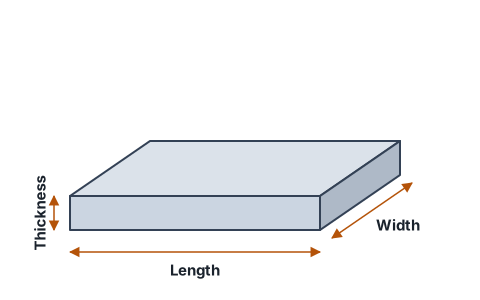
This concrete slab calculator works out how much concrete you need to pour a slab, in cubic yards, cubic feet, and 40, 60, or 80 lb bags. Enter the length, width, and thickness, choose a waste allowance, and you have an instant material estimate for your patio, garage, or shed slab.
How to use this calculator
- Enter the slab length and width and pick their unit.
- Enter the thickness: 4 inches for patios and walkways, 5 to 6 inches for driveways.
- Pouring a sidewalk or path? The concrete sidewalk calculator adds the control joint layout, the accessible width check and the form lumber, none of which a plain slab needs.
- Choose a waste allowance (10% is a safe default).
- Read the cubic yards for ready-mix delivery, or the bag count if you are mixing by hand.
For footings, walls, tube forms, stairs or ramps, the main concrete calculator covers each shape in one place.
The formula
A slab is a simple rectangular box, so the volume is length times width times thickness. Keep every measurement in feet, then divide by 27 to convert cubic feet into cubic yards:
Cubic yards = (Length ft × Width ft × Thickness ft) ÷ 27
Worked example. A 12 ft × 10 ft slab poured 4 inches thick: thickness is 4 ÷ 12 = 0.333 ft, so the volume is 12 × 10 × 0.333 = 40 cubic feet. Divide by 27 and you get 1.48 cubic yards, or about 67 × 80 lb bags. Add 10% waste and you would order about 1.63 cubic yards of ready-mix.
Pouring for something specific? A garage slab needs a particular mix and a floor slope, a shed slab is built to the building footprint exactly, and a hot tub pad has to carry a concentrated load with no shimming afterwards, and a slab for a steel kit building has to resist the outward thrust of a rigid frame, which thickness alone does not answer. For a small standalone pad for an AC unit, a generator or a tank, the pad calculator adds a round option and the equipment dimensions and clearances that decide how big it has to be.
Under the slab, the base course has its own arithmetic and its own arguments: the gravel calculator gives the tons, the code depth and which stone to use, and how to pour a slab covers where the vapor retarder goes.
Reinforcing it? The rebar calculator counts the bars, lap splices, weight and cost for a slab grid, and checks the spacing you picked against the ACI steel benchmark. Which reinforcement to use in the first place is covered in rebar, mesh and vapor barrier.
Concrete by common slab size
Every figure below comes out of the same engine the calculator above runs. "As ordered" adds 10 percent and rounds the way a supplier takes an order.
| Slab size | Area | Cubic yards | As ordered | 80 lb bags |
|---|---|---|---|---|
| 8 x 8 ft | 64 sq ft | 0.79 yd³ | 1 yd³ | 36 |
| 10 x 10 ft | 100 sq ft | 1.23 yd³ | 1.5 yd³ | 56 |
| 12 x 12 ft | 144 sq ft | 1.78 yd³ | 2 yd³ | 80 |
| 20 x 20 ft | 400 sq ft | 4.94 yd³ | 5.5 yd³ | 223 |
| 24 x 24 ft | 576 sq ft | 7.11 yd³ | 8 yd³ | 320 |
| 30 x 30 ft | 900 sq ft | 11.11 yd³ | 12.25 yd³ | 500 |
The bag column is the reason the table stops being useful fast. The QUIKRETE Concrete Mix data sheet puts an 80 lb bag at 0.60 cubic feet, so a cubic yard takes 45 bags, a 60 lb bag at 0.45 and a 40 lb bag at 0.30, giving 60 and 90 per yard. A 10 by 10 shed pad is 56 bags, which is a long but survivable afternoon. A 20 by 20 slab is 223, which is not a job anyone should do by hand.
If you only know the area and not the dimensions, the square footage calculator takes it from there, and the yardage calculator has the fuller chart of net against ordered volume at every thickness.
How thick should the slab be?
Thickness is the input that moves the order most, and it is the one people guess at. It scales the volume exactly: a 6 inch slab is half as much concrete again as a 4 inch slab over the same area, so a 20 by 20 pad goes from 4.94 to 7.41 cubic yards on that change alone.
The Michigan Concrete Association guidelines set the practical floor and the step above it: "The minimum concrete thickness for a driveway is 4 inches", and "When traffic will include delivery vehicles, the minimum concrete thickness shall be 5 inches." The same document specifies 4,000 psi at 28 days for residential flatwork per ACI 332 and a total air content of 6.5 percent plus or minus 1.5, which matter as much as the thickness in a freezing climate and get skipped far more often.
In practice: 4 inches for a patio, walkway, shed base or ordinary garage floor; 5 inches once a loaded truck, a boat trailer or an RV is part of normal use; 6 inches for equipment, workshops and anything carrying a concentrated point load. Slab thickness works through the edge cases, and if the slab is a house foundation rather than a flat pour, concrete slab foundation covers monolithic, stem-wall and floating designs.
What goes under the slab
The calculator sizes the concrete. It does not size what the concrete sits on, and a slab is only as flat as its base. The Michigan guidelines call for unstable material to be removed to a minimum depth of 6 inches and replaced with "crushed stone, gravel, or sand - compacted to 95%", with the sub-base itself "a minimum of 4 inches in thickness compacted", and a minimum fall of 1/8 inch per foot for drainage.
Two things follow for your estimate. First, the base is its own material order, in tons rather than yards, and the gravel calculator handles it, and how to pour a slab has where the vapor retarder goes in the stack. Second, a base that is low or dished holds more concrete than your flat calculation says, and nobody finds out until the truck is half empty, which is what the waste allowance below is really for.
Waste, rounding and the truck minimum
The calculator defaults to a 10 percent waste allowance, at the top of the published range. NRMCA's CIP 31, Ordering Ready Mixed Concrete, says to "Order about 4% to 10% more concrete than is estimated from a volumetric calculation of the plan dimensions." Take the low end on a flat, well-formed slab on a tight base, and the high end on rough subgrade or where the forms are not dead level.
Then round up to the next quarter or half yard, because that is how a supplier takes the order. Running short mid-pour is not a small problem: it means either a cold joint across the finished slab or a second delivery with its own charge, and both cost far more than the extra quarter yard.
There is a ceiling on that logic, though, and it is the truck minimum. CIP 31 notes that "The typical capacity of a truck mixer is 8 to 12 cubic yards", which is where the ten yard minimum on most price lists comes from. Almost every slab on the table above is under it, so a short-load surcharge is the normal case rather than the exception. You are already paying it, and ordering extra yards to feel safe does not remove it. Add the allowance, round up once, and stop. The slab cost calculator shows what that surcharge does to the bill.
Where the joints go
Jointing is not part of the volume, but it decides whether the slab you just estimated stays in one piece, and it is worth settling before the pour rather than after. NRMCA's CIP 6, Joints in Concrete Slabs on Grade, gives the spacing as 24 to 36 times the slab thickness, then caps it: "It is further recommended that joint spacing be limited to a maximum of 15 feet."
At 4 inches that is a joint every 8 to 12 feet, at 6 inches every 12 to 15. The groove wants a depth of at least a quarter of the slab thickness and never less than 1 inch, and the panels it creates have a shape rule too, since "The length should not exceed 1.5 times the width." That last one catches people on narrow slabs: a 10 foot wide pad can have 15 foot panels, but a 9 foot wide one is limited to 13.5 and the 15 foot cap never binds. The slab will crack on its own schedule if you do not give it one.
Adjusting for thickness and edges
Thicker slabs need proportionally more concrete, so a 6-inch slab uses 50 percent more than a 4-inch slab over the same area. Thickened edges and footings add volume too. If your slab has a 6-inch perimeter footing, calculate that strip separately and add it to the field total so you do not come up short.
The fastest way to get an exact number, including bags, yards, and a waste allowance, is to run your dimensions through the calculator at the top of this page. For bag counts by size, the concrete bag calculator breaks it down by 40, 60, and 80-pound bags. Estimating a slab as a job rather than just sizing it, with waste, bags and cost in one place, is covered in how to estimate a concrete slab. For a broader walkthrough, see our guide on how much concrete you need.
Bags or ready-mix
The break-even between bags and a truck sits around one to two cubic yards. Under that, bagged mix from a hardware store is convenient and you avoid delivery and short-load fees. Over it, mixing dozens of bags by hand is slow, and a ready-mix truck is both cheaper per yard and far easier on your back. For a 10 by 10 shed pad, bags are reasonable. For a 20 by 20 slab needing nearly 5 yards, order a truck.
Frequently asked questions
How much concrete do I need for a slab?
Multiply the slab’s length, width, and thickness (all in feet) to get cubic feet, then divide by 27 to get cubic yards. For a 12 ft × 10 ft slab at 4 inches thick that’s about 1.5 cubic yards before waste.
How many bags of concrete are in a cubic yard?
It takes roughly 45 × 80 lb bags, 60 × 60 lb bags, or 90 × 40 lb bags to make one cubic yard. Bags are practical for small slabs; order ready-mix once you pass about half a yard.
How thick should a concrete slab be?
Four inches is standard for patios, walkways, and shed bases. Use 5 to 6 inches for driveways or anywhere vehicles will park, and add rebar or mesh for crack control.
Should I add extra concrete for waste?
Yes. Add about 5 to 10% to allow for spillage, uneven subgrade, and over-excavation. Running short mid-pour creates a cold joint, so it is better to slightly over-order.
Does this calculator work in metric units?
Yes. The results show both cubic yards and cubic meters, so you can use whichever your supplier quotes in.