Concrete Driveway Calculator
This concrete driveway calculator estimates the driveway concrete volume from the length, width, and slab thickness. It returns cubic yards, cubic feet, weight, and bag counts, and it has an optional second thickness so you can model a driveway that slopes or thickens at the apron. It is a fast concrete driveway estimator for any single- or double-car drive. Note that the apron at the street end is usually built to the city specification rather than yours, and commonly thicker than the rest of the drive.
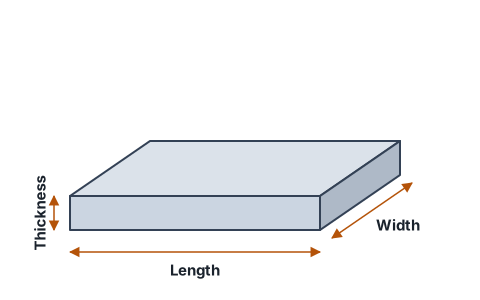
How to use this calculator
- Enter the driveway length and width.
- Set the thickness: 4 inches for cars, 5 to 6 inches for trucks and RVs.
- Add a second thickness only if the slab slopes or thickens at one end.
- Choose a waste allowance and read the cubic-yard total for ready-mix.
How to measure a driveway for concrete
The calculator is only as good as the two numbers you feed it, and a driveway is the one slab on a house that almost never measures the way it looks. Run the tape along the finished edges you intend to pour, not along the string line or the existing asphalt, and take the width in three places rather than one. Drives wander. A 12 ft drive that pinches to 11 ft at the garage and opens to 13 ft at the street averages 12 ft, and if you order for 11 you will be short at the far end with a truck sitting on the clock.
Length runs from the garage slab or threshold to the back edge of the apron, not to the curb. The last few feet at the street are a separate pour with their own thickness and their own inspection, so measure to where your work stops and let the driveway apron carry its own number. Record everything to the nearest half foot and round up rather than down. Concrete you do not use costs one short load. Concrete you run out of costs a cold joint across the middle of the drive.
Before you measure for a new pour at all, look at what is already there. If the existing slab is sound and the problem is the surface, you are measuring for an overlay instead, which needs area but not thickness. Driveway resurfacing cost covers when that is the honest answer and when it is throwing money at a slab that has already failed, and concrete resurfacing explains what a resurfacer can and cannot bridge.
Driveways that are not rectangles
Break the shape into rectangles, measure each one, and add the areas. This handles every driveway anyone actually owns: the straight run plus a turnaround, the straight run plus a parking pad, the drive that widens to two cars at the garage. The only rule is that no square foot gets counted twice, so where two rectangles meet, decide the dividing line first and measure to it.
For sizing the pieces, Landscaping Network puts a single-car driveway at 9 to 12 ft wide and a double at 20 to 24 ft, a single turnaround at 10 by 20 ft and a double at 20 by 20 ft, and a parking stall at 10 ft wide by 20 ft long as a minimum. So a 12 by 40 ft run with a 10 by 20 ft turnaround off one side is 480 plus 200, which is 680 square feet, not the 480 the tape run alone would give you.
Where the shape has no straight edges to work with, strip it. Measure the width every 5 ft along the length, average those widths, and multiply the average by the length. Six readings on a 30 ft curve get you within a few percent, which the waste allowance absorbs.
Curved ends, flares and circular drives
A curve is part of a circle, so find its radius and use the circle. The flare where a drive opens out at the street, or the rounded corner of a turnaround, is usually a quarter circle: its area is the radius squared times pi, divided by four. A 10 ft radius flare is 78.5 square feet, which at 5 inches thick is 1.21 cubic yards on its own.
A circular or horseshoe drive is a ring, not a disc, and this is where people order twice what they need. Measure the radius to the outside edge and the radius to the inside edge, square both, subtract the smaller from the larger, and multiply by pi. A drive running from a 20 ft outer radius to a 10 ft inner radius is pi times 300, so 942.5 square feet, or 14.54 cubic yards at 5 inches and 16 yards once you add 10 percent. Treat the same drive as a solid 20 ft circle and you would order 19.4 yards and eat the difference.
Only the area changes in any of this. Once you have the square footage, the thickness and the division by 27 work exactly as they do for a rectangle, and you can put the area straight into the concrete square footage calculator if you would rather not convert it yourself.
Square feet to cubic yards
Area in square feet, thickness in inches, cubic yards of ready-mix before waste:
| Area | 4 in | 5 in | 6 in |
|---|---|---|---|
| 200 sq ft | 2.47 yd³ | 3.09 yd³ | 3.70 yd³ |
| 300 sq ft | 3.70 yd³ | 4.63 yd³ | 5.56 yd³ |
| 400 sq ft | 4.94 yd³ | 6.17 yd³ | 7.41 yd³ |
| 500 sq ft | 6.17 yd³ | 7.72 yd³ | 9.26 yd³ |
| 600 sq ft | 7.41 yd³ | 9.26 yd³ | 11.11 yd³ |
| 720 sq ft | 8.89 yd³ | 11.11 yd³ | 13.33 yd³ |
| 800 sq ft | 9.88 yd³ | 12.35 yd³ | 14.81 yd³ |
| 1,000 sq ft | 12.35 yd³ | 15.43 yd³ | 18.52 yd³ |
Read it as a sanity check on whatever the calculator tells you. A 12 by 40 ft single drive is 480 square feet, so 5.93 cubic yards at 4 inches and 7.41 at 5, which is 6.5 and 8.2 yards once you add 10 percent. A 20 by 30 ft double is 600 square feet, 7.41 yards at 4 inches and 9.26 at 5. Those are the two orders most driveways turn out to be.
How wide, how thick, and where the joints go
Thickness is the input people guess at, and it is worth two minutes of reading because it moves the order more than the width does. The Michigan Concrete Association driveway and sidewalk guidelines set the floor at 4 inches, and raise it: "When traffic will include delivery vehicles, the minimum concrete thickness shall be 5 inches." If a moving truck, a boat trailer, or the garbage truck backing up the drive is part of normal life, 5 inches is the number, and going from 4 to 5 on a 600 square foot double adds about 1.85 cubic yards.
The same document specifies 4,000 psi at 28 days for residential flatwork per ACI 332, a total air content of 6.5 percent plus or minus 1.5, a compacted sub-base of at least 4 inches, and a minimum fall of 1/8 inch per foot for drainage. Those four get skipped more often than the thickness does, and the air content is the one that quietly decides whether the drive survives ten winters. What psi concrete you need has the full picture, and the slope calculator turns 1/8 inch per foot into a fall you can set with a level.
Jointing is part of measuring, because it decides how the pour gets divided. NRMCA's CIP 6, Joints in Concrete Slabs on Grade, gives the spacing as 24 to 36 times the slab thickness and then caps it: "It is further recommended that joint spacing be limited to a maximum of 15 feet." At 4 inches that is a joint every 8 to 12 ft, at 5 inches every 10 to 15. It also sets the groove depth at a quarter of the slab thickness and never less than 1 inch, and it limits the panel shape, since "The length should not exceed 1.5 times the width."
That last rule catches people out on narrow drives. A 10 ft wide drive can have panels up to 15 ft long, so joints every 12 ft are fine. A 9 ft drive cannot: 13.5 ft is its limit, and the 15 ft cap is not the binding number. Work the joint layout out before you pour rather than after, because the slab will crack on its own schedule if you do not give it one.
None of this changes if you are putting a decorative finish on top. A stamped or exposed-aggregate drive is the same slab at the same thickness with a different last hour of work, so the yardage here still applies and only the price moves. Stamped concrete cost has what that finish adds per square foot, and concrete versus asphalt driveway cost is the one to read if the material itself is still open.
The formula
A driveway is a large slab: length × width × thickness ÷ 27 for cubic yards. If you enter a second thickness, the calculator uses the average of the two:
Where a public sidewalk crosses the driveway, that section is poured at 6 inches or the driveway thickness, whichever is greater, and it belongs in the sidewalk calculator rather than this one.
Cubic yards = (Length ft × Width ft × Thickness ft) ÷ 27
Worked example. A 20 ft × 10 ft driveway at 5 inches thick: 5 inches is 0.417 ft, so 20 × 10 × 0.417 = 83.3 cubic feet, or 3.09 cubic yards. Slope it from 5 to 6 inches and the average 5.5 inches gives about 3.40 cubic yards, because a tapered pour takes the average of the two thicknesses. The slope calculator covers how much fall a drive needs in the first place and what pitching the surface rather than the base costs. Driveways want a stronger mix than an interior slab. See what psi concrete you need for the figure to order.
Before you order, if the drive will see winter road salt, read our note on what to specify for a driveway that lasts, because the Type IL cement in most ready-mix today leaves less room for error.
Frequently asked questions
How much concrete do I need for a driveway?
Multiply length × width × thickness in feet, then divide by 27 for cubic yards. A 20 × 10 ft driveway at 5 inches thick is about 3.1 cubic yards before waste.
How thick should a concrete driveway be?
Four inches is the minimum for cars; use 5 to 6 inches for trucks, RVs, or frequent heavy loads. Thicker slabs with rebar resist cracking far better.
How many yards of concrete for a 2-car driveway?
A typical 20 × 20 ft two-car driveway at 5 inches thick needs about 6.2 cubic yards. Add 10% waste and round up when ordering ready-mix.
How do I measure a driveway for concrete?
Measure the width in three places and use the average, because drives wander by a foot or more end to end. Take the length from the garage slab to the back of the apron, not to the curb, since the apron is a separate pour. Record to the nearest half foot and round up.
How do I calculate concrete for a circular or L-shaped driveway?
Break an L-shape into rectangles, measure each, and add the areas without counting the corner twice. A circular drive is a ring: square the outer radius, square the inner radius, subtract, and multiply by pi. A 20 ft outer and 10 ft inner radius gives 942.5 square feet, or 14.54 cubic yards at 5 inches thick.
Does a driveway need rebar or wire mesh?
Yes. Reinforcement and properly spaced control joints are what keep a driveway from cracking under vehicle weight and seasonal ground movement.