Concrete Mix Calculator
This concrete mix calculator works out how much portland cement, sand and gravel you need to batch your own concrete. Enter the length, width and thickness of the pour (or a finished volume if you already know it) and pick a mix ratio such as 1:2:3 or 1:2:4. It gives you the cement in 94 lb bags and the sand and aggregate in cubic feet and cubic yards.
How to use this calculator
- Measure the pour, or type a finished volume. If you fill in both, the volume field wins.
- Pick a ratio. 1:2:3 is the recipe printed on Quikrete and Sakrete portland cement. 1:2:4 is the older general-purpose mix and uses less cement.
- Buy what it shows, plus a little extra sand and gravel. They're cheap, and a second trip isn't.
Buying premixed bags instead? Use the concrete bag calculator. Only need the volume? The yardage calculator is quicker.
Concrete mix ratio chart
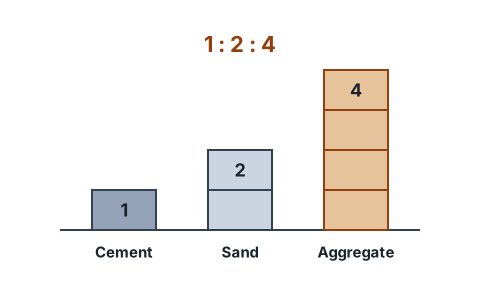
A ratio is written cement : sand : gravel, in parts by loose volume. 1:2:4 means one bucket of cement, two of sand and four of gravel.
| Ratio | Cement (94 lb bags) | Sand | Gravel | Typical use |
|---|---|---|---|---|
| 1:1.5:3 | 8 (7.6 ft³) | 11.3 ft³ | 22.7 ft³ | Richer mix, more paste |
| 1:2:3 | 7 (6.9 ft³) | 13.9 ft³ | 20.8 ft³ | The manufacturers' recipe |
| 1:2:4 | 6 (5.9 ft³) | 11.9 ft³ | 23.8 ft³ | Traditional general purpose |
| 1:2.5:5 | 5 (4.9 ft³) | 12.2 ft³ | 24.5 ft³ | Mass fill |
| 1:3:6 | 5 (4.2 ft³) | 12.5 ft³ | 24.9 ft³ | Lean, non-structural fill |
Bag counts are rounded up, which is why the two leanest rows both show 5. The sand and gravel barely change from row to row; the cement does, and it's the expensive part. 1:2:3 is the concrete recipe on the Quikrete portland cement data sheet and the Sakrete portland cement page.
The formula and a worked example
Loose sand, gravel and cement take up more room than the concrete they make, because the sand and paste fill the gaps between the stones. So the calculator multiplies the finished volume by its dry-volume factor of 1.54, a common estimating allowance, then splits the result by the ratio.
Dry volume = finished volume × 1.54; each material = dry volume × (its parts ÷ total parts)
Example: one cubic yard at 1:2:4
- 1 cubic yard = 27 ft³, so the dry volume is 27 × 1.54 = 41.6 ft³
- 1 + 2 + 4 = 7 parts, so one part is 41.6 ÷ 7 = 5.94 ft³
- Cement: 1 part = 5.9 ft³, or 6 bags (a 94 lb sack is about 1 ft³ of loose cement)
- Sand: 2 parts = 11.9 ft³ (0.44 yd³). Gravel: 4 parts = 23.8 ft³ (0.88 yd³)
In metric, one cubic meter at 1:2:4 needs 1.54 m³ of dry material: 0.22 m³ cement, 0.44 m³ sand and 0.88 m³ gravel. The US bag is 94 lb (42.6 kg), so bag counts don't carry over to 50 kg bags.
How many bags of cement per cubic yard
For ordinary concrete, about 5 to 6 bags of 94 lb portland cement per cubic yard. Quikrete's data sheet says "five to six 94 lb (42.6 kg) bags of QUIKRETE Portland Cement is typically used" per cubic yard, and ACI confirms "a bag or sack of cement is 94 lb (43 kg) in the United States." That's where ready-mix terms like a five-sack or six-sack mix come from. Check the bag you buy: Quikrete's data sheet also lists 31 and 47 lb bags.
Ratios don't set the strength. Water does.
Charts pair 1:2:4 with 3,000 psi, but we found no US standard that assigns a strength to a volume ratio. The Portland Cement Association's manual Design and Control of Concrete Mixtures describes volume ratios as "the arbitrary volumetric method" that modern mix design replaced. Modern concrete mix design proportions by weight and absolute volume to hit a target strength, and the number that sets strength is the water to cementitious materials ratio by weight (the same as water to cement for a plain portland mix), from PCA Table 9-3:
| 28-day strength | Non-air-entrained | Air-entrained |
|---|---|---|
| 2,000 psi | 0.82 | 0.74 |
| 3,000 psi | 0.68 | 0.59 |
| 4,000 psi | 0.57 | 0.48 |
| 5,000 psi | 0.48 | 0.40 |
| 6,000 psi | 0.41 | 0.32 |
With one 94 lb bag of cement, 0.57 is 53.6 lb of water, about 6.4 gallons. At 0.48 it's 45.1 lb, about 5.4 gallons. One gallon per bag is the gap between roughly 4,000 and 5,000 psi, so measure the water, not just the shovelfuls. More in concrete psi.
Which mix for a slab or foundation
Start from the strength the job needs. IRC Table R402.2 sets the residential minimums by weathering potential:
| Where | Negligible | Moderate | Severe |
|---|---|---|---|
| Basement walls, foundations and other concrete not exposed to the weather | 2,500 | 2,500 | 2,500 |
| Basement and interior slabs (not garage) | 2,500 | 2,500 | 2,500 |
| Walls and vertical work exposed to weather | 2,500 | 3,000 | 3,000 |
| Porches, carport slabs, steps, garage floors | 2,500 | 3,000 | 3,500 |
Interior slabs and unexposed foundations
2,500 psi in the model code. Local amendments can raise it: Minnesota requires 5,000 psi for most footings. A careful 1:2:3 mix with measured water is a reasonable choice. Size it with the footing calculator or slab calculator.
Outdoor slabs where it freezes
3,000 to 3,500 psi and 5 to 7 percent entrained air in moderate and severe areas. A troweled garage floor may drop to 3 percent air at 4,000 psi. This is a ready-mix job.
Posts, pads and fill
Non-structural work is where batching your own makes most sense, and lean ratios like 1:3:6 belong only here. For posts, see the fence post calculator.
Why a hand mix can't replace ready-mix outdoors
Freeze-thaw resistance comes from entrained air: tiny bubbles, 10 to 1,000 micrometers across, that give freezing water room to expand. The admixtures chapter of PCA's Design and Control of Concrete Mixtures says it's "produced by using either an air-entraining cement or by adding an air-entraining admixture during batching." The bigger voids that "occur in all concretes as a result of mixing, handling, and placing" don't protect it, and PCA puts ordinary concrete with 1 inch aggregate at about 1.5 percent air, well short of the 5 to 7 percent the IRC asks for outdoors.
Your own mix, bags or a truck
There's no single standard concrete mix. A ready-mix supplier quotes strength in psi and cement in sacks; a site mix is quoted as a ratio. Pick the route by size and exposure:
- Your own mix (this page): cheapest materials, most control, and the water is up to you. How to mix concrete covers the method.
- Premixed bags: the proportions are done for you. Count them with the bag calculator, or the Quikrete and Sakrete calculators.
- Ready-mix: the only way to get air entrainment and a documented strength. See what a yard costs.
For block and brick, use the mortar calculator. Buying sand and stone by the ton? The gravel calculator converts the volumes.
Frequently asked questions
What is a 1:2:4 concrete mix?
It means 1 part portland cement, 2 parts sand and 4 parts gravel, measured by loose volume. It is the traditional general-purpose recipe and uses a little less cement than 1:2:3. We found no US standard that assigns a strength to it; the water you add decides the strength.
How much cement, sand and gravel do I need per cubic yard?
At 1:2:4, about 6 bags of 94 lb portland cement, 11.9 cubic feet (0.44 cubic yards) of sand and 23.8 cubic feet (0.88 cubic yards) of gravel. At 1:2:3, about 7 bags, 13.9 cubic feet (0.51 cubic yards) of sand and 20.8 cubic feet (0.77 cubic yards) of gravel. Both include the 1.54 dry volume allowance.
How many bags of portland cement are in a cubic yard of concrete?
About five to six 94 lb bags for ordinary concrete. Quikrete's portland cement data sheet gives that range, and it is where the terms five-sack and six-sack mix come from.
Why do I need more dry material than the finished volume?
Loose sand, gravel and cement are full of air gaps, and the sand and cement paste fill the spaces between the stones once you add water. The calculator multiplies the finished volume by its dry-volume factor of 1.54, a common estimating allowance.
What psi is a 1:2:3 concrete mix?
The ratio alone does not set it. Strength comes from the water to cementitious materials ratio by weight: PCA's Table 9-3 pairs 0.57 with 4,000 psi and 0.68 with 3,000 psi for non-air-entrained concrete. With one 94 lb bag of cement, 0.57 is about 6.4 gallons of water.
Can I hand mix air-entrained concrete?
Not without an additive. PCA says entrained air comes from an air-entraining cement or an air-entraining admixture. Ordinary concrete with 1 inch aggregate holds about 1.5 percent air, while the IRC asks for 5 to 7 percent on exposed slabs in moderate and severe weathering areas.