Concrete Block Calculator
Work out how many concrete blocks a wall takes, with doors and windows deducted, plus the mortar to lay them and the grout to fill the cores. The block figures follow CMHA's published estimating tables rather than a rule of thumb, including its 5 percent waste allowance, so the number you get is the number to order.
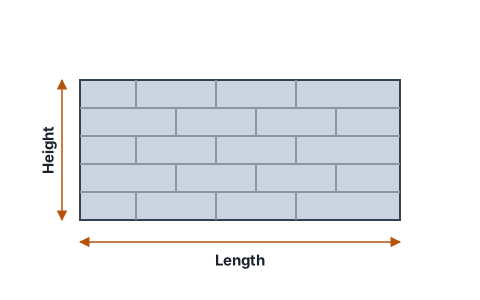
How to use this calculator
- Enter the wall length and height. Use the outside dimensions of the wall face.
- Pick the block width. It does not change the block count, but it does change the mortar and the core fill, and the section below explains which width a wall actually needs.
- Say whether you are filling the cores, and at what spacing. If there is vertical reinforcement in the wall, the cells with steel in them have to be grouted.
- Add any doors and windows. They come off in full.
- Read the block count, courses, mortar and grout, and open the cost panel if you want a price.
For what those blocks weigh, which decides how they get to site, see concrete block weight. For mortar on its own, including how to mix it, use the mortar calculator.
The formula
Divide the wall area by the face area of one block, including its mortar joint.
Blocks = Wall area (ft²) ÷ 0.889 ft² = Wall area × 1.125
A nominal 8 by 16 inch face is 128 square inches, which is 128 divided by 144, or 8/9 of a square foot. One divided by 8/9 is 1.125, so every square foot of wall takes 1.125 blocks.
Worked example. A 20 by 8 foot wall is 160 square feet, so 160 × 1.125 = 180 blocks. Add CMHA's 5 percent waste and you order 189. That is 15 blocks per course across 12 courses.
You will see 119 blocks per 100 square feet quoted as the industry figure. It is the same arithmetic: 112.5 blocks per 100 square feet, plus 5 percent, rounded up. Our calculator shows both the raw count and the count with waste so you can see which you are looking at.
The block count does not change with wall thickness. A 4 inch block and a 12 inch block have the same 8 by 16 inch face, so both work out at 1.125 per square foot. CMHA states this directly. What changes with thickness is the mortar and the grout.
Block sizes, and which width you need
Concrete blocks are named width by height by length, and every dimension is nominal: an 8 x 8 x 16 block is actually 7-5/8 x 7-5/8 x 15-5/8 inches, because the 3/8 inch mortar joint makes up the difference and keeps the wall on an 8 inch module. Every width takes 1.125 blocks per square foot, which is why the calculator only asks for the wall area. The full list of sizes, shapes such as bond beam, lintel and open-end units, and the metric equivalents is on the concrete block sizes and dimensions page.
What the calculator cannot tell you is which width the code requires. IRC R606.4.1 requires masonry bearing walls more than one story high to be at least 8 inches thick, and allows 6 inches for a one-story dwelling or garage no more than 9 feet tall, with another 6 feet permitted up to a gable peak. So a 4 inch block is not a bearing wall width at all, and a 6 inch block is a one-story product.
Above 8 inches you are usually buying resistance to lateral load rather than bearing capacity: CMHA publishes reinforcement tables for 8, 10 and 12 inch foundation walls that tie wall thickness and bar spacing to how much unbalanced backfill the wall can take. When you order, remember that a real wall is not all standard stretchers: count the bond beam or lintel units over openings and along reinforced courses, and half blocks for the ends of alternate courses.
Filling the cores
This is the part most block calculators leave out, and it is usually the largest material cost after the blocks themselves.
The quantities come from CMHA's published table, in cubic feet of grout per 100 square feet of wall. Every row is the fully grouted figure divided by the spacing, because a two core 16 inch block has its cells at roughly 8 inch centers.
| Spacing | 6 in wall | 8 in wall | 10 in wall | 12 in wall |
|---|---|---|---|---|
| Every cell | 25.6 | 36.1 | 47.0 | 58.9 |
| 16 in on center | 12.8 | 18.1 | 23.5 | 29.5 |
| 24 in on center | 8.6 | 12.1 | 15.7 | 19.7 |
| 32 in on center | 6.4 | 9.1 | 11.8 | 14.8 |
| 48 in on center | 4.3 | 6.1 | 7.9 | 9.9 |
A fully grouted 8 inch wall takes about 1.34 cubic yards of grout per 100 square feet, which is more concrete than most people expect and is why a grouted wall roughly doubles in weight.
Note that 4 inch blocks are missing from that table on purpose. CMHA excludes them from its grouting guidance because the cells are too small to consolidate properly. Our calculator declines to give a figure for a 4 inch wall rather than inventing one.
A discrepancy worth knowing about
Bag counts and volume do not agree, and the gap is large.
Producers publish core fill grout at about 0.66 cubic feet per 80 lb bag, and CMHA's own bag yield table says much the same. But work the cell geometry out and those yields run 20 to 39 percent optimistic against the volume in the same document's wall area table. There is a second reason to doubt them: 80 lb in 0.66 cubic feet implies a density of about 121 lb per cubic foot, while the industry figure for grout is 140. At 140, an 80 lb bag yields only 0.571 cubic feet.
So our calculator gives you both: a conservative bag count from volume at 140 lb per cubic foot, and the count you would get from the yield printed on the bag. If you buy to the bag yield, expect to be short. Every other calculator we looked at silently picks one.
When you have to grout, and what with
There is no "grout above X feet" rule. Grouting follows the steel: reinforcement has to sit in grout, so the cells with bars in them get filled and the rest usually do not. In a normal residential wall CMHA is explicit that the wall is "grouted only at reinforced cells".
What does trigger filling regardless: code requires two adjacent cells grouted solid on each side of every opening, with continuous vertical reinforcement in one of them. Our calculator adds that as a separate line when you enter openings and choose to grout. Bond beams and horizontal steel also need grouted courses, and in higher seismic categories bar spacing tightens to 48 inches or less, which pushes a lot of walls toward solid grouting anyway.
Use grout, not concrete. Grout to ASTM C476 is mixed to an 8 to 11 inch slump, far wetter than concrete, precisely so it flows into a 3 inch cell around a bar without bridging. Ordinary concrete has coarser aggregate and a 3 to 5 inch slump and will leave voids. The high water content is not a strength problem, because the block absorbs water out of the grout after it is placed. You can order C476 grout ready-mixed; you just should not order concrete and call it grout.
Mortar, and a correction to the usual rule
The figure repeated everywhere is 3 bags of mortar per 100 blocks. It is real, it comes from CMHA, and it is routinely quoted wrong.
CMHA's basis is 8 bags of 70 lb masonry cement plus 1 ton of sand laying 240 blocks, which works out at 3.3 bags per 100 blocks. Those are bags of masonry cement, and you still have to buy roughly 0.42 tons of sand to go with them. Quoting "3 bags per 100" without the sand is the error to avoid, because it describes a different product entirely.
If you are buying preblended bagged mortar, where you add only water, the number is roughly double:
- CMHA: 16 blocks per 80 lb bag, so 6.25 bags per 100 blocks.
- Quikrete: "up to" 13 blocks per 80 lb bag, so 7.7 bags per 100.
- Sakrete: 12 blocks per 80 lb bag, so 8.3 bags per 100. This is the only one that states its yields exclude waste and spillage.
Our calculator shows that whole range rather than picking one, along with the masonry cement and sand alternative.
Mortar does change with wall thickness, though nobody publishes it. Only the face shells are bedded, not the full width of the block, so a 12 inch wall takes about 20 percent more mortar than an 8 inch one, not the 50 percent the width ratio suggests. A 4 inch and a 6 inch block take the same, because ASTM C90 gives both the same minimum face shell. We calculated those figures from the C90 minimums and a 3/8 inch joint, and the calculator scales the bag count accordingly.
Waste: three materials, three different allowances
Most calculators apply one blanket percentage to everything. CMHA publishes different figures for each material, and using one number is wrong in two cases out of three:
- Block: 5 percent. This is a published allowance, not a rule of thumb, and it is already inside the familiar 119 units per 100 square feet.
- Grout: 3 percent. Already inside the wall area table above.
- Mortar: already counted. The published batch yields carry a nominal waste allowance, so adding more on top double counts. CMHA's only extra instruction is to add half a ton if the sand order exceeds three tons.
The 5 percent block allowance also covers the cutting waste around doors and windows, which is why openings can be deducted in full without adding anything back.
What a block wall costs
Four independent cost guides updated in 2026 converge on $15 to $30 per square foot installed for a straightforward block wall, split roughly into $5 to $13 of materials and $10 to $17 of mason labor.
| Source | Installed | Updated |
|---|---|---|
| HomeGuide | $15 to $30 | January 2026 |
| Homewyse, concrete block wall | $15.70 to $20.42 | September 2026 |
| Homewyse, CMU block wall | $19.53 to $25.08 | September 2026 |
| Angi, fence | $10 to $30 | September 2026 |
| HomeAdvisor, privacy wall | $10 to $30 | June 2026 |
Take that convergence with some salt. HomeGuide, Angi and HomeAdvisor all publish an identical $10 to $17 per square foot for labor, which suggests one underlying data source rather than three independent ones. And the aggregators contradict themselves:
- Homewyse disagrees with itself, giving $15.70 to $20.42 for a "concrete block wall" and $19.53 to $25.08 for a "CMU block wall" on the same date with the same reference quantity. Those are the same assembly, 24 to 28 percent apart.
- Angi gives two different materials figures on one page, $3 to $6 and $10 to $30 per square foot. Only the first is plausible: at 1.125 blocks per square foot and $1.25 to $2.50 a block, the block alone is $1.41 to $2.81 before mortar.
- HomeGuide's own labor figures do not reconcile. It gives $5 to $10 per block, which at 1.125 blocks per square foot is $5.63 to $11.25, against its own $10 to $17 per square foot.
We also looked for public bid data, which normally beats cost aggregators, and there is none for block walls. State DOT item lists are highway items, and there is a genuine trap in them: in DOT usage "concrete masonry" means structural concrete measured in cubic yards, not block. Anyone mining Wisconsin DOT for "Concrete Masonry Retaining Walls" would find $2,995 per cubic yard and publish a wildly wrong number. Building bids, where CMU actually appears, are usually lump sum rather than unit price, which is why the data does not exist.
So the honest position: use the calculator's cost panel as a planning figure with your own block price, and treat $15 to $30 per square foot installed as the range to sanity-check a quote against.
The footing, and how tall the wall can be
The rule of thumb is that a footing is twice the wall width and as deep as the wall is thick. That is trade practice, and it is close enough for an 8 inch wall while being wrong for a 12 inch one.
The actual code rule has two parts. IRC R403.1.1 sets the footing width from the soil's bearing capacity through a table, with a 12 inch minimum width and a 6 inch minimum thickness. Then the projection rule: the footing must project at least 2 inches past the wall on each side, and no more than the footing's own thickness.
That second part is what generates the familiar proportions. An 8 inch wall on a 16 inch footing projects 4.19 inches each side, so a 6 inch thick footing satisfies it. A 12 inch wall on a 24 inch footing projects 6.19 inches each side, so a 6 inch footing does not comply and you need about 7 inches, which in practice means 8. Work the concrete out with the footing calculator.
Footings also have to sit at least 12 inches below undisturbed ground and below the local frost line, which is a jurisdictional number rather than a national one.
Height limits without reinforcement
For a free-standing wall, the governing limit is the ratio of height to thickness, and it is stricter than people expect. A cantilevered hollow masonry wall is limited to a height of four times its thickness, so an 8 inch block wall tops out at about 2 feet 6 inches unreinforced. Solid or fully grouted gets you six times the thickness, or about 3 feet 9 inches.
That is why CMHA's fence tables show only a 4 foot 8 inch wall as a solid grouted unreinforced option and reinforce everything taller. A 6 foot unreinforced block fence is not a code-compliant option, whatever the neighbors built. Above about 8 feet, or with any surcharge on a retaining wall, it needs engineering rather than a table.
On permits, IRC R105.2 exempts fences up to 7 feet and retaining walls up to 4 feet measured from the bottom of the footing, not from grade, and the exemption disappears if the wall supports a surcharge. Check locally, because jurisdictions vary this.
Frequently asked questions
How many concrete blocks do I need for a wall?
Find the wall area (length × height) and divide by the face area of one block. A standard 16 × 8 inch block covers about 0.89 ft² with its mortar joint, so a wall needs roughly 1.125 blocks per square foot, or 113 blocks per 100 square feet before waste.
How many concrete blocks are in a square foot?
About 1.125 standard 8 × 8 × 16 inch blocks per square foot of wall, once the mortar joints are included. The Concrete Masonry Checkoff estimating tables list 119 units per 100 square feet, which is the same 113 blocks plus a 5 percent waste allowance.
How much mortar do I need for a block wall?
Between 6 and 8 bags of premixed mortar per 100 blocks, depending on the bag and the block size. The widely repeated figure of 3 bags per 100 blocks is for masonry cement, which you still have to mix with sand, not for a bag of premixed mortar that goes straight in the mixer.
How much grout does it take to fill block cores?
A fully grouted 8 inch wall takes about 36 cubic feet of grout per 100 square feet, which is roughly 1.3 cubic yards. Filling every other core at 16 inches on center halves that, and at 48 inches on center it drops to about a quarter.
What is the actual size of a cinder block?
A nominal 8 × 8 × 16 inch block actually measures 7⅝ × 7⅝ × 15⅝ inches. The missing ⅜ inch on each face is taken up by the mortar joint, which is why calculators use the nominal size.
What does a concrete block wall cost per square foot?
Most block walls land between $10 and $25 per square foot installed, with the materials making up only about a quarter of that. Core fill, reinforcement, and a deep footing all push the figure toward the top of the range.