Concrete Calculator
CalculatingConcrete.com is a free suite of concrete calculators. Estimate exactly how much concrete you need, in cubic yards, cubic feet, cubic meters, and 40, 60, or 80 lb bags, for slabs, footings, walls, tube forms, stairs, ramps, and more. If you came looking for a cement calculator, this is the same thing: cement is an ingredient in concrete, and the math is identical. Pick a calculator below to get an instant, accurate estimate.
Concrete calculators
Every tool returns the volume and the number of bags you need, with a waste allowance built in. Choose the one that matches your pour:
- Slab CalculatorPatios, shed bases and garage floors
- Floor CalculatorInterior rooms by area
- Yardage CalculatorWhat to actually order
- Bag Calculator40, 60 and 80 lb sizes
- Block CalculatorBlocks, mortar and core fill
- Sidewalk CalculatorWalkways and paths
- Pad CalculatorAC, generator or spa bases
- Footing CalculatorTrenches and post holes
- Deck Footing CalculatorSized off the IRC load table
- Weight CalculatorPounds and tons before you haul
- Mix CalculatorCement, sand and gravel by ratio
- Sonotube CalculatorTube forms, piers and columns
- Stairs CalculatorSteps and a landing
- Driveway CalculatorParking aprons too
- Wall CalculatorPoured and foundation walls
- Square Footage CalculatorFrom a known area
- Crushed Concrete CalculatorLoose and compacted tonnage
- Rebar CalculatorBars, spacing, laps and weight
- Gravel CalculatorSub-base under a pour
- Mortar CalculatorLaying block or brick
- Fence Post CalculatorPer hole and per run
- Fence Post Depth CalculatorDepth from fence height
- Slope CalculatorDrainage fall on a slab
- Concrete Ramp CalculatorDoor and porch access
- Self-Leveling CalculatorFloor leveler by depth
- Cost CalculatorMaterial, delivery and labor
- Slab Cost CalculatorPrice to pour one
- Pad Cost CalculatorSmall pours, measured
- Driveway CostItemized, start to finish
- Steps Cost CalculatorFront entry stoops
- Curb CalculatorMountable, barrier or edging
- Curb & Gutter CalculatorCombined section with a pan
How to calculate concrete
Concrete is sold by the cubic yard, so estimating a job comes down to finding its volume. Measure the length, width, and thickness of the pour, convert everything to feet, multiply them together for cubic feet, then divide by 27 to get cubic yards:
Cubic yards = (Length ft × Width ft × Thickness ft) ÷ 27
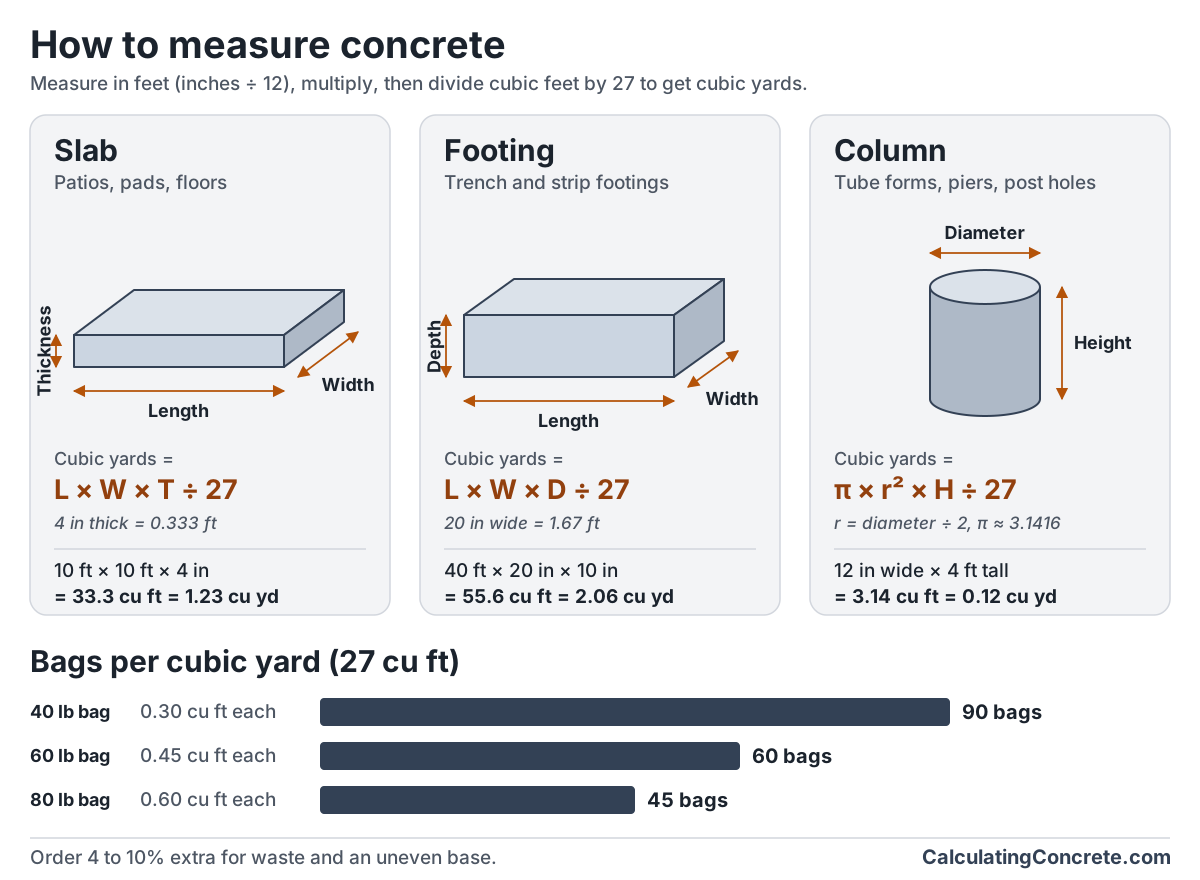
For example, a 10 ft × 10 ft slab at 4 inches thick is 10 × 10 × 0.333 = 33.3 cubic feet, or about 1.23 cubic yards. Add waste before you order: NRMCA's CIP 31 says to order 4 to 10 percent more than the plan dimensions give you. Our guides walk through the full method in detail:
- How much concrete do I need - the step-by-step method, formulas, and worked examples.
- A worked slab estimate - a 20 by 24 ft pad taken from tape measure to ordered yards.
- How many bags of concrete in a yard? - the full 40/60/80 lb bag chart.
- How much does a yard of concrete cost? - average prices per yard, bag, and sq ft.
- Concrete slab guide - cost, thickness, reinforcement, and how to pour one.
- Concrete curb guide - cost, landscape edging, curb and gutter, and how to pour one.
- Concrete floor guide - cost, cleaning, painting, staining, polishing, epoxy, and how thick to pour one.
- Concrete estimate guide - how to estimate concrete, what it costs per yard and per square foot, plus a free estimate template.
If you bid concrete work every week, our guide to concrete estimating software covers what takeoff and estimating tools cost and when a takeoff tool pays for itself.
Use this diagram on your site
If you run a ready-mix plant, a building supply yard or a contracting business, or you teach the trade, you are welcome to put the measuring diagram above on your own site or handouts. It is free to share under the Creative Commons Attribution 4.0 license, as long as the credit line linking back to CalculatingConcrete.com stays with it. Paste this code into any HTML or embed block, or download the PNG (2400 × 1760).
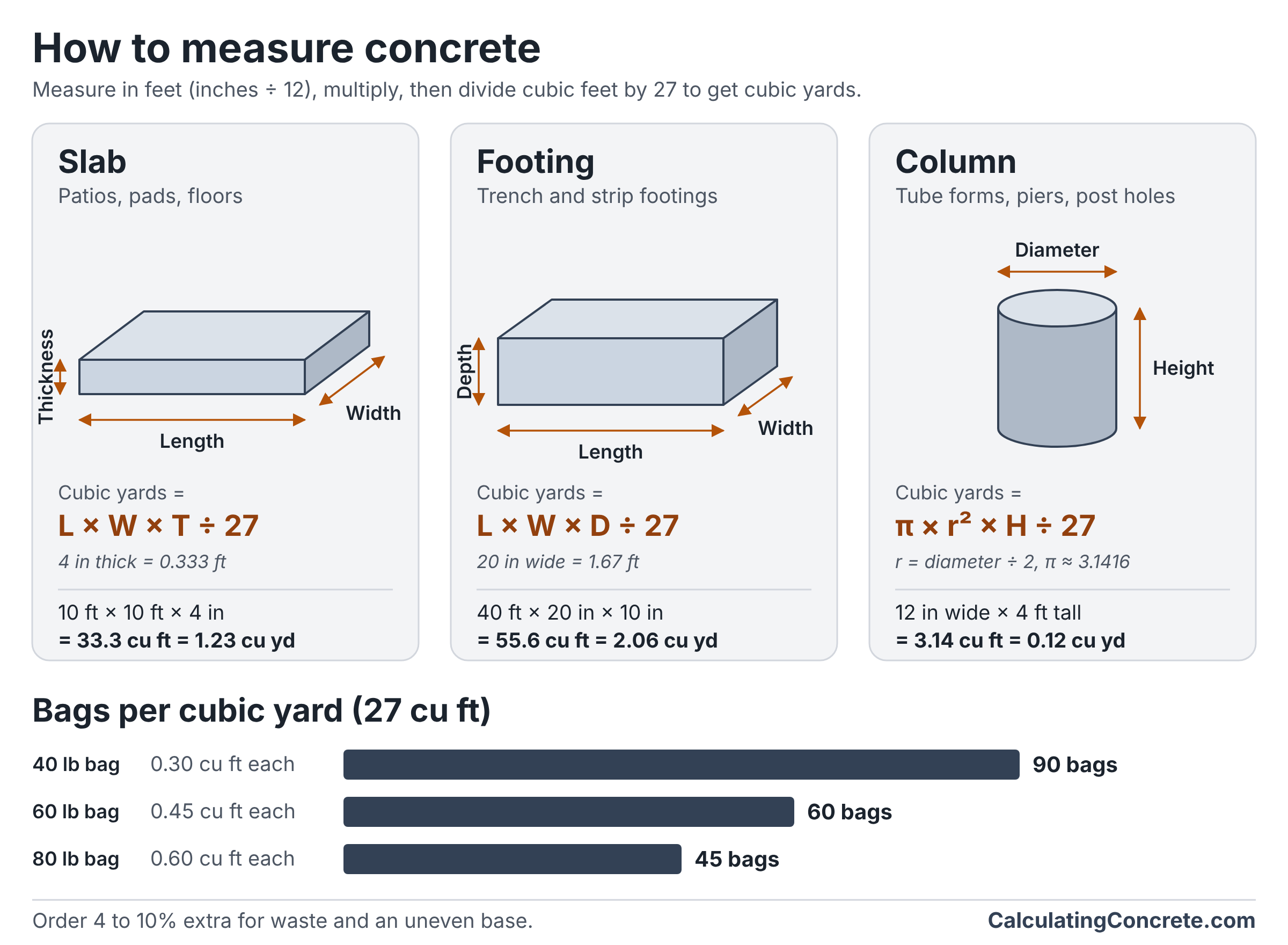
<a href="https://calculatingconcrete.com/"><img src="https://calculatingconcrete.com/assets/img/diagrams/how-to-measure-concrete.png" width="1200" height="880" alt="How to measure concrete for a slab, footing and column, with bags per cubic yard" style="max-width:100%;height:auto"></a>
<p>Diagram by <a href="https://calculatingconcrete.com/">CalculatingConcrete.com</a></p>
Which calculator do I need?
The shape of the pour decides the tool. Find the job on the left and the calculator on the right does the geometry for you.
| What you are pouring | Use this |
|---|---|
| A flat rectangle: patio, shed base, garage floor | Slab calculator or pad calculator |
| A room you only know the square footage of | Square footage calculator |
| A round cylinder, tube form, pier or column | Cylinder and tube calculator |
| A trench footing or grade beam | Footing calculator |
| A vertical wall or stem wall | Wall calculator |
| Steps or a stair flight | Stairs calculator |
| A sloped ramp up to a door or porch | Ramp calculator |
| A driveway | Driveway calculator |
| Curb, or curb and gutter | Curb calculator |
| Filling hollow block | Block calculator |
| Mortar to lay block or brick | Mortar calculator |
| Fence, mailbox or sign posts | Fence post calculator |
| The gravel base that goes underneath | Gravel calculator |
| Bags rather than ready-mix | Bag calculator |
| What the pour will weigh | Weight calculator |
| What it will cost | Cost calculator |
Round forms cause the most confusion, because people search for them by half a dozen names. Cylinder, tube, Sonotube, pier, post and column are all the same calculation: the area of a circle times the depth.
Curbs are the other row worth a second look. A barrier curb, a mountable one and a full curb and gutter are each measured a little differently, so if you are not sure which you are pouring, read up on the types of curbs before you pick the calculator.
Cement calculator or concrete calculator?
These get used interchangeably, and for estimating they are the same search. Strictly, though, they are not the same material.
Cement is a fine gray powder, usually Portland cement. It is the glue. Concrete is what you get when you mix that cement with sand, aggregate and water. Nobody pours cement on its own, so when someone says they need a cement slab or asks for a cement calculator, they mean concrete, and every calculator here gives them the right answer.
There are two cases where the distinction matters for real:
- You are batching by ratio. If you are mixing on site to a ratio such as 1:2:4, you genuinely need the cement quantity as its own number. The concrete mix calculator splits a volume into cement, sand and aggregate.
- You are buying bagged mix. A bag of concrete mix already contains cement, sand and stone. A bag of straight cement does not. Count bags of mix with the bag calculator, or by brand with the Quikrete and Sakrete calculators.
So: buying cement, sand and stone separately, use the mix calculator. Anything else, use the shape calculator and ignore the wording.
The numbers behind the calculators
Every tool here runs on the same handful of constants. They are worth knowing, because they let you sanity-check any estimate, including one a contractor hands you.
| Figure | Value |
|---|---|
| Cubic feet in a cubic yard | 27 |
| Density of normalweight concrete | 150 lb per cubic foot, about 4,050 lb per cubic yard |
| Yield of an 80 lb bag | 0.60 cubic feet, so 45 bags per cubic yard |
| Yield of a 60 lb bag | 0.45 cubic feet, so 60 bags per cubic yard |
| Yield of a 40 lb bag | 0.30 cubic feet, so 90 bags per cubic yard |
| Common site mix ratio | 1:2:4 cement to sand to aggregate |
| Waste allowance to add | 4 to 10 percent (NRMCA CIP 31) |
| Gravel base density | 1.25 to 1.5 tons per cubic yard |
Density is the one people find most useful. At 150 lb per cubic foot, a 10 by 10 slab at 4 inches thick weighs roughly 5,000 lb, which is why you want the weight calculator before you load a trailer. Use the mix calculator for ratios, and see bags of concrete per yard for the full bag chart.
Brand calculators
Working with a specific bagged mix? Use a brand calculator to get the exact bag count by product and bag size.
Concrete guides
New to estimating concrete? These plain-English guide sections cover the formulas and the math behind every calculator.
Frequently asked questions
How do I calculate how much concrete I need?
Multiply length by width by thickness in feet to get cubic feet, then divide by 27 for cubic yards. A 10 by 10 slab at 4 inches thick is 10 × 10 × 0.333 = 33.3 cubic feet, or 1.23 cubic yards. Add 5 to 10 percent for waste before ordering.
Is a cement calculator the same as a concrete calculator?
For estimating, yes. Cement is the powder that binds sand and aggregate into concrete, so a "cement slab" is really a concrete slab. Use the mix calculator only if you are buying cement, sand and stone separately and need them split out.
How many 80 lb bags of concrete are in a cubic yard?
45. An 80 lb bag yields about 0.60 cubic feet, and there are 27 cubic feet in a cubic yard. A 60 lb bag yields 0.45 cubic feet, so 60 bags per yard, and a 40 lb bag yields 0.30, so 90 bags per yard.
How much does a cubic yard of concrete weigh?
About 4,050 lb, or just over 2 US tons, based on normalweight concrete at 150 lb per cubic foot. The weight calculator works it out for your pour.
Which calculator should I use for a round form?
The cylinder and tube calculator. Cylinder, tube form, Sonotube, pier, post and column are all the same calculation: the area of the circle times the depth.
Do these calculators work in metric?
Yes. Every calculator accepts meters and centimeters as input units and returns cubic meters alongside cubic yards and cubic feet. Pricing and bag sizes are US, so costs are in dollars and bags are 40, 60 and 80 lb.
Do I need a concrete calculator app?
No. These run in your phone browser, update as you type, and need no install or account. Bookmark the page or add it to your home screen if you want it one tap away on site.
How much waste should I add to a concrete order?
5 to 10 percent for most jobs. Add nearer 10 percent when the subgrade is uneven, the forms are irregular, or you are pouring a thin slab, since a small depth error over a big area adds up fast.