Types of Curbs: Barrier, Mountable, Flush and More
There are eight common types of curbs, and height and shape tell them apart. Three line streets: the barrier curb (about 6 inches with a near-vertical face), the mountable curb (about 4 inches and sloped so you can drive over it) and curb and gutter, which adds a gutter pan for drainage. Flush or ribbon curbs and mow curbs sit level with the pavement or lawn, landscape curbing rises 4 to 6 inches to border garden beds, and wheel stops and asphalt curbs handle parking lots.
The 8 types of curbs at a glance
Every profile below is drawn to the same scale, so you can compare them side by side. Pick one to jump to it.
- Barrier curb6 in, vertical face. Streets and islands.
- Mountable curbAbout 4 in, sloped. You can drive over it.
- Curb and gutterCurb plus a gutter pan. Street drainage.
- Flush or ribbon curbLevel with the pavement. Edges and drainage.
- Mow curbFlush in the lawn. A clean mower edge.
- Landscape curbing4 to 6 in above grade. Bed borders.
- Wheel stopAbout 5 to 6 in. Ends a parking stall.
- Asphalt curbAbout 4 in bead. Parking lot edges.
Barrier curb (vertical or street curb)
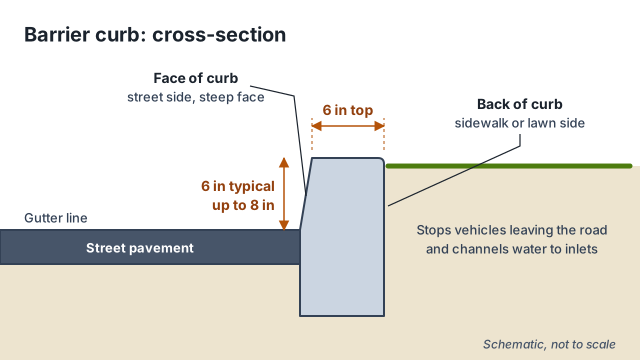
The standard street curb. Its tall, nearly vertical face keeps vehicles on the pavement, protects the sidewalk behind it and channels stormwater to the inlets. The catch is that you can't drive over it, it's hard on snowplows, and road design guides keep tall vertical curbs off high-speed roads.
- Height
- 6 in typical, up to 8 in on arterials
- Drive over?
- No, only at a curb cut
- Used for
- Streets, parking lot islands, sidewalks
Mountable curb (rolled or rollover curb)
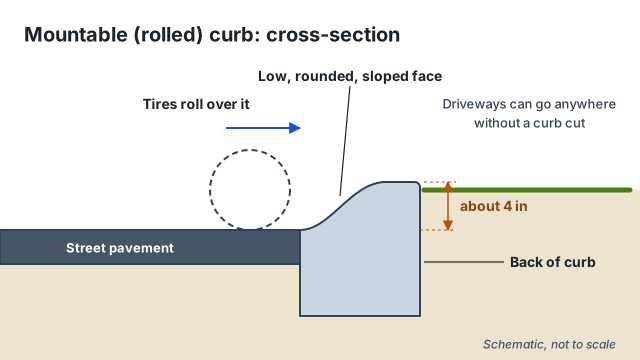
A low, rounded face a tire can climb anywhere along the run. Subdivisions like it because a driveway can go in anywhere without cutting the curb. In exchange it holds back less water than a barrier curb and won't stop a car that leaves the road.
- Height
- About 4 in, sloped face
- Drive over?
- Yes, anywhere
- Used for
- Residential streets, driveway access
Curb and gutter
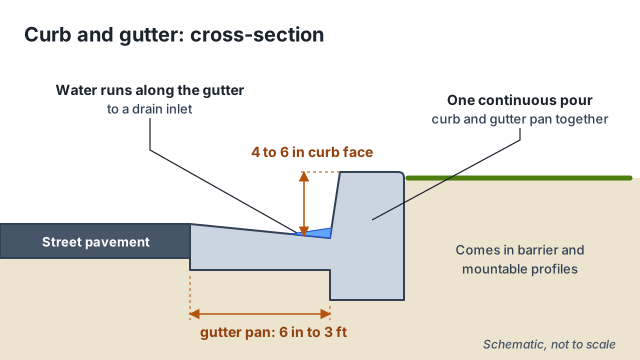
A curb and a flat gutter pan poured as one piece. The pan carries runoff along the street to a drain, and the single pour makes a stronger edge than a curb on its own, which is why most city streets use it. It comes in barrier and mountable profiles and in two drainage directions: a catch curb slopes the pan into the curb face to collect water, and a spill curb slopes it away so water sheds off. Some agencies draw the spill version as its own standard, like the University of Michigan's 18 inch spill-out curb and gutter detail.
- Height
- 4 to 6 in face, plus a 6 in to 3 ft pan
- Drive over?
- Depends on the profile
- Used for
- Street and parking lot drainage
Flush curb and ribbon curb
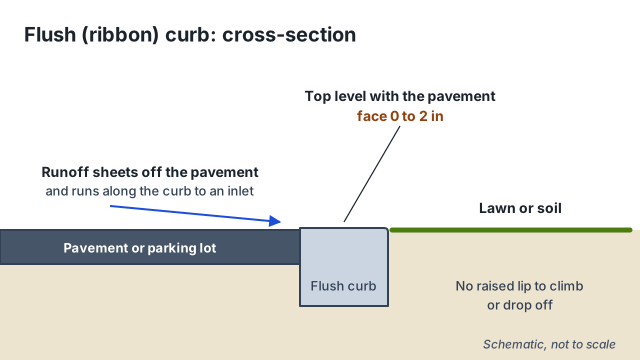
A flush curb sits level with the pavement next to it. It hardens the edge so the asphalt doesn't crumble, and gives runoff a clean line to follow, with no lip to climb.
Ribbon curb is the same idea drawn as a wider, often reinforced band. Waco, TX, for example, specifies a ribbon curb 24 inches wide and 7.5 inches thick with three #4 bars running its length.
- Height
- Flush, 0 to 2 in face
- Drive over?
- Yes
- Used for
- Rural road edges, parking lots, islands
Mow curb (mowing strip)
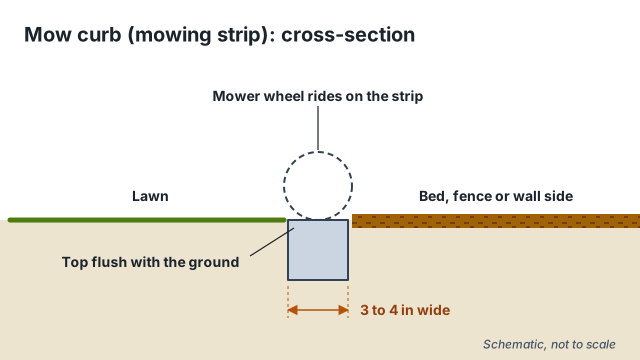
A narrow concrete band poured flush with the soil between a lawn and a bed, fence or wall. The mower wheel rides on top of it, so the edge gets cut clean and you can put the string trimmer away. It takes very little concrete (you can work out the bag count in a minute) and is one of the easiest pours a homeowner can do.
- Height
- Flush with the grass
- Drive over?
- Not a traffic curb
- Used for
- Lawn to bed or fence line
Landscape curbing
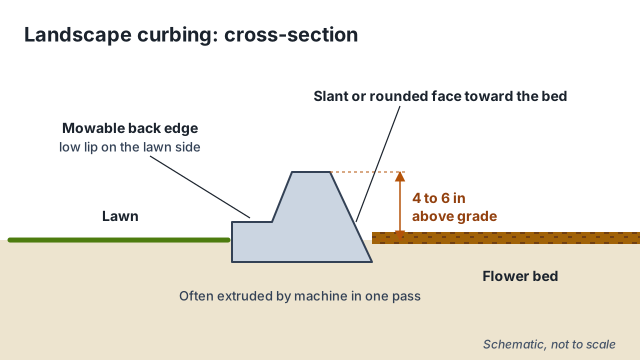
The decorative border you see around flower beds, trees and walkways. It's usually extruded on site by a curbing machine in one continuous pass, can be colored or stamped, and keeps a low lip on the lawn side so the mower can run along it.
- Height
- 4 to 6 in above grade
- Drive over?
- No
- Used for
- Bed, tree and path borders
Wheel stops (parking curbs)
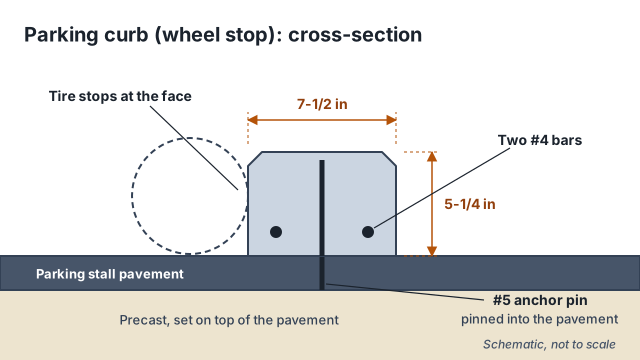
Short precast blocks pinned at the head of a parking space so a tire stops before the bumper hits a wall or walkway. Also called parking blocks or curb stops. Unlike every other type here, they're single units, not a continuous run. A typical 6 foot concrete unit weighs about 165 lb and is held down with two #5 anchor pins. Plan on two people to set one, or check the weight of a different size.
- Height
- About 5 to 6 in, 4 to 8 ft long
- Drive over?
- No
- Used for
- Parking stalls
Asphalt curb and extruded curb
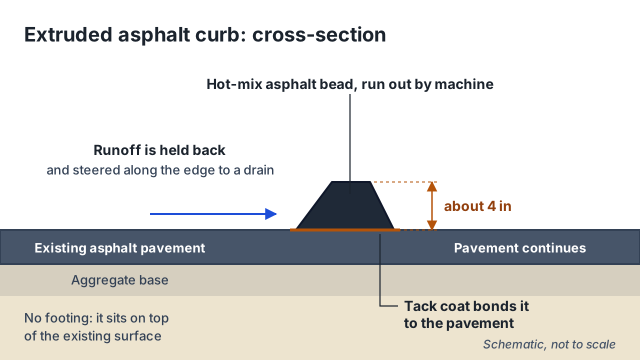
Extruded describes how a curb is placed, not its shape. A machine forces a very stiff mix through a mold as it moves along the line, so there are no forms. Extruded concrete curb is pinned to the pavement with dowels or adhesive.
Asphalt curb is the hot-mix version, run out as a bead on top of existing pavement around parking lots and driveways. It's cheap and fast but scuffs and deforms where cars hit it. Wisconsin DOT pays for it as a standard item, asphaltic curb, section 465, while Caltrans calls the same product a dike and treats it as drainage rather than a curb.
- Height
- Usually 4 to 6 in
- Drive over?
- No, but it won't stop much
- Used for
- Parking lot edges, water control
Driveway curbs, sidewalk curbs and curb ramps
These aren't separate profiles. They're the places where one of the curbs above has to meet something else.
Driveway curb cuts
With a mountable curb you can usually drive straight over. With a barrier curb you need a curb cut: the curb is lowered and a sloped apron is poured. That concrete sits in the public right of way, so expect a city permit and the city's spec. Driveway aprons and curb cuts
Sidewalk curbs
A street curb with a sidewalk behind it, at the usual 6 inch height. Some cities pour curb and walk as one slab. Others ban it: Centralia, WA says monolithic pour of curb and sidewalk will not be allowed.
ADA curb ramps
Where a sidewalk meets a crossing, the curb ramps down to street level: 1:12 maximum running slope, 1:48 maximum cross slope, no lip, and truncated dome warnings at the back of curb. Curb ramp rules
Curb materials compared
Shape is one way to sort curbs. Material is the other, and it moves the price more than the profile does. The Federal Highway Administration notes that curbs can be built from concrete, asphalt or cut stone.
| Material | Cost per foot | Best for | Watch out for |
|---|---|---|---|
| Cast-in-place concrete | About $39 to $42 | Streets, curb and gutter, driveways | Forms and curing time on site |
| Precast concrete | About $41 | Wheel stops, repairs, modular runs | A joint every 3 to 8 ft |
| Extruded asphalt | About $7 to $10 | Parking lot edges, water control | Scuffs and deforms under contact |
| Granite | About $90 to $150 | Northeast streets with heavy salt and plowing | Highest upfront cost |
The concrete figures are national means from a 2025 UMass Transportation Center study. Most of that is forming and labor: a 6 by 18 inch curb uses about 0.03 cubic yards per foot, so at the $160 average ready-mix price per cubic yard, the concrete itself is only about $4 of it. The asphalt range is Wisconsin DOT's average bid price for its asphaltic curb item in FY2023 and FY2024. Granite comes from East Providence, RI bids for 6 by 18 inch granite curb, and some cities require it outright: Quincy, MA says all curbing installed on any street in the city shall be granite. Its selling point is that it can be pulled and reset when the road is repaved. For bid prices with quantities and what landscape curbing costs per foot, see our concrete curb cost guide.
Precast vs cast-in-place
- Cast-in-place is formed and poured on site. It runs continuously with no joints between units and follows curves and grade exactly. Most street curb is built this way.
- Precast is made and cured at a plant, then set on site. You get tighter quality control and no field cure, but a joint every few feet. Best for wheel stops and repairs. See precast concrete curb.
If you're fixing a damaged run, the concrete curb repair guide covers cost, who pays and how to patch it.
Curb dimensions and parts of a curb
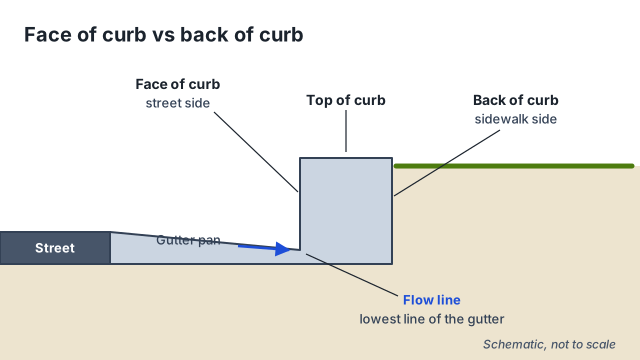
Face of curb vs back of curb
The face of curb is the street side, the surface a tire would hit, and it's the line most plans dimension from. The back of curb is the sidewalk or lawn side. Check which one your plan means before you set forms, because mixing them up moves the whole curb by its own width.
- Top of curb
- The flat top, usually 6 in wide.
- Flow line
- The low point of the gutter, where water runs.
- Reveal
- How much of the face shows above the gutter once it's built.
- Batter
- How far the face leans back from vertical.
| Dimension | Typical | Published range |
|---|---|---|
| Barrier curb height | 6 in | 3 to 9 in |
| Mountable curb height | 4 in | Under 6 in, sloped |
| Top width | 6 in | 6 to 9 in |
| Gutter pan width | 24 in | 6 in to 3 ft |
The only curb height in federal law is a definition, not a limit: the 2023 Public Right-of-Way Accessibility Guidelines call standard curb height "usually between 3 inches (75 mm) and 9 inches (230 mm)." Everything else is local, and your city's standard drawing always wins. Search your city name plus "standard details" to find it. For the agency-by-agency numbers, see how tall is a curb.
Can a car drive over it?
It depends on the state. TxDOT calls a curb mountable if its face is under 6 inches. WSDOT says vertical curbs over 4 inches are not mountable, but sloped curbs up to 6 inches are. NJDOT caps new sloping curb at 4 inches. A 5 inch vertical curb passes in Texas and fails in Washington.
Is there a minimum or maximum curb height?
No code sets one for ordinary street curb. NJDOT allows a face under 3 inches only if drainage math shows the water stays below the reveal, so in practice the curb has to be taller than the water. At the top end, AASHTO limits a vertical curb to 4 inches where it sits in front of a traffic barrier, a rule quoted in NCHRP Report 537, because a taller face can launch a car over the rail.
Which type of curb do you need?
| If you need to | Use | Height |
|---|---|---|
| Keep cars on the road and carry water | Barrier curb and gutter | 6 in |
| Let cars cross anywhere | Mountable curb | About 4 in |
| Edge pavement with no lip | Flush or ribbon curb | Flush |
| Stop a car in a parking stall | Wheel stop | 5 to 6 in |
| Edge a parking lot on a budget | Asphalt curb | 4 to 6 in |
| Give the mower a clean edge | Mow curb | Flush |
| Border a bed with a finished look | Landscape curbing | 4 to 6 in |
Anything in the street right of way has to match your city's standard drawing, so check that first. Then put the length, height and width into the concrete curb calculator to get cubic yards, or use the curb and gutter calculator for a section with a pan. For cost and installation, the concrete curb guide has the rest. Pouring a slab, footing or steps instead? You can calculate concrete for any shape on our homepage. If you're building it yourself, our step-by-step guide to concrete curb installation covers forms, base and finishing.
Frequently asked questions
What is the difference between a barrier curb and a mountable curb?
A barrier curb has a tall vertical face (about 6 inches) that blocks vehicles and is meant to be hard to cross. A mountable, or rolled, curb is lower with a sloped face so a car can drive over it anywhere. Barrier curbs are for control and drainage, mountable curbs are for easy access. Our mountable curb guide compares them in full.
Is an asphalt curb as good as a concrete curb?
It is cheaper and faster to install but less durable. Wisconsin DOT's asphaltic curb item averaged about $7 to $10 per linear foot in FY2023 and FY2024, against national means near $39 to $42 for concrete in a 2025 UMass Transportation Center study, and asphalt scuffs and deforms under repeated contact. Use it for parking lot edges and water control, and use concrete where the curb has to hold its shape or meet a street standard.
What is a mow curb?
A mow curb, or mowing strip, is a narrow band of concrete poured flush with the ground between a lawn and a bed or fence. The mower wheel rides along it so you get a clean edge without hand trimming. It sits at grass level, so it is not a traffic curb.
Are parking curbs and wheel stops the same thing?
Yes. Parking curb, wheel stop, parking block, and concrete curb stop all mean the same short precast block at the head of a parking space. It stops the tire before the car rolls too far. Standard units are about 6 feet long and 6 inches tall.
Do I need a permit to cut a curb for a new driveway?
Almost always, yes. The street curb sits in the public right of way, so lowering or cutting it usually requires a curb cut permit from the city and, in many places, a licensed contractor. Check with your local public works or streets department before any work starts.
Should I use precast or cast-in-place curb?
Use cast-in-place for continuous runs like street curb, curb and gutter, or a driveway apron, because it pours as one monolithic piece and follows curves and grade. Use precast for discrete units like parking blocks, where speed and consistent quality matter more than a custom fit.
How tall is a standard street curb?
Most street curbs stand about 6 inches above the gutter, and some arterial roads go up to 8 inches. Residential streets often use a lower mountable curb closer to 4 inches so residents can drive over it into their driveways.