Concrete Curb and Gutter
Curb and gutter is a raised concrete curb and a flat gutter pan built as one section: the curb edges the road and the pan carries stormwater along it to an inlet. A typical street section is a curb about 6 inches tall on a pan 18 to 24 inches wide, at least 6 inches thick, poured monolithically on a compacted aggregate base.
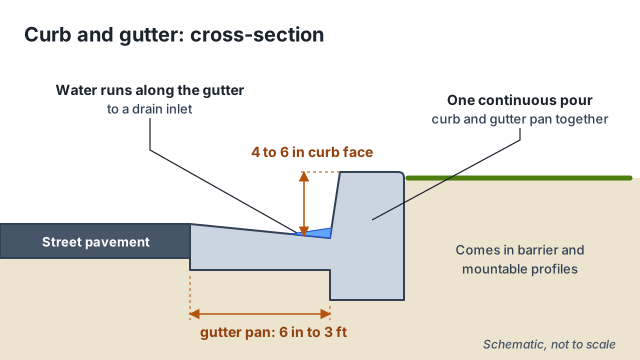
What "monolithic curb" means
Monolithic means poured in one piece, but specs use it for three different joins, so check which one a drawing means before you price it:
Curb with its gutter pan
The usual meaning on a street job. Palo Alto requires it outright: "All gutters, including valley gutters, concrete curb and gutter shall be constructed monolithically."
Curb with the pavement
This is what "integral curb" means in most DOT documents. MoDOT: "Integral type curbs are either doweled to the pavement or constructed monolithically with the pavement." New York City's integral curb and gutter is the curb plus the first 6 to 12 inches of roadway, used where drainage is hard to manage.
Curb with the sidewalk
Some cities pour the walk with the curb. Palo Alto's spec has the sidewalk poured together with the curb and gutter unless the engineer directs otherwise.
Where a gutter is poured separately from concrete pavement, it gets tied in with steel. Hamel, Illinois, for example, ties the gutter flag to the pavement with #4 bars at least 30 inches long at 30 inch centers.
Typical curb and gutter dimensions
- Curb height
- 6 in or more for a vertical curb
- Gutter pan width
- 18 to 36 in, 24 in common
- Gutter thickness
- 6 in minimum
- Base
- 4 in of aggregate, typical
TxDOT calls a curb vertical when its face is "6-in or higher" and mountable below that. Wisconsin DOT's standard detail has 18, 30 and 36 inch curb and gutter, with "A 6" MINIMUM GUTTER THICKNESS" (8 inches next to a concrete truck apron). Tennessee DOT says combined curb and gutter "is usually 24 inches wide." MoDOT places "A 4 in. Type 5 aggregate base" under curb and gutter.
The flow line (or gutter line) is the low line of the pan where it meets the curb face. It's the line the grades are set to and the line curb height is measured from. Profiles of each curb type are in types of curbs and mountable vs barrier curb.
What the gutter pan does
The pan is a shallow triangular channel. It's sloped down toward the curb so runoff gathers in a narrow strip at the curb face instead of spreading across the lane.
| Agency | Gutter cross slope |
|---|---|
| Caltrans | "typically 8.33 percent toward the curb" |
| Tennessee DOT | Typically 8.3 to 8.5 percent |
| Wisconsin DOT | 4 percent standard; 3/4 in per ft (6.25 percent) still allowed |
| At a curb ramp | 5 percent maximum (Caltrans, citing ADA limits) |
Gutter spread
In a storm, water backs out from the curb into the lane. The width it covers is the spread, and drainage design keeps it under a limit: Tennessee DOT says "the greatest allowable spread on any facility should be 8 feet, including the gutter width." Spread comes from the modified Manning's equation, which Iowa SUDAS gives as:
Q = (0.56 ÷ n) × Sx1.67 × SL0.5 × T2.67
Q is flow in cubic feet per second, n is Manning's roughness (0.012 for a troweled concrete gutter), Sx is the cross slope, SL is the longitudinal slope and T is the spread in feet. Because T is raised to the 2.67 power, doubling the spread carries about 6.4 times the flow.
Minimum grade along the gutter
A pan that doesn't fall along its length ponds. Tennessee DOT asks for "a minimum longitudinal slope of 0.5%" and says it "should be no less than 0.4%." Your local standard may differ.
Inlets, depressions and valley gutters
Curb and gutter depression
At an open-throat inlet the pan is warped down to steer water in. Iowa SUDAS lists a depression about 6 inches deep (4 inches in another section of the same manual) and typically 3 feet wide for its standard intakes. That's extra concrete a per-foot figure doesn't include.
Curb opening inlets
Iowa SUDAS recommends them "in sags and on grades less than 3%," because they catch less as the grade steepens. On a grade, a combination inlet is figured as a grate alone: capacity is computed "by neglecting the curb opening."
Valley gutters
A valley gutter carries flow across a street or intersection. Palo Alto builds them from 4,500 psi concrete with #4 bars "twelve (12) inches on center, both ways," at least seven days before paving.
Joint spacing
Ten feet is a common contraction joint interval. Expansion joints are much further apart, and specs disagree on how far:
| Spec | Contraction joints | Expansion joints |
|---|---|---|
| UFGS 32 16 19 (federal) | 5 to 15 ft | 30 to 120 ft |
| MAG (Arizona) | 10 ft max | 50 ft max |
| City of Fairfax, VA | about 10 ft | about 90 ft |
| Wisconsin DOT | 6 to about 20 ft | 6 to 300 ft on tangents, next to asphalt pavement |
Location matters as much as interval. MAG puts expansion joints at all radius points and both sides of each driveway and alley entrance. Where curb and gutter adjoins asphalt pavement, Wisconsin puts one 3 feet from each side of an inlet, and Fairfax 6 to 10 feet from drop inlets. On curves, MAG runs joints "along the radial lines of the curve." Wisconsin wants contraction joints "at least 2 inches deep"; MAG wants at least 3/4 inch and 25 percent of the thickness.
Slipforming vs hand forming
| Item | Hand formed | Slipformed |
|---|---|---|
| Slump (UFGS) | 3 in ± 1 | 1 in ± 1/2 |
| Forms | 2 in nominal plank or steel; 3/4 in boards laminated for radius bends | The machine's mold |
| Shaping | Face form pulled 2 to 6 hours after placing | Must hold its shape as it leaves the mold |
The stiff slipform mix is the whole difference. Fairfax says for slipform work "This slump must be between 0 and 2 inches," and rejects concrete above 2. For hand-formed work, Fairfax pulls the face forms "as soon as concrete has attained sufficient set for the curb to stand without slumping."
The concrete mix
The federal UFGS spec calls for 3,500 psi at 28 days and 5 to 7 percent air. Air matters wherever deicing salt reaches the gutter. FHWA's report on deicers and concrete says freeze-thaw protection depends on air voids "spaced closely enough to relieve the stress generated as the pore solution freezes," and recommends 6 ± 1.5 percent air and a water-cement ratio below 0.45 where deicers are used. Reinforcement is usually left out: UFGS says it "normally will not be required for curb and gutter construction."
Why curb and gutter fails
A University of Texas study for TxDOT found "almost all damaged CCCG systems were found at U-turn curbs," because of excessive off tracking by turning traffic, and that "failure occurred regardless of vertical tie bar spacing and joint spacing." It recommended a curb width of 24 inches or more, epoxy-grouted dowels, and dowels at least 8 inches from the traffic face. Cracked or heaved sections are covered in curb repair.
How to build curb and gutter
- Prepare the base and set the line. Compact the subgrade, place the specified aggregate base (MoDOT uses 4 inches), and set a string line so the flow line stays true.
- Set forms or the slipform machine. Use straight, full-depth forms of 2 inch nominal plank or steel, with 3/4 inch boards laminated for radius bends, or run a slipform machine along the line.
- Place a mix that suits the method. About 3 inches of slump for hand-formed work and about 1 inch for slipforming, because a slipformed section has to hold its shape as it leaves the mold.
- Pour the curb and pan as one unit. Place them monolithically and strike the pan to its cross slope toward the curb face.
- Cut the joints. Form contraction joints at the local interval, commonly about 10 feet, and full-depth expansion joints at structures, radius points, driveways and existing work.
- Strip, finish and cure. Pull hand face forms once the curb stands without slumping (2 to 6 hours after placing under UFGS), finish the surface, and cure the section before traffic reaches it.
Forming and pouring in more detail: how to pour a concrete curb. Where the run crosses a driveway you'll need a driveway apron, and at a crosswalk a curb ramp.
How much concrete for curb and gutter
Split the section into rectangles (and a triangle if the face is battered), add the areas, then multiply by the length.
Cubic yards = cross-section (sq in) ÷ 144 × length (ft) ÷ 27
Example: 100 feet of a 24 inch pan with a 6 inch curb
- Pan, 24 × 6 in: 144 sq in
- Curb above the pan, 6 × 6 in: 36 sq in
- Total: 180 sq in ÷ 144 = 1.25 sq ft
- × 100 ft = 125 cubic feet ÷ 27 = 4.63 cubic yards, or 5.09 with 10 percent waste
Add inlet depressions separately. The curb and gutter calculator does the math from your pan width, thickness and curb size; for a curb with no pan, use the concrete curb calculator.
Cost per linear foot
On public work, bid prices are the best published numbers. Arkansas DOT's June 2026 weighted averages show:
Type A 1 ft 6 in
$31.25
per linear foot
- Quantity
- 84,431 ft
Type E-1 2 ft
$31.48
per linear foot
- Quantity
- 2,068 ft
Removal old curb and gutter
$14.09
per linear foot
- Quantity
- 11,442 ft
Those are contractor bids on state highway jobs. A short residential run is priced by local contractors and can come in well above or below them, so get quotes. See concrete curb cost and the concrete curb guide.
Frequently asked questions
What is the difference between a curb and a curb and gutter?
A curb is the raised edge on its own. Curb and gutter adds a flat gutter pan at its base, poured as part of the same section, which carries stormwater along the road to an inlet.
What is a monolithic curb?
A curb poured in one piece with whatever it adjoins. On a street job that usually means the curb and gutter pan poured together, which Palo Alto requires outright. In DOT documents an integral or monolithic curb can instead mean a curb cast with the pavement slab, and some cities pour the sidewalk with the curb as well, so check which one the drawing means.
What is a gutter pan?
The flat concrete strip at the base of the curb, usually 18 to 36 inches wide and at least 6 inches thick. It slopes down toward the curb, typically 8.33 percent in Caltrans practice and 4 percent on Wisconsin DOT's standard, so runoff gathers at the curb face and runs to an inlet.
How far apart are the joints in curb and gutter?
Contraction joints are commonly about 10 feet apart; the federal UFGS spec allows 5 to 15 feet. Expansion joints are much further apart: 30 to 120 feet under UFGS, 50 feet maximum under MAG in Arizona, and about 90 feet in Fairfax, Virginia. They also go at radius points, driveways and inlets.
How much concrete do I need for curb and gutter?
Add up the cross-section in square inches, divide by 144 for square feet, multiply by the length and divide by 27. A 24 by 6 inch pan with a 6 by 6 inch curb is 1.25 square feet, so 100 feet takes 4.63 cubic yards, or about 5.1 with 10 percent waste. Add inlet depressions separately.
How much does curb and gutter cost per linear foot?
On Arkansas DOT's June 2026 weighted average bid prices, 1 foot 6 inch curb and gutter came in at $31.25 a foot over 84,431 feet, and 2 foot curb and gutter at $31.48. Removing old curb and gutter averaged $14.09 a foot. Small private jobs are priced locally and can differ a lot.