Stamped Concrete Patterns and Colors
Stamped concrete patterns come down to a handful of families: slate, brick, cobblestone, wood plank, random stone, and seamless textures with no joints at all. Color comes from three separate products used together. The pattern decides how the joints look and how much hand work the crew does at the edges. The color system decides whether the color goes all the way through the slab or only into the top layer. This guide covers both, using the manufacturers' own specifications, and what each choice does to the price.
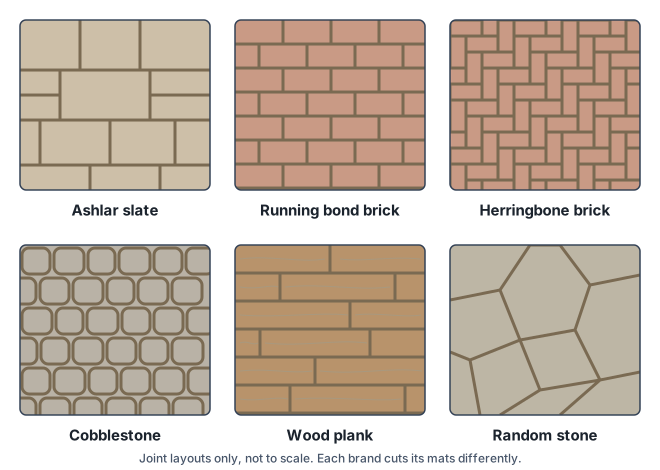
The main stamped concrete patterns
Pattern names vary by brand, but the families are the same everywhere. The dimensions below are from two of the largest stamp makers, Brickform and Butterfield, and they show how much the "same" pattern varies.
| Pattern | What it looks like | Published sizes |
|---|---|---|
| Ashlar slate | Rectangular and square slate pieces of several sizes, laid in an interlocking layout | Brickform Ashlar Cut Slate: stones 5 by 10 in to 7 by 21 in on a 23 in square tool, joints 1/8 to 1/4 in wide and 5/8 in deep. Butterfield Majestic Ashlar: grout lines 1/4 to 3/8 in |
| Slate tile | Square slate tiles in a grid | Butterfield sells fixed sizes: 6 by 6 in, 12 by 12 in, 18 by 18 in and 3 by 3 ft |
| Running bond brick | Bricks offset by half a brick each row | Brickform FM-5150: each brick 3-1/2 by 7-1/2 in, joints 1/2 to 3/4 in wide and 1/4 in deep |
| Herringbone and basketweave brick | Bricks set at right angles in a zigzag, or in pairs alternating direction | Brickform herringbone tool 25-1/4 by 36-1/2 in; basketweave tool 16 by 32 in |
| Cobblestone | Small rounded stones in rows or fans | Brickform London Cobble: "a traditional lightly textured cobblestone pattern" |
| Wood plank | Long boards with grain texture, staggered ends | Brickform Wood Planks: planks 12 in wide in 2, 3, 4 and 6 ft lengths |
| Random stone and flagstone | Irregular stone shapes with uneven joints | Sold by both makers under stone and fieldstone names |
| Seamless texture | Stone or slate texture with no joints at all | Brickform texture skins overlap each other by about 20 percent |
Sources: Brickform's concrete stamping catalog and running bond brick specification, and Butterfield Color's Majestic Ashlar and stamp pattern catalog.
Slate is the forgiving choice. Random stone sizes mean a joint that lands slightly off does not break a visible grid the way it would in brick or tile, and the texture is deep. Brickform describes its ashlar slate as "hand-tooled to create a more pronounced, chipped, fragmented texture with small, deep joints."
Patterned mats versus seamless textures
Every pattern above has joints that imitate the mortar lines between real stones or bricks. A seamless texture does not. Brickform's texture skin catalog explains the difference: skins are "feathered edge stamping tools that can be rotated and overlapped," producing "continuous textures that do not have simulated grout or mortar joints like other stamp textures."
That difference shows up in the tool list. A patterned set needs the joints to line up across every mat, so it comes with extras for the edges and corners where a full mat will not fit. Brickform's running bond set is 9 rigid stamps, 2 floppy stamps, a texture skin and a touch-up wheel, and its ashlar slate set is 12 rigid mats, 2 floppy mats, a skin and a wheel. A seamless texture just overlaps.
Which patterns cost more
No manufacturer or trade body publishes a price difference by pattern. The only pattern-by-pattern prices we found come from Angi, which puts brick at about $9 per square foot installed, slate at $11, cobblestone at $14, wood plank at $16, and a custom logo or inlay at $18 to $22. That fits the tool lists above: patterns with more joints to line up and more detail at the edges take longer to stamp inside the same setting window.
Color count matters as much as pattern. One pattern and one color is the bottom tier of every published price range; a contrasting border and a second color moves you into the middle. Stamped concrete cost has the full tier table and a calculator for your area.
How stamped concrete gets its color
Most stamped work uses up to three color products, each doing a different job:
- Integral color is pigment mixed into the whole batch, so the color runs through the full depth of the slab. Davis Colors' specifications note that its iron oxide pigments meet ASTM C979 and that "the color shows through even if the slab chips." Solomon Colors' technical data gives the dose: an optimum of 2 to 4 percent of the cementitious weight, saturation at about 7 percent, and a warning that more than 10 percent can reduce strength.
- Color hardener is a dry powder of cement, pigment and fine aggregate broadcast onto the fresh surface and floated in. It colors only the top layer but makes that layer denser. Brickform's color hardener "improves abrasion resistance" at 60 pounds per 120 square feet, or per 90 square feet for lighter colors. Sika's Lithochrome data sheet gives 50 to 90 pounds per 100 square feet for residential patios, walkways and pools.
- Antiquing release is the colored powder spread on just before the mats go down. It stops the mats sticking and leaves a second, darker color in the joints and low spots, which is what makes stamped concrete look like stone rather than tinted concrete. Butterfield gives about 3 to 4 pounds per 100 square feet. Brickform's release data sheet says to wash off 80 to 85 percent of it afterwards, and warns that excess release "may lead to delamination of the sealer."
A typical patio uses all three, or color hardener plus release on plain gray concrete. Integral color alone is the cheaper route and wears better if the surface chips, because there is no colored skin to lose.
Choosing stamped concrete colors
Will it fade? The pigment largely does not; the surface does. Davis Colors puts it plainly: "The color can't fade, but the concrete can." Solomon says its iron oxide pigments are UV-stable but notes that carbon black, the pigment in many charcoal and black mixes, can fade. What dulls a stamped slab is surface wear, dirt and efflorescence, and a fresh coat of sealer brings most of the depth back. Sealing stamped concrete covers how and when.
Light or dark around a pool or patio? Lighter is cooler underfoot. The EPA's cool pavements guidance puts new gray concrete at about 40 percent solar reflectance and cites an estimate that every 10 percent increase in reflectance lowers the surface temperature by about 7°F. Darker pigments reflect less and run hotter. Nobody publishes reflectance figures by stamped concrete color, so treat a charcoal pool deck as hot without a number attached.
Two colors look more natural than one. A base color with a darker release in the joints reads as stone. A single flat color with no release tends to read as tinted concrete rather than stone.
Stamped concrete patio ideas that also solve problems
- A border band where the joints go. A patio needs control joints every 8 to 12 feet, and a saw cut across a stone pattern looks like a crack. A smooth or contrasting band laid exactly where the joint falls hides it in the design. Plan it before the pour; what drives the price up covers it.
- Slate in the field, brick or cobble on the border. The classic two-pattern patio, and the definition of the mid-price tier.
- Wood plank for a deck look next to a house where a wood deck would sit on the ground. It is one of the pricier patterns because of the grain detail.
- Seamless texture for large areas. No joints to line up, and it pairs with a bordered edge.
- Lighter colors around a pool, for the heat reason above, with a slip-resistant additive in the sealer. Stamped concrete pool decks covers the details.
If the patio does not exist yet, how to pour a concrete patio covers the slope, base and joints the pattern sits on. If you have a sound slab already, a stamped overlay applies the same patterns over existing concrete.
Frequently asked questions
What is the most popular stamped concrete pattern?
Nobody publishes market share figures. Slate patterns, especially ashlar slate, are a common choice because the random stone sizes forgive small layout errors and the deep texture gives grip. Brick, cobblestone and wood plank are the other main families.
Which stamped concrete patterns cost more?
Patterns with more joints and detail. The only pattern-by-pattern prices we found, from Angi, put brick at about $9 per square foot installed, slate at $11, cobblestone at $14 and wood plank at $16. Adding a second color or a border moves a job up a price tier.
How is stamped concrete colored?
With up to three products: integral color mixed through the whole batch, color hardener broadcast onto the fresh surface, and an antiquing release powder that leaves a darker accent color in the joints and stops the mats sticking.
Does stamped concrete color fade?
The iron oxide pigments are UV stable, though carbon black can fade. What dulls stamped concrete is surface wear, dirt and efflorescence. A fresh coat of sealer restores most of the color depth.
What color stamped concrete is best around a pool?
A light one. New gray concrete reflects about 40 percent of sunlight, and every 10 percent increase in reflectance lowers surface temperature by roughly 7 degrees F, so darker colors run noticeably hotter underfoot.