Barrier Curb (Vertical Curb)
A barrier curb is the tall, near-vertical curb that keeps a vehicle on the pavement. Its face stands about 6 inches above the gutter, sometimes up to 8, and it is steep enough that a car cannot cross it except at a curb cut. You will also see it called a vertical curb, a stand-up curb or simply a street curb, and those names all mean the same thing. It is one of the two families every curb belongs to, the other being the mountable (rolled) curb built to be driven over. This page is a spoke of our concrete curb guide and goes deeper than the short entry in our types of curbs guide.
Here is what a barrier curb is, the heights and batter agencies publish for it, where the standards require one and why, and what it costs per foot. When you know the section and the length, the concrete curb calculator turns it into cubic yards and bags.
What a barrier curb is
The Federal Highway Administration puts the whole taxonomy in one line in its guidance on curbs: there are two types of curbs, barrier and mountable. A barrier curb is the control half of that pair. The steep face is the point. It physically blocks vehicles from leaving the pavement, protects the sidewalk and the lawn behind it, and holds stormwater in the gutter so it runs to the inlets instead of sheeting across the road.
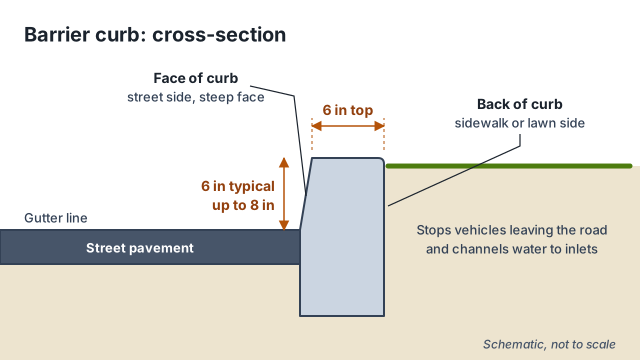
The Texas DOT Roadway Design Manual draws the dividing line by height: a vertical curb has a vertical or nearly vertical face 6 inches or higher, while a mountable curb has a face less than 6 inches. So barrier and vertical are the same thing, named from two directions: barrier for what it does, vertical for how it looks.
Published face heights and batter by agency
Six inches is the common barrier-curb face height, and most agencies publish a near-vertical face rather than a truly plumb one. The lean is called batter, and the clearest published figure comes from the Caltrans Highway Design Manual, which gives vertical curbs a batter of about 1:4 and a height that varies from 4 to 8 inches.
| Document | Face height | Face / batter |
|---|---|---|
| TxDOT RDM 4.10.12 | 6 in or higher | Vertical or nearly vertical |
| Caltrans HDM 303.2, Type A | 6 in standard, 4 to 8 in range | About 1:4 batter |
| NJDOT RDM 5.6.4 | 6 in with sidewalk, up to 8 in | Vertical |
| Iowa SUDAS 5C-2 | 6 in typical, 8 in some arterials | Vertical |
| WSDOT Design Manual 1239 | Over 4 in is not mountable | Vertical |
| MoDOT EPG 609 | 6 in and taller | Vertical |
| Seattle Streets Illustrated | 6 in | Vertical |
| Minneapolis Street Design Guide | 6 in | Vertical |
Iowa SUDAS states it in one sentence: typically a curb should be 6 inches high and 6 inches wide, with 8 inches permitted on some arterial and collector streets at 40 mph or less. For the full range, including sloped and mountable heights, mow and flush curbs and what reveal and batter mean on a plan sheet, see our how tall is a curb and curb dimensions references.
The AASHTO 4-inch figure, and the condition it depends on
You will find the claim repeated everywhere that a curb should be no taller than 4 inches. It is a real rule, but it is almost always quoted with its opening clause cut off. NCHRP Report 537 gives the AASHTO Green Book sentence in full: "if a curb is used in conjunction with a traffic barrier, the height of a vertical curb should be limited to 100 mm or it should be of the sloping type." The 100 mm is about 4 inches.
The condition is the whole sentence. The 4-inch limit applies to a vertical curb placed in front of a traffic barrier such as a guardrail, where a taller curb could launch an errant vehicle over the rail. It is not a general ceiling on curb height. MoDOT applies it exactly as written, dropping the curb to 4 inches directly beneath guardrail and building 6-inch and taller curb everywhere else. So a 6-inch barrier curb on an ordinary street is not over any limit; the 4-inch figure simply does not apply to it.
Where agencies require a barrier curb, and why
Three published reasons put a barrier curb on a job: containment, drainage and parking control.
Containment, below a speed threshold. A barrier curb keeps vehicles on the pavement, but only at lower speeds. A car that strikes a vertical face at speed can be tripped or vaulted, so the standards keep the tall curb off fast roads. FHWA states that barrier-type curbs are not recommended for projects with design speeds above 40 mph, and Caltrans advises avoiding curb altogether at posted speeds of 40 mph or more. That is why you see barrier curb on collector and arterial streets and around parking-lot islands, but mountable curb or no curb on highways.
Drainage. A 6-inch vertical face holds back more gutter flow than a low rolled curb, so it carries stormwater to the inlets on steeper streets and where inlets are spaced far apart. The containment that stops a tire also keeps the water in the channel.
Parking control. Height is sometimes chosen purely to change behavior. NJDOT allows an 8-inch vertical face specifically to discourage parking, at 40 mph or less with no guide rail. The taller the face, the more firmly it tells a driver to stay off the verge.
Barrier curb and gutter
Most barrier curb on a street is not poured on its own. It is cast monolithically with a flat gutter pan in front of it, as a single barrier curb and gutter section, so the curb and the channel that drains to it go in together. The barrier is the vertical part; the gutter is the flat pan the water runs along.
New York City's integral curb and gutter standard is a good worked example of a barrier section: 6 inches wide on top, 18 inches deep overall, with a 7-inch reveal above the gutter. The reveal is the step a pedestrian sees; the rest is buried, which is why you order concrete for the full section and not the visible face. The concrete curb and gutter guide covers the profiles, pan widths and how the two are formed together, and the curb and gutter calculator figures the concrete when the pan is poured with the curb.
Barrier vs mountable, in short
The two families split on one choice: can a car cross the curb anywhere, or only at a cut. A barrier curb has a vertical face 6 inches or taller and can be crossed only at a curb cut. A mountable curb has a sloped face under 6 inches, usually 4 inches or less, that a vehicle can roll over anywhere along its length. Barrier curbs are for control; mountable curbs are for access, which is why subdivisions full of future driveways use the rolled profile and busy streets use the vertical one. The mountable guide sets the two profiles side by side and covers where each is required.
What a barrier curb costs per foot
Barrier curb is priced per linear foot, and the published unit prices depend heavily on how much you buy. From the state DOT and municipal bid records in our concrete curbing cost study, NJDOT paid $115.00 a foot for a 9 by 14 inch vertical curb on a 200-foot item and $100.00 for a 9 by 16 inch vertical curb on 853 feet, while on larger quantities a plain concrete curb runs lower, with Montana DOT at $70.69 a foot on 645 feet and Arkansas DOT at $43.78 on 1,596 feet of concrete curb type A.
The spread is the quantity, not the product. Short runs carry the fixed cost of mobilizing a crew, forms and a concrete order, so a few hundred feet always costs more per foot than a few thousand. If you are pricing a street or a parking lot, the cost guide has a full year of weighted bid data from ten state DOTs; if you are estimating a short replacement, expect to pay more. Either way, start with the quantity: measure the run and use the concrete curb calculator to get the cubic yards before you compare a quote.
Frequently asked questions
What is a barrier curb?
A barrier curb is a tall, near-vertical curb, usually about 6 inches high, that keeps vehicles on the pavement and can be crossed only at a curb cut. It is one of the two curb families, the other being the mountable (rolled) curb.
Is a barrier curb the same as a vertical curb?
Yes. Barrier and vertical are two names for the same curb. "Barrier" describes what it does, keeping cars on the road, and "vertical" describes its steep face. It is also called a stand-up curb or a street curb.
How tall is a barrier curb?
Usually about 6 inches above the gutter, and up to 8 inches on some arterials or to discourage parking. TxDOT defines a vertical curb as a face 6 inches or higher; below 6 inches the curb is considered mountable.
Why are barrier curbs not used on high-speed roads?
A vehicle that strikes a vertical face at speed can be tripped or launched, so FHWA does not recommend barrier curbs above a 40 mph design speed and Caltrans advises avoiding curb entirely at 40 mph or more. Mountable curb or no curb is used instead.
What is barrier curb and gutter?
It is a barrier curb cast in one piece with a flat gutter pan in front of it, so the vertical curb and the channel that drains to it are poured together as a single section. Most street barrier curb is built this way.