Extruded Curb: Concrete and Asphalt
Extruded curb is curb placed by a machine that forces a very stiff mix through a mold as it travels along the line, with no forms. In concrete it uses a near-zero-slump mix and is pinned to the pavement with dowels or adhesive. In asphalt it's a hot-mix bead tacked onto the existing surface, the low curb you see around parking lots.
Extruded concrete vs extruded asphalt curb
| Feature | Extruded concrete | Extruded asphalt |
|---|---|---|
| Mix | Stiff, 0 to 1 in slump, 3/8 in stone | Hot-mix asphalt, intermediate course |
| Held down by | Dowels or adhesive into the pavement | Tack coat, about 0.10 to 0.15 gal per sq yd |
| Joints | Tooled or sawed, about every 9 ft | None |
| Agencies call it | Extruded curb, slipform curb | Asphalt curb, asphaltic curb, HMA curb, dike |
| Best for | Curb that has to hold its shape | Parking lot edges and water control |
If you're comparing extruded curb against the other profiles (barrier, mountable, ribbon and so on), see types of curbs. This page is about the placement method itself.
Extruded vs slipform curb: same machine
Agencies use the two words for the same equipment, often in the same sentence. Sacramento County's specification says curbs "may be constructed using an approved extrusion or slipform machine," and the Hampton Roads regional standard requires slip-form equipment "equipped to place/extrude, form, consolidate, and finish" the concrete, then refers to "the top of the extruded curb." Ohio DOT gives the plainest definition: a self-propelled machine that will "force the concrete through a mold of the proper cross-section."
The manufacturers don't agree either. Power Curbers sells a line it calls Extruders for concrete, asphalt or compacted subgrade, while GOMACO says its Curb Cadet "will slipform concrete curb with an option to extrude asphalt." We didn't find a specification that treats them as different methods. Where the phrase "extruded curb" shows up as a pay item or plan title, it usually means concrete: WSDOT's standard plan titled Extruded Curb is cement concrete. Asphalt versions get named by their material instead.
The extruded concrete curb mix
The curb has to hold its shape the moment it leaves the mold, so the mix is far stiffer than anything you'd pour into forms. Sacramento County puts it as concrete that "will maintain the shape of the section without support after extrusion." The most complete numbers we found come from the Town of Trumbull, Connecticut extruded concrete curb item.
- Cement
- 620 lb per cu yd minimum
- Sand
- About 2,100 lb per cu yd
- Stone
- About 1,150 lb of 3/8 in aggregate
- Strength
- 4,000 psi at 28 days
- Fiber
- At least 1 lb per cu yd
- Slump
- 0 to 1 in (manufacturer guidance)
Miller Curber's mix sheet is blunt about the slump: "If the mix is too wet the curb may slough off." Note the 3/8 inch top size, against 3/4 inch for a typical slab. The concrete mix calculator shows how far that moves the proportions.
How extruded curb is held in place
Extruded curb sits on the pavement instead of being built into the ground, so the connection is the whole structure. Sacramento County: "Extruded concrete curbs must be anchored to existing pavement either by placing dowels or by using an approved adhesive." Caltrans allows adhesive in place of dowels too, and Trumbull requires the base course to be cleaned of "dust, dirt, oil and other deleterious materials" first.
- No steel inside. None of the specifications we read require rebar inside the section. The only reinforcement anywhere was fiber. That's why a damaged length usually gets replaced rather than patched, which curb repair covers.
- Joints are cut, not formed. Memphis lets machine-placed curb have its joints sawed "in lieu of constructing the curb or curb and gutter in sections." Trumbull tools control joints "at intervals not to exceed nine (9) feet," which is why extruded curb breaks into roughly 9 foot pieces.
How extruded concrete curb is installed
- Prepare the grade. The machine follows what's under it. One Sacramento-area specification wants the subgrade within plus or minus 0.10 ft of design.
- Clean the pavement. Remove dust, dirt and oil where the curb will sit so the anchor holds.
- Set dowels or adhesive. Follow the local spec for spacing and product.
- Extrude with a stiff mix. Keep the slump near zero so the faces don't sag behind the mold.
- Cut joints and cure. Tool or saw control joints at the specified spacing, then cure like any exposed concrete.
The finished line is checked tightly: Sacramento County holds the gutter flow line and back of curb to "plus or minus 0.05 foot in any 25-foot length."
Extruded asphalt curb
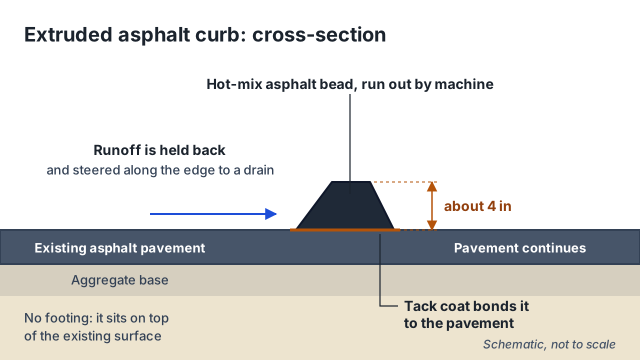
This is the low bead around parking lots and along asphalt driveways, run out of a machine straight onto the existing pavement. Wisconsin DOT section 465 pays for it as a standard item: "Construct asphaltic curb in one layer on a prepared asphaltic pavement or base foundation." Ohio DOT specifies a 448 intermediate course mix with PG 64-22 binder, placed by a hopper and power-driven screw and compacted with a vibrating tamper.
The bond to the pavement is the job, and three sources agree on the tack coat rate:
| Source | Rate |
|---|---|
| Ohio DOT | 0.15 gal per sq yd |
| California water district spec (Caltrans materials) | 0.1 gal per sq yd |
| Asphalt Paving Association of Iowa | 0.10 gal per sq yd maximum |
In cold weather, the City of Lincoln requires the surface be heated "so that it is sufficiently plastic to form a bond with the hot asphaltic concrete curb."
Why California calls it a dike
Caltrans has no asphalt curb item. The extruded asphalt product is a dike, and the Highway Design Manual treats it as drainage, for containing and directing runoff, while curbs handle channelization, access control and separating pedestrians from vehicles. Caltrans dikes come in 2, 4 and 6 inch heights, with the 4 inch Type E listed as "the preferred dike type." If you're looking for an asphalt curb spec in a Caltrans-influenced state and finding nothing, search for dike instead.
Is asphalt curb allowed on public streets?
Yes, in plenty of places. It's a state pay item in Ohio and Wisconsin, both public road specifications. Where concrete or granite is the local standard it needs approval, and in California it's reclassified rather than banned. We found no specification that prohibits it on a public street.
What extrusion can't do
- Tight curves and short runs. Iowa SUDAS allows hand methods "for radius, returns, and sections of curb and gutter 100 feet or less," and requires a machine only above 250 feet. GOMACO's tightest published radius is about 24 inches, depending on the mold.
- Big sections. The mold limits the size. GOMACO's Curb Cadet molds fit within 12 inches wide by 14 inches high; Miller Curber's commercial machines run 3.5 to 18 inches high.
- A bad subgrade. The machine copies the grade it rides on.
- A wet mix. There's no second chance. By the time you see the face sag, that length is defective.
What extruded curb costs
Be careful what you compare. Almost all published machine and price data is for curb and gutter on a large slipform paver, and we found no state price book with an item literally named extruded curb. What does exist is Wisconsin DOT's asphaltic curb item, which averaged $7.10 per linear foot in FY2023 and $9.85 in FY2024. Its FY2025 figure of $26.89 almost certainly reflects small bid quantities rather than a market move. For concrete curb prices and why quantity swings them so much, see concrete curb cost.
If you want the machine rather than the curb, the curbing machine guide covers rental and purchase. If you want a decorative garden border, landscape curbing uses the same process with a sand and cement mix and no anchors. To size a pour, use the concrete curb calculator.
Frequently asked questions
What is extruded curb?
Extruded curb is curb placed by a machine that forces a stiff mix through a shaped mold as it moves along the line, so no forms are needed. It can be concrete or hot-mix asphalt, and it sits on top of existing pavement, held by dowels, adhesive or a tack coat.
Is extruded curb the same as slipform curb?
In practice, yes. Agency specifications use extrusion and slipform for the same self-propelled machine, sometimes in one sentence, and we found no specification that defines them as different methods. Some manufacturers draw a line by material, using slipform for concrete and extrude for asphalt.
What slump is used for extruded concrete curb?
Close to zero. Curb machine makers recommend 0 to 1 inch, and the Hampton Roads regional standard allows slipform concrete with a slump as low as zero. A wetter mix sags once it leaves the mold.
Does extruded curb have rebar?
None of the specifications we reviewed require steel inside the section. The steel, where there is any, is in the dowels into the pavement below, and the only internal reinforcement we found was fiber, such as the 1 lb per cubic yard minimum in Trumbull, CT.
Why does Caltrans call asphalt curb a dike?
Caltrans classifies extruded asphalt as a drainage feature for containing and directing runoff, not as a curb, which in its manual handles channelization, access control and pedestrian separation. Its dikes come in 2, 4 and 6 inch heights, with the 4 inch Type E preferred.
How much does extruded asphalt curb cost?
Wisconsin DOT bid averages for its asphaltic curb item were $7.10 per linear foot in FY2023 and $9.85 in FY2024. Small jobs cost more per foot because the setup is the same whatever the length.