Concrete Curb Repair and Replacement
Concrete curb repair depends on how deep the damage goes: chips, spalls and narrow cracks take a fast-setting repair mortar and an afternoon, while a section that has broken off, dropped or heaved gets saw-cut out and re-poured. Public bids put curb and gutter replacement at about $56 to $70 per linear foot, but on a short run the trip, not the footage, sets the price. Check your city code first, because the curb sits in the public right-of-way.
Repair or replace a concrete curb
Patch when the damage is on the surface and the curb hasn't moved. Replace when a section has broken through, dropped or heaved, because that means the base under it failed.
Spalling or chips
Patch
Freeze-thaw and de-icing salt flake the face. Chip to sound concrete and patch.
One crack, edges level
Fill
Open it slightly, clean it and fill with a flexible sealant or fortified patch.
Section broken off
Re-pour
Usually a tire or plow blade. Saw-cut, dowel into the old curb and pour in a form.
Heaving or sinking
Replace
Frost, roots or a washed-out base. Fix the base, then pour a new section.
No agency publishes a measurable repair-or-replace threshold for curbs. Minneapolis and Des Plaines publish defect numbers (a 1 inch or 1 1/8 inch lip), but only for sidewalks. The cards above are a judgment call.
Best products for concrete curb repair
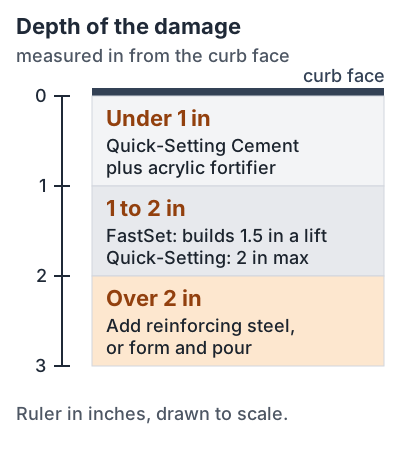
The depth of the hole decides which product works; no single curb repair kit covers every case. The patching mortars each have a published thickness limit, and that limit decides whether you trowel it in or build a form.
Fast-setting repair mortar
Broken edges and corners that must hold their shape.
Quick-setting cement
Hand-shaping an edge on a vertical face, with no form.
Concrete resurfacer
A thin overlay across a flaking face. It won't rebuild an edge.
Flexible crack sealant
Cracks under about 1/4 inch on a curb that still moves.
Bonding agent or slurry
Priming old concrete so the patch sticks.
Bagged 4,000 psi mix
Re-pouring a full section in a form.
QUIKRETE's FastSet Repair Mortar data sheet lists curbs as a use, builds at least 1.5 inches in one application and calls for reinforcing steel in vertical patches deeper than 2 inches. Its Quick-Setting Cement data sheet sets a 1 to 2 inch range and wants acrylic fortifier below 1 inch.
How many containers to buy
Work out the hole's volume in cubic feet and divide by the yield: a 20 lb pail of FastSet yields 0.18 cubic feet, a 60 lb bag 0.54.
Example: a spall 1.5 in deep, 6 in tall and 24 in long is 216 cubic inches, or 0.125 cubic feet, so one 20 lb pail (0.18 cu ft) fills it in a single lift. Twice as deep and you're past the 2 inch line where the data sheet calls for reinforcing steel.
How to patch a spalled or chipped curb
A chip or spall is a one-afternoon job with a cold chisel, a wire brush, a margin trowel and a container of repair mortar.
- Chip and undercut. Remove loose concrete until you hit sound material, and cut the edges slightly wider at the bottom so the patch locks in.
- Clean and dampen. Wire-brush, rinse out the dust and leave the surface damp but not puddled.
- Prime. Brush on a bonding agent or a cement slurry. Skipping this is the usual reason a patch pops off.
- Pack the mortar. Press fast-setting mortar in with a margin trowel, in lifts of about 1.5 inches, the depth FastSet builds in one application (see how many containers to buy).
- Shape the profile. Once it's thumbprint-hard, mold the face and top to line up with the curb on each side.
- Cure it damp. Mist it or cover it with plastic for a few days and keep traffic off.
How to fix a cracked concrete curb
For a crack under about 1/4 inch with level edges, chase it open with a grinder or chisel, blow out the dust and fill it with a flexible masonry sealant, which moves with the curb better than a rigid patch.
If one side sits higher than the other, the base moved. Filling won't hold; cut out the section and rebuild it.
How to rebuild a broken curb section
A section that broke off or dropped gets cut back to sound concrete and re-poured in a form, tied into the old curb with dowels.
- Cut back to sound concrete. Saw-cut past the visible damage until the cut edge no longer crumbles under a chisel.
- Fix the base. If the gravel under it is soft or washed out, add new gravel and compact it.
- Dowel in. Drill and epoxy short rebar dowels into the cut ends of the old curb.
- Form it. Build and brace a form that matches the curb's height and face so it can't bow.
- Pour stiff. Prime the cut faces, place a stiff 4,000 psi mix, rod out the voids and tool the edge.
- Cure. Cover it and keep traffic off for about 7 days.
The concrete curb calculator gives the bag count for the section, and the curb pouring guide covers forming and finishing in detail.
Concrete curb repair cost
Montana DOT's 2025 weighted average for new concrete curb and gutter was $70.09 across 9,025 feet.
Replace
$56 to $70/ft
Grand Chute, WI: four bids of $59 to $70 on 520 ft. South Milwaukee, WI 2025: $56.25 to $65.39 for new curb, plus $10 to $16.14 to remove the old.
Removal only
$6 to $21/ft
DOT averages from Wisconsin and Montana, on runs of hundreds to thousands of feet.
City reimbursement cap
$110/ft
Columbus, OH pays up to this per foot of approved curbing, based on the lowest of three bids.
Short runs cost far more per foot
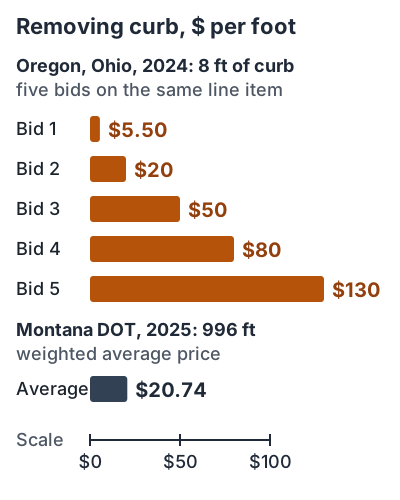
Quantity sets a small curb bill more than condition does. On one 2024 Oregon, Ohio contract, five contractors bid the same 8 feet of curb removal, and the top bid was 24 times the low one.
Bundle every repair on your street or lot into one visit. Mobilization alone ran $3,000 to $17,500 across the four Grand Chute bids, and on a short repair it's most of the price.
Public bid prices for curb and gutter
| Source | Per foot | Item |
|---|---|---|
| Grand Chute, WI 2022 | $59, $65, $65, $70 | Remove and replace curb and gutter, 520 ft |
| South Milwaukee 2025 | $56.25, $65.39 | New 24 in curb and gutter, 225 ft |
| South Milwaukee 2025 | $56.55, $58.62 | New 31 in curb and gutter, 260 ft |
| NJDOT 2024 | $65, $70 | 9 by 16 in vertical curb, 1,545 ft |
| Montana DOT 2025 | $70.09 | Average, new curb and gutter, 9,025 ft |
Public bids include traffic control and bonding, so treat them as a ceiling for a private job.
See concrete curb cost for new installation prices by curb type.
Who is responsible for curb repair
Your city's ordinance decides who repairs the curb, and cities split three ways. Check the code and ask about a cost-sharing program before you hire anyone.
Owner pays, curb named
Kansas City, MO; Springfield, OH; Brighton, CO. California includes "curbing" in its legal definition of sidewalk (Streets and Highways Code section 5600).
Sidewalk only
Memphis and Seattle assign owners the sidewalk and stop at the curb.
City shares the cost
Brighton pays 50 percent, Idaho Falls $21 a foot, Tulare County $25 a foot, and Des Plaines does the work at no cost.
- Curb work can need a contractor. San Francisco lets owners fix minor sidewalk defects, but curb work requires a licensed A or C-8 contractor with a $25,000 street excavation bond.
- City tree roots. NYC doesn't charge one to three family homes for sidewalk damage from city trees; Sacramento makes the owner repair it anyway.
- Ignore a notice and you pay more. Kansas City gives 30 days, then does the work and puts a lien on the property.
- City vehicle damage is a claim. In California, a claim for property damage must be filed within one year under Government Code section 911.2.
- Private HOA street. The curb is usually common area; in California the association repairs it (Civil Code section 4775).
Cutting or lowering a curb for a driveway
Concrete curb cutting needs a city curb cut or driveway permit, because the curb is in the right-of-way.
Pittsburgh's curb cut permit sheet shows what to expect:
- Apply and pay. A $75 residential application fee and a $150 residential permit fee.
- Hire a registered contractor. The city requires registration, a bond and insurance.
- Book three inspections. Before work, after the form is set but before the pour, and after the concrete sets. You can't pour on your own schedule.
Widening a driveway is usually an apron job; see concrete driveway apron for thickness rules and who owns it.
Asphalt and extruded curb repair
Asphalt and extruded curb usually gets replaced. It's glued to the pavement rather than built on a base: the Town of Trumbull, Connecticut specification bonds extruded curb to the asphalt with concrete adhesive and tools joints no more than 9 feet apart, so failed curb lets go in lengths.
No DOT or city specification we found covers repairing it, and small-quantity prices scatter: seven contractors bid 216 feet of asphalt dike for Sonoma County in 2024 at $5 to $200 a foot.
Types of curbs compares asphalt and concrete if you're replacing it.
Parking lot curb repair
Parking lot curbs break where vehicles turn. A Texas DOT study of damaged curb and gutter found nearly all of it at U-turns, where off-tracking truck tires drag sideways across the curb. Drive-aisle corners take the same sideways load, so a section replaced in kind tends to fail again. Concrete curb and gutter covers the stronger section that study recommends.
ADA
28 CFR 36.211 requires keeping accessible features working. That covers a curb ramp on an accessible route, not an ordinary run of curb. See the concrete curb ramp guide.
Wheel stops
East Bay Regional Park District's detail: precast 4,000 psi, two #4 bars and two 24 inch anchors.
Frequently asked questions
Who is responsible for repairing the curb in front of my house?
Your city's ordinance decides. Kansas City, Missouri; Springfield, Ohio; and Brighton, Colorado name the curb as the owner's job, and California folds curbing into the owner's sidewalk duty. Memphis and Seattle assign only the sidewalk, and several cities share the cost, so check your municipal code and ask about a reimbursement program before you pay anyone.
How much does concrete curb repair cost per linear foot?
Public bids for curb and gutter replacement run about $56 to $70 per linear foot, and Montana DOT's 2025 average for new curb and gutter was $70.09. Short runs cost much more per foot: five contractors bid 8 feet of curb removal in Oregon, Ohio at $5.50 to $130 a foot.
Can you repair a concrete curb yourself?
Chips, spalls and narrow cracks are a DIY afternoon with fast-setting repair mortar. A broken-off section takes a form, dowels and a stiff mix. Check permits first: San Francisco, for one, requires a licensed, bonded contractor for any curb work in the street.
What is the best product to fix a broken concrete curb?
A fast-setting repair mortar for broken edges and corners, or quick-setting cement with acrylic fortifier to hand-shape an edge. QUIKRETE's FastSet builds at least 1.5 inches per lift and needs reinforcing steel past 2 inches on a vertical patch, so a deeper break needs a form and bagged concrete. No single curb repair kit covers every depth.
When should I replace a curb instead of patching it?
Replace it when a section has broken through, dropped or heaved, or when one side of a crack sits higher than the other, because the base has failed. No agency publishes a measurable threshold for curbs (see why there's no standard), so it's a judgment call.
Do I need a permit to cut or lower my curb for a driveway?
Almost always, because the curb is in the public right-of-way. Pittsburgh, for example, charges a $75 application fee and a $150 residential permit fee and inspects three times, including after the form is set and before the pour.