Type IL Cement and Your Driveway: Why Some New Slabs Flake, and How to Order Concrete That Lasts
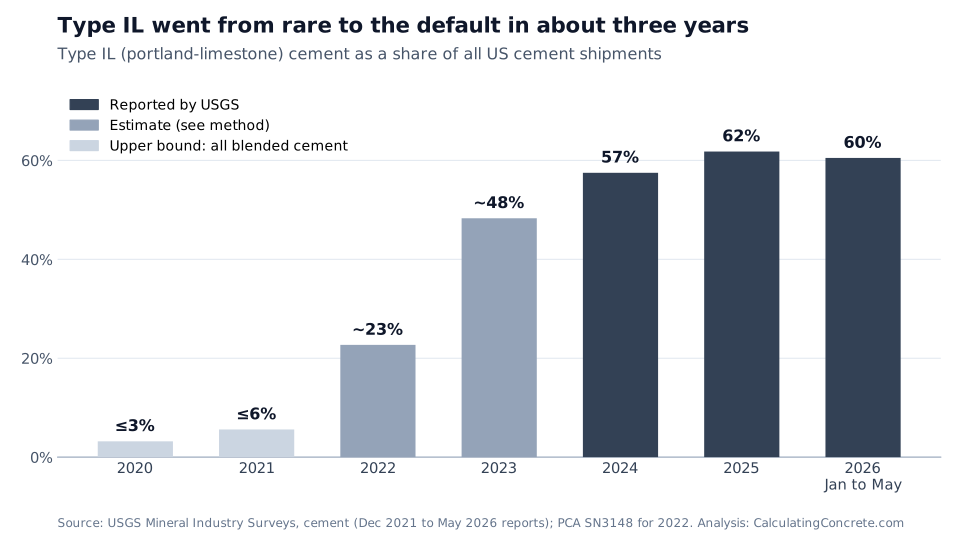
The cement in most of the ready-mix poured in North America changed over the last few years. It's called Type IL, or portland-limestone cement, and it now makes up about 6 in 10 tons of cement shipped in the US. In controlled tests it holds up as well as the old stuff. On real driveways, some crews and homeowners are watching new concrete flake apart after one winter. Both things are true. Type IL didn't make concrete weaker. It made the process less forgiving, and the margin it took away is the margin a lot of residential pours were quietly relying on. The fix is mostly in how you order, place, cure and treat the slab, and you can control most of that before the truck shows up.
What changed in the cement
Ordinary portland cement has always been allowed a little limestone, up to 5%, under ASTM C150. Type IL raises that to between 5 and 15%, and the number in parentheses on a mill certificate, like Type IL(10), tells you the actual percentage. The Federal Highway Administration's tech brief on portland-limestone cement says most suppliers target 10 to 12% limestone and grind the cement 10 to 30% finer to make up for it.
Why bother? Limestone doesn't need to be burned in a kiln, so swapping some clinker for it cuts emissions. FHWA puts the average reduction at 8.3%; the American Cement Association rounds it to about 10%. It also lets a plant stretch its kiln output, which matters when cement is tight.
The switch happened fast. Type IL has been in the ASTM C595 and AASHTO M240 specs since 2012, but it barely registered in the market until 2022. By April 2024, every state transportation department had approved it, with Connecticut the last to sign on. In some markets the changeover took about a year and a half: a Dallas-Fort Worth ready-mix owner told the Concrete Logic podcast his area went from about 95% Type I/II to 90% Type IL inside 18 months.
That speed matters for your driveway. Many builders and finishers didn't know the cement had changed until their concrete started behaving differently. When Kansas City station FOX4 investigated crumbling driveways in new subdivisions, a spokesperson for the local home builders association said builders only learned about the switch after the fact.
Canada has been doing this since 2008
If you're in Canada, none of this is new. The Canadian standard CSA A3001 added portland-limestone cement, sold as Type GUL, in 2008, and it went into the National Building Code in 2010, according to a Canadian durability review by Michael Thomas and Doug Hooton. By 2021 the Cement Association of Canada counted more than 10 million cubic meters of it placed, with approval from transportation ministries in eight provinces, Nova Scotia and New Brunswick among them. Canada's longer track record is one of the better arguments that the cement itself isn't the whole story.
Lab vs field: why both sides are right
Read the industry literature and Type IL is a non-event. Read a contractor forum and it's a disaster. The gap makes sense once you line up what each side actually measured.
| Question | Controlled studies | Field reports |
|---|---|---|
| Freeze-thaw durability | Durability factors of 98 to 104%, the same as portland cement, in Canadian lab work. Over 900 lane miles of highway in Colorado, Utah and Oklahoma, the oldest from 2007, performing as well as or slightly better than portland after about a decade, per the National Concrete Pavement Technology Center. | New driveways flaking after one winter in Kansas City and in a steady stream of homeowner posts on Reddit. |
| Salt scaling | Mixed but always within limits. In one Canadian test series Type IL scaled less than portland (10 vs 40 g/m²); in data cited by a 2025 PCI Journal review it scaled more (113 vs 52 g/m²). Both are far under typical Canadian specification limits of 800 to 1,000 g/m². | Contractors on a contractor-run complaint site describe spalling two to three years after placement. |
| Bleed water | Lower and slower. In a lab study cited in Concrete International, limestone cements bled at about half the rate of Type I. | 39% of surveyed contractors saw reduced bleed and 31% saw more surface crusting. |
| Set time | About 10% shorter on average (FHWA). | 51% of surveyed contractors saw longer setting. An industry presentation put the range at an hour faster to two hours slower. |
| Finishing | "As well or better" than portland, says a 2023 industry technical summary. | 45% reported harder finishing and 43% more plastic shrinkage cracking. |
The contractor numbers come from a survey of 173 people by the American Concrete Institute and American Society of Concrete Contractors, published in January 2024, mostly about trowel-finished slabs. It's the best data anyone has collected from the field, and 77% of respondents said the concrete needed more water to place.
Here's the part both sides tend to skip. Lab specimens are mixed to spec, finished at the right moment and cured perfectly. Highway paving is machine-placed, tested on site and inspected. A residential driveway is often none of those things: hand-finished on a hot or windy afternoon, nobody checking air content, maybe a little water added at the chute to make it easier to work. The lab and the highway prove the material can perform. The driveway shows what happens when the process has less slack in it. As the Michigan Concrete Association put it in a 2025 presentation on Type IL and scaling, finish too early and you trap water under the surface; finish too late and you're working a dried-out top.

The Concrete Logic podcast summed up the contractor-side view well in June: Type IL exposed the bad habits the industry was already tolerating. That's a fair read. It's also cold comfort if your driveway is the one that got exposed.
How scaling actually happens
Scaling is when thin flakes come off the top of a slab, leaving pits and exposed stone. It's different from cracking. The concrete underneath is usually sound; what fails is a weak skin a few millimeters thick.

Three things make that skin weak:
- Extra water at the surface. Water added at the truck, sprayed on to help finishing (crews call it "blessing" the slab), or bleed water worked back in. The Michigan Concrete Association's rule of thumb is that each extra gallon per cubic yard costs about 200 psi and raises permeability by around 50%.
- Finishing at the wrong moment. Too early seals water under the surface. Overworking also drives out the tiny entrained air bubbles that give freezing water somewhere to go.
- Poor curing and early salt. A slab that dries out too fast in its first days never builds a strong surface. One that sees deicers before it has had time to dry out gets saturated, freezes, and pops.
Weather adds pressure. A 2023 brief from the National Concrete Consortium tied a run of Iowa scaling problems to three things at once: portland-limestone cement, a loss of experienced finishers, and 18% more freeze-thaw cycles in Des Moines than in the 2006 to 2007 winter. No single cause, in other words. Stack enough small problems and the surface gives.
The Five Margins
If Type IL takes away some forgiveness, the job is to add it back somewhere else. We break that into five margins. You won't control all five yourself, but you can ask for every one of them in writing.

- Mix. Air-entrained concrete is the single biggest defense against freeze-thaw damage. Ask for it by number, along with strength and water-cement ratio. More on this in the order sheet, and our guide to concrete PSI explains the strength side.
- Water. No water added on site. If the mix is too stiff, the fix is a water-reducing admixture from the plant, not the hose. Ask that any water added be written on the delivery ticket.
- Timing. Exterior slabs get a broom finish after the bleed water has gone, with no steel trowel. On hot, dry or windy days, an evaporation retarder sprayed on the surface buys finishers time. The ACI field guide suggests starting at fairly low evaporation rates with Type IL.
- Cure. A pigmented curing compound applied right after texturing, with full coverage. The Michigan association's slide on this is in all caps: spray within 30 minutes of texturing. A National Concrete Consortium brief says the coverage should look "as white as a sheet of paper." Our concrete cure time guide covers the timeline.
- First winter. Let it dry. The Portland Cement Association's guidance is about 7 days of curing followed by 30 days of air drying before deicers; the Michigan bulletin written for Type IL asks for at least 40 days and flags October and November pours as the riskiest.
What to write on your concrete order
Most homeowners never see the concrete order. The contractor calls the plant and asks for a "driveway mix." That phrase means different things at different plants, so the most useful thing you can do is put the specs in your contract and ask the contractor to order to them. If you're getting quotes, run the numbers through our driveway calculator and driveway cost calculator first so you know roughly how many yards you're buying.
Here's the order we'd put in writing for a driveway, garage apron, walkway or patio that will see snow and salt.
US order sheet
Exterior flatwork, freeze-thaw with deicer exposure
Compressive strength: 4,000 psi minimum at 28 days
Air entrainment: 6% target, 5 to 8% acceptable (3/4 in. stone)
Maximum water-cement ratio: 0.45
Slump: about 4 in.; no water added on site (use a water reducer if needed)
If fly ash or slag is used: fly ash 25% max, slag 50% max of total cementitious
Delivery ticket to show: cement type, air content, and any water added
Air test (ASTM C231) on the first truck, please
Canada order sheet
CSA A23.1 exposure class C-2 (driveway, garage apron, sidewalk, exterior steps)
Compressive strength: 32 MPa at 28 days
Maximum water-to-cementing materials ratio: 0.45
Air content: 5 to 8% (20 mm aggregate)
No water added on site
Delivery ticket to show: cement type (GU or GUL), air content, water added
The Canadian numbers follow the C-2 class as summarized by Omega Ready Mix's guide to CSA A23.1:24 exposure classes. Ask your supplier to confirm against the current standard.
Why these numbers, when every source says something different
Here's what nobody else tells you: the official guidance doesn't agree with itself. Residential codes set minimums, structural codes set stricter ones, and industry groups land somewhere in between. We lined them up.
| Source | Strength | Air content | Max water-cement ratio | Deicers |
|---|---|---|---|---|
| International Residential Code, Table R402.2 (as adopted in Minnesota; porches, steps, garage floors; severe weathering) | 3,500 psi | 5 to 7% | Not set | Not addressed |
| NRMCA CIP 2 (ready-mix industry) | 4,000 psi | About 6% | Not set | Avoid the first winter if possible; never ammonium or magnesium; calls calcium chloride and rock salt acceptable |
| PCA IS177 (cement industry) | 4,000 psi before freezing | 5 to 8% | 0.45 | None the first winter for late-season pours |
| ACI 318, class F3 (structural code, freeze-thaw with deicers) | 5,000 psi | 6% (3/4 in. stone) | 0.40 | Assumes deicer exposure |
| Michigan Concrete Association (Type IL bulletin) | 4,000 psi | 5 to 8% | 0.45 | Minimize for a year; never calcium or magnesium |
| CSA A23.1 class C-2 (Canada) | 32 MPa (about 4,640 psi) | 5 to 8% | 0.45 | Not addressed |
Our order sheet takes 4,000 psi because it's where the flatwork-specific guidance converges, and it's a common ready-mix product. It adds the 0.45 water-cement cap because a strength number alone doesn't stop someone adding water at the chute. The structural code's deicer class asks for more (5,000 psi and 0.40), so if your budget allows a stronger mix, it buys extra margin. The calcium chloride split is real: the ready-mix association calls it acceptable, the Michigan group says never, and a Wisconsin DOT study ranked it between rock salt (least harmful) and magnesium chloride (most harmful). We'd stick with sand the first winter and plain rock salt, sparingly, after that.
Questions to ask your contractor before the pour
- Which plant is the concrete coming from, and will you order it to these specs?
- Is it Type IL? Has your crew poured Type IL exterior work through a winter here, and how did it hold up?
- Who checks air content on site? Will you test the first truck?
- What's your policy on adding water at the truck?
- How do you decide when to start finishing? (You're listening for "after the bleed water is gone," not a clock time.)
- What curing method do you use, and when does it go on?
- If the forecast is hot, windy or near freezing, will you reschedule?
- What does your warranty say about surface scaling, and for how long?
A good contractor won't be offended by any of these. For more on what happens when the truck arrives, see our guide to ready-mix delivery.
Pouring this fall? The First Winter Calculator
Late-season pours are where scaling claims cluster. A homeowner in Michigan described pouring in the third week of October, about a week before freezing nights, then asking pros about surface scaling the next spring. Enter your dates to see whether your slab gets enough drying time before the first salt.
First Winter Calculator: subtract your pour date from the first day salt is likely to touch the slab. 40 days or more meets both the PCA (37-day) and Type IL (40-day) targets. Fewer than 37 days means plan a no-salt first winter or wait for spring.
Targets: the Portland Cement Association recommends about 7 days of curing plus 30 days of air drying before deicers. The Michigan Concrete Association's Type IL bulletin asks for at least 40 days. This calculator assumes the slab was cured properly; it can't account for weather, mix or workmanship.
Short on days? You have three real options: pour in the spring, commit to a no-salt first winter (sand for traction, shovel early, and keep slushy tires off it where you can), or both. Road salt tracked in on tires counts as salt.
Already flaking? Finding the cause before arguing about who pays
If you're reading this after the fact, you're in good company. One r/Concrete thread about a driveway crumbling at 18 months drew close to 200 comments. The owner said no salt was used; commenters split between Type IL, low air content and salt. The contractor looked at it briefly and declined responsibility. That pattern, where everyone has a theory and nobody pays, shows up again and again. A Canadian homeowner described a slab poured in June and spalling nine months later with only sand used on it. On the other side, an inspector who oversaw about 60 miles of 2023 freeway paving with Type IL said none of it looked like that and blamed workmanship.

What a petrographic exam tells you
Petrography means a lab cuts a core from your slab and examines it under a microscope. It can show the air-void system, signs of extra water at the surface, and how the top was finished. In an April 2026 Concrete International viewpoint, petrographer Dipayan Jana argued that the same scaling symptoms can come from slag, excess air or finely ground Type I/II cement, not only Type IL, and that petrography is how you tell them apart. If real money is at stake, it's the evidence that holds up.
Who usually pays
Ready-mix suppliers generally say their responsibility ends when the concrete leaves the truck, and contractors on the contractor complaint site say they've been left holding the liability. One reported replacing three driveways poured in 2024 with the supplier covering material but not labor. Your best evidence is paperwork: the contract specs, the delivery tickets, photos of the pour day, and the date you first used any deicer.
Repair or replace?
Light scaling on an otherwise sound slab can be cleaned and sealed with a penetrating silane or siloxane sealer, which slows further damage. Widespread scaling is harder. In a Garage Journal thread from May 2026 about a porch spalling after years of calcium chloride, replies were split: some suggested capping it with stone or tile, and the ones who weighed in on resurfacers said to cut it out and replace it rather than trust a thin topping. If you're weighing it, our driveway resurfacing cost guide and the concrete vs asphalt comparison will help you price both paths.
Myth vs evidence
Some of the scariest numbers about Type IL circulate without a source. Here's what we could and couldn't trace.
| Claim | What we found |
|---|---|
| "Type IL is weaker." | It has to meet the same strength and set requirements as portland cement under ASTM C595. Early strength can lag in some mixes; a contractor on r/Concrete reported about 50 days to reach design strength. That's a mix design problem worth testing for, not proof the cement is weak. |
| "You need 20% more cement." | Comes from testimonials on the contractor complaint site. We found no published study measuring it. The underlying idea is plausible, since 77% of surveyed contractors saw higher water demand, but the 20% figure is unverified. |
| "Cracking is up 10x." | Same source, no data behind it. |
| "20 to 30% of investigated cases fail, according to NIST and OSHA." | Repeated on at least one industry blog. We couldn't trace it to any NIST or OSHA publication. |
| "Type IL causes scaling." | Lab tests and highway sections say no difference on average, though one data set showed more scaling with Type IL (still within limits). Field complaints are real but tangled up with water, finishing, curing, weather and salt. Fairest summary: it narrows the margin for error. |
| "A sealer will fix it." | A penetrating sealer helps protect sound concrete. It can't fix a weak skin, and an Alberta contractor on the complaint site reported peeling even on sealed slabs. |
| "It's all the finisher's fault." | Not fair either. Finishers inherited a material that behaves differently, often without being told, and the ACI survey shows real changes in bleed and set time. |
Can you still get Type I/II, and is it worth it?
Sometimes. In 2025 roughly a third of US cement shipped was still not blended, per USGS figures, though that share varies a lot by region and much of it goes to specific jobs. In June a Texas ready-mix owner told the Concrete Logic podcast that producers are moving Type I/II back into some markets, possibly because customers want it or because of cost. He named no producer, and we couldn't confirm any plant publicly switching back. Bagged portland cement is still sold for small jobs; if you want Type I/II, check the bag for "ASTM C150 Type I/II" rather than C595.
Is it worth chasing? If your local plant offers it at a similar price, it removes one variable. But it won't save a slab that gets water added, finished too early or salted in November. And as the petrographer quoted above points out, finely ground Type I/II can produce the same scaling symptoms. We'd spend the effort on the Five Margins first and treat the cement type as a bonus.
How we built the chart
We took annual US shipments of portland and blended cement, imports included, from the December issues of the USGS Mineral Industry Surveys for cement (December 2021 to December 2025) and the May 2026 issue. For each year we used the latest revised total available.
- 2024, 2025 and 2026 (January to May): USGS reports Type IL tonnage directly (59.3, 62.7 and 23.9 million tons). We divided by total shipments.
- 2023: USGS doesn't report a full-year Type IL tonnage, but its reports put Type IL at about 97 to 98% of blended cement that year. We applied 97% to blended shipments (54.2 million tons) for an estimate of about 52.6 million tons, or about 48%. Using 98% changes the result by less than a point.
- 2022: USGS doesn't break out Type IL. We used the Portland Cement Association's figure of about 24.8 million tons consumed, from its 2024 PLC research report, which is a consumption measure rather than shipments.
- 2020 and 2021: Type IL isn't reported, so the bars show all blended cement as an upper bound (3.2% and 5.6%).
2025 figures are preliminary, and the 2026 figure covers five months only, so it isn't directly comparable with full years.
Community material in this guide comes from public Reddit threads, the Garage Journal forum and the contractor site 1lcementproblems.com. It's anecdotal by nature, and we've linked each thread we drew on so you can read it yourself.
Have a Type IL story, good or bad? Tell us. We'll update this guide as new research and USGS data come out.
Frequently asked questions
Is Type IL the same as Type 1L?
Yes. The "L" stands for limestone. You'll see it written Type IL, Type 1L, PLC, or in Canada, GUL.
How do I know if my concrete has Type IL in it?
Ask for the delivery ticket or the plant's mix submittal. Nationally, the odds have been better than even since 2024, and in many regions they're much higher than that.
Is Type IL concrete OK for a driveway?
Yes, if it's air-entrained, placed without added water, finished at the right time, cured and kept from early salt. Those conditions mattered with the old cement too; they just matter more now.
Why is my new driveway flaking after one winter?
Usually a weak surface layer meeting water, freeze-thaw and salt. Check the delivery tickets for added water and air content, think about when salt first touched it, and use the decision tree above.
When should I seal a new driveway?
Penetrating silane or siloxane sealers are the common recommendation for exterior slabs, applied once the concrete has cured and dried, following the product label. Our concrete sealing guide covers products and timing.
Is it too late to pour a driveway in October?
Not automatically, but run your dates through the calculator above. If you can't get 30 to 40 drying days before salt, plan a no-salt first winter or wait until spring.
Does Canada have the same problem?
Canada has used portland-limestone cement since 2008 and has a longer field record. Scaling happens there too, for the same reasons: water, timing, curing and salt.