The History of Concrete: Why a 1937 Sidewalk Outlasts Your New Driveway
Old concrete mostly isn't better concrete. It's surviving concrete. The 1937 sidewalk outside your grandmother's house is still there for five reasons: the bad slabs from that era were torn out long ago, the cement set slowly, there was almost no road salt, crews kept pours stiff and wet, and there was no steel inside to rust. Your new driveway gets none of those breaks. John Wilson's film The History of Concrete visits America's oldest concrete street and the world's oldest concrete in Rome, but it's a funny, personal film, not a materials lecture. This is the science behind what you see on screen, with sources, and what to ask for so your next slab lasts like a WPA sidewalk.
The short answer
In August 2026, a post in r/Concrete described a 1937 WPA sidewalk, dated plaque and all, sitting almost flawless after roughly 90 New England winters, next to a city patch about ten years old that was falling apart. It drew 522 upvotes and more than a hundred replies many of them from people in the trade. (The subreddit's moderation bot later pulled it as a homeowner question, so the live link may show it as removed.) The top answer, at 829 points, was two words long in spirit: survivor bias.
That's the right place to start, but it isn't the whole story. The cement in a 1937 sidewalk was a different product from the cement in a 2026 driveway. The 1937 slab spent its first decades in a country that barely salted its roads. It was poured stiff by crews paid to babysit it, and it had no steel in it. Every one of those differences is documented, and every one of them points the same way.
What follows is a short history of how we got here, the five factors that explain the gap, and what you can actually control when you order your own concrete.
A history of concrete in nine dates
People have been making lime and pozzolan concretes for thousands of years, and the Romans built the Pantheon's dome with one. The material in your driveway is much younger. Here are the dates that matter for the old-versus-new question.
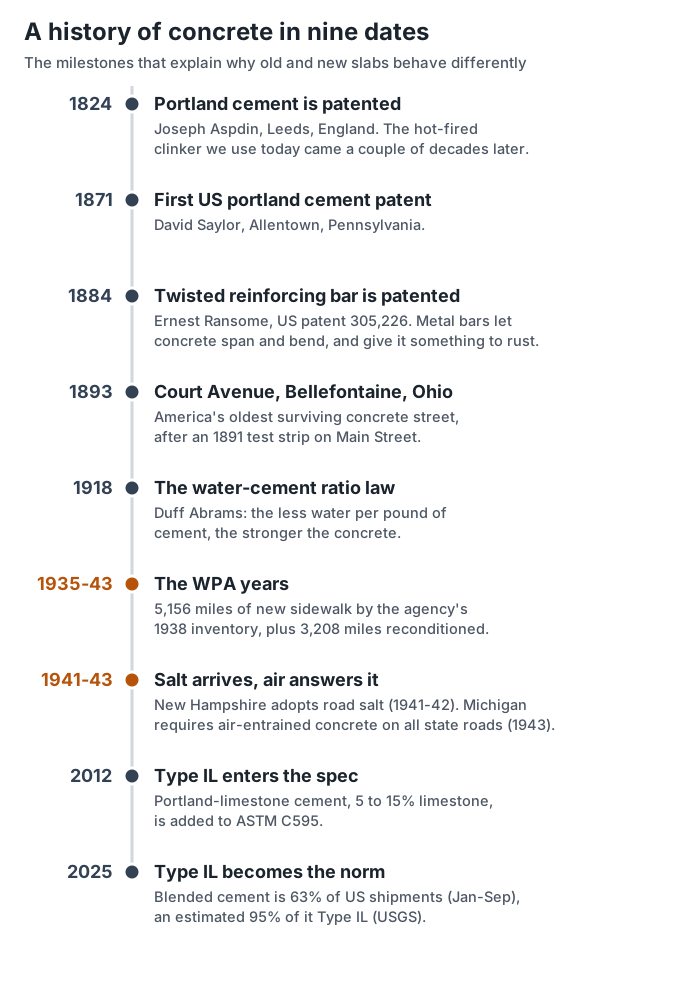
1824. Joseph Aspdin, a bricklayer from Leeds, took out British patent No. 5022 for "an improvement in the modes of producing an artificial stone." He called it portland cement because it looked like Portland stone. Britannica's history of cement credits the hotter-burned clinker that's closer to today's product to the following decades, so "invented in 1824" is a slight flattening.
1871. David Saylor of Allentown, Pennsylvania, received US patent 119,413 for burning limestone "to incipient vitrification" to match imported portland cement.
1884. Ernest Ransome patented a twisted iron or steel bar for embedding in concrete so it would grip. Reinforcing steel is what lets concrete span, bend and get thinner. It's also, eventually, the thing that rusts.
1893. Court Avenue in Bellefontaine, Ohio, was paved in concrete after cement maker George Bartholomew laid a short test strip on Main Street in 1891. It's a national civil engineering landmark, and Wilson's film pays it a visit. Hold that thought for the survivor section.
1918. Duff Abrams at the Lewis Institute in Chicago published the finding every concrete tech still learns first, later restated in his 1927 ACI paper: for workable concrete, strength and durability are governed by how much water you use per unit of cement. Less water, better concrete.
1935 to 1943. The Works Progress Administration put millions of people to work, and a lot of that work was concrete. By the agency's own 1938 inventory, it had built 5,156 miles of new sidewalk, reconditioned 3,208 more, and laid 4,480 miles of new curb. You'll see "24,000 miles of sidewalk" quoted online; we couldn't trace that figure to any WPA document, so we don't use it.
1941 to 1943. New Hampshire became the first state with a general road salt policy in the winter of 1941-42, and the whole country used just 5,000 tons that season, according to the Transportation Research Board's Highway Deicing report. Meanwhile engineers had noticed, by accident, that some cements with grease or oil in them resisted freeze-thaw scaling much better. That turned into air entrainment, and Michigan made it mandatory on all state pavements in 1943.
2012. Portland-limestone cement, Type IL, with 5 to 15% ground limestone, was added to ASTM C595 and AASHTO M 240, according to the Federal Highway Administration.
2025. Blended cements made up 63% of US cement shipments in the first nine months of the year, and an estimated 95% of that was Type IL, per the USGS Mineral Commodity Summaries 2026. If your driveway went in recently, it almost certainly has Type IL in it.
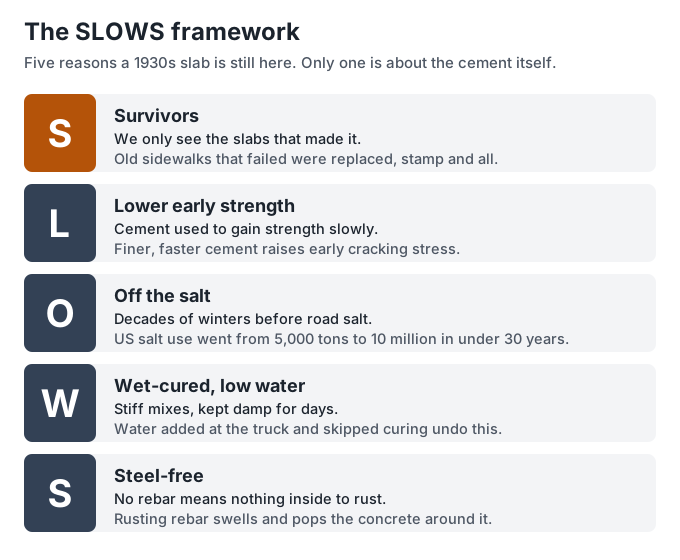
The SLOWS framework: five reasons old slabs are still here
When you put the research and the trade's own explanations side by side, they sort into five factors. We call it SLOWS, partly as a memory aid and partly because "slow" is the common thread. Old concrete set slowly, was cured slowly and aged slowly in a gentler world.
S: Survivors
Every old slab you can still see is a winner. The losers were jackhammered out decades ago and replaced, and nobody photographs a sidewalk that no longer exists.
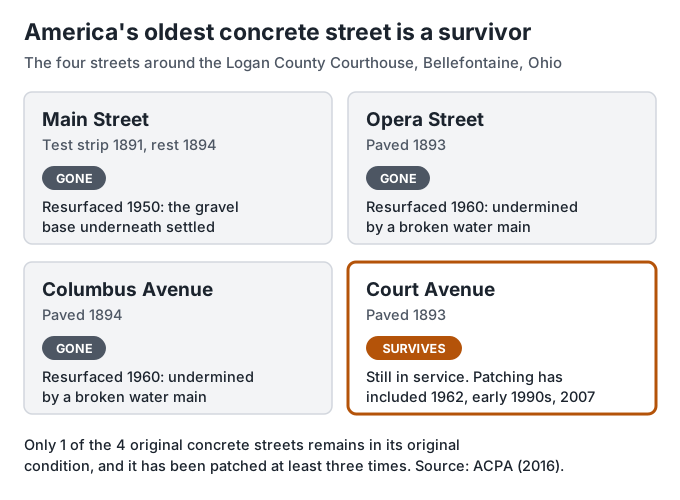
Bellefontaine is the cleanest example we found, because its records are good. Four streets around the Logan County Courthouse were paved in concrete between 1891 and 1894. According to the American Concrete Pavement Association's 125th anniversary program, Main Street was resurfaced in 1950 because its gravel base settled, and Opera Street and Columbus Avenue were resurfaced in 1960 after a broken water main undermined them. Court Avenue is the only one still in original condition, and even it has had concrete patching over the years, including in 1962, the early 1990s and 2007.
The same thing shows up with WPA sidewalks. When Chicago public radio station WBEZ looked into who built the city's WPA sidewalks, it found that a stamp that survives has likely been protected by a bridge or overpass, or sits on a less-traveled path. The obvious inference is that busy, exposed sections took the abuse and got replaced, stamp and all.
Survivor bias doesn't mean old concrete was bad. The 1930s produced plenty of good slabs. It means the sample you walk past every day was filtered for you, and a fair comparison would need the failure rate of 1937 pours, which nobody kept.
L: Lower early strength
This is the one where the concrete itself really did change. Through the 20th century, cement makers ground cement finer and raised the content of the fast-reacting compound C3S, because contractors wanted forms stripped and floors loaded sooner. The American Concrete Institute's own FAQ says the result is that an ordinary Type I cement today behaves much like the high-early-strength Type III of earlier decades.
Faster isn't free. NIST researchers wrote in 2011 that cements have become "progressively finer" over the past 50 years and that the extra early heat can bring thermal cracking and lower ultimate strength, particularly in massive pours. A separate 2008 NIST study on cement fineness warned that the industry's focus on early strength may be producing cements more prone to early-age cracking.
Concrete scientists P. Kumar Mehta and Richard Burrows made the broader argument in a 2001 Concrete International article, "Building Durable Structures in the 21st Century": a century of building for speed favored high-early-strength concrete, and the structures crack too much and wear out too early as a result. Burrows had laid out the evidence three years earlier in his 1998 ACI monograph, The Visible and Invisible Cracking of Concrete.
The plain-English version: a concrete that gains its strength slowly also builds up internal stress slowly, and has more time to accommodate it. A 1930s sidewalk was made with cement that was in no hurry.
O: Off the salt
A sidewalk poured in 1937 got four winters before any state had a road salt policy, and about 18 before national use reached a million tons a year. Then the curve went nearly vertical.
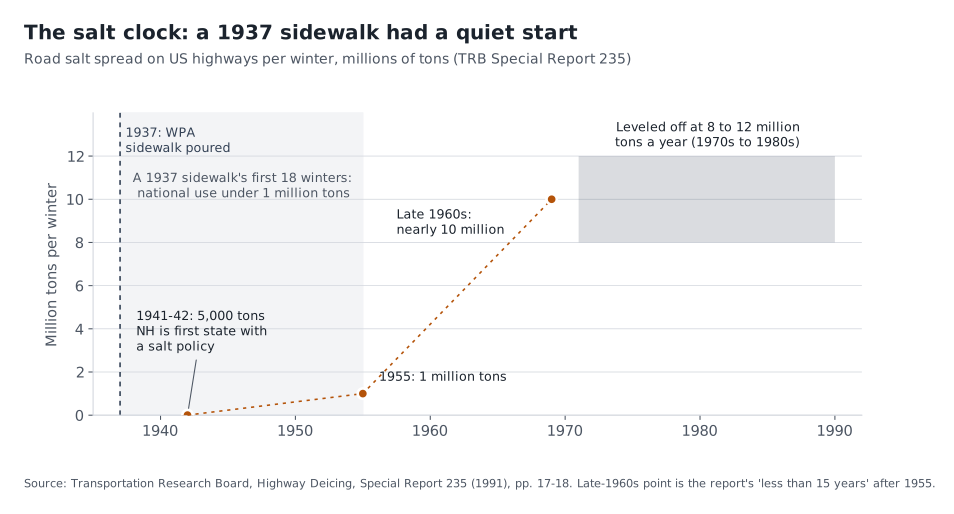
The TRB report puts it in numbers: 5,000 tons in the winter of 1941-42, 1 million tons by 1955, and nearly 10 million tons less than 15 years after that, driven by the postwar push for bare pavement. By 2014 the US was spreading about 24.5 million metric tons of rock salt for deicing, according to USGS figures compiled by the American Geosciences Institute.
Salt hurts concrete two ways. On the surface, salty meltwater soaking a weak top layer through freeze-thaw cycles makes it flake, which is called scaling (our Type IL post covers this in detail). Deeper down, chloride reaches any steel and starts it rusting. The TRB found that unprotected bridge decks in heavily salted northern cities reached the corrosion threshold in 10 to 15 years.
Your driveway sees salt from your own bag and the slush off your tires, often in its very first winter. The WPA sidewalk got a couple of decades to mature first, and a mature, dense slab resists salt far better than a young one.
W: Wet-cured, low water
Abrams' rule from 1918 still holds: water you add to make concrete easier to place is water that weakens it. The National Ready Mixed Concrete Association's guidance on adding water on the jobsite says about a gallon per cubic yard raises slump by roughly an inch, and that no water should go in once the mix's maximum water-cement ratio or maximum slump has been reached.
In practice, water gets added anyway. A July 2026 r/Concrete thread asking why truck drivers add water collected the reasons straight from batchers and drivers: loads that lose about an inch of slump on a half-hour drive, finishers who ask for it wetter so it's easier to work, and drivers who once had a load set up in the drum and have been nervous about stiff loads ever since.
The other half of W is curing. Concrete needs moisture to keep hydrating, and a slab that dries out in its first days ends up with a weaker, more porous top. The WPA existed to create jobs, so labor was the one thing it had plenty of. One commenter in the WPA thread described those pours as designed around manpower: carefully chosen aggregate, no rebar, and crews keeping the slab wet for about a week, which nobody could afford to pay for today. We couldn't find a WPA curing spec to confirm the "week," so treat it as trade lore that fits the evidence. Either way, the slab that gets a real cure is the one that lasts. Our concrete cure time guide has the timings.
S: Steel-free
Most WPA sidewalks were plain concrete, and plain concrete has no steel inside to rust. When rebar or wire mesh corrodes, the rust takes up more room than the steel did, and it pushes the concrete around it apart. That's the spalling you see on old parking garages and bridge railings.
It's an expensive problem. An FHWA-funded 2002 study put the direct cost of corrosion in the US at $276 billion a year, and a later FHWA report estimated that corrosion of highway bridges alone costs $8.3 billion a year in direct costs.
The point comes up again and again in online arguments about Roman concrete. In a 2023 r/todayilearned thread with more than 16,000 points, a reply with more than 2,000 points made exactly this argument: put steel in Roman concrete and it would have deteriorated too. Steel is a trade-off we make on purpose. It lets us build thinner and longer, and it holds cracks together, but it gives the slab a built-in way to fail.
What 97 concrete pros said
To see how the trade itself explains the gap, we read every comment in that August 2026 r/Concrete thread and coded each substantive one by the explanation it gave. Ninety-seven of them made at least one argument. Here's how they split.
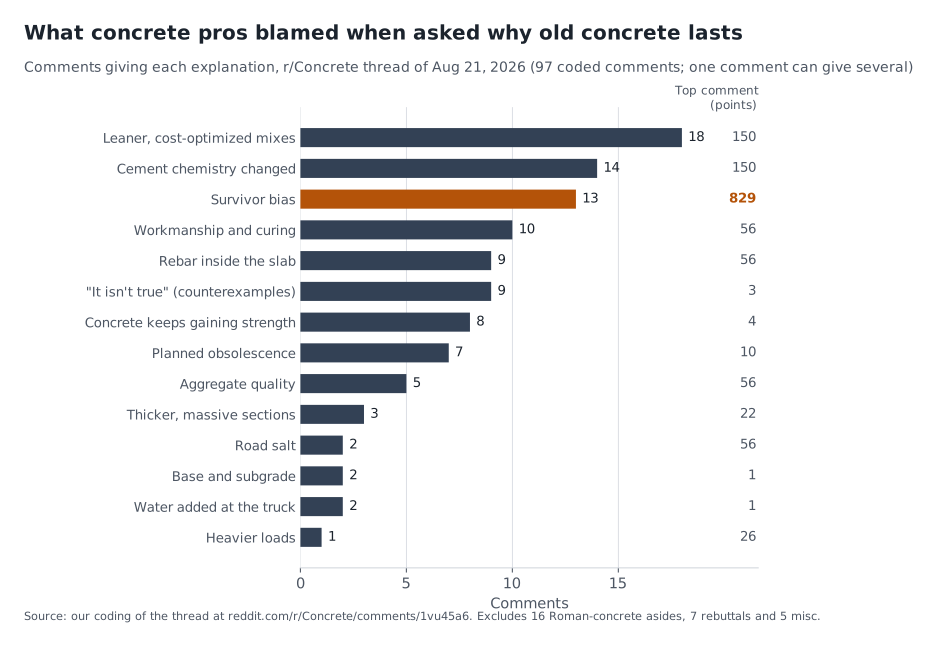
Two things stand out. First, survivor bias wins the vote, but leaner mixes win the count. The most convincing version of the lean-mix argument came in a 150-point reply: cement plants now have much tighter quality control, so mix designers can trust it and cut cement content down to just what the spec needs. When cement quality varied, everyone added extra for the bad days, and that extra made old concrete tougher than it had to be. A 103-point reply put it more bluntly: nobody wants to pay for 6,000 psi sidewalks when 3,000 psi will suffice.
Second, the people with inside knowledge mostly agreed. One commenter said they'd been a technical manager at a large supplier and that their bonus was tied to cement savings in mix designs. Another said lower-grade mixes now get enough testing to strip cement out and still just pass.
The thread wasn't one-sided. Nine comments pushed back with counterexamples: a 1930s foundation that crumbles by hand, an almost 100-year-old garage slab falling apart, and cores pulled from a spalling 1937 bridge where the best result was 700 psi. Old concrete failed too. You just don't see it anymore, which brings us back to S.
What's notable is what the pros barely mentioned. Only two comments brought up road salt, which the historical record suggests is one of the biggest differences of all.
Roman concrete: not stronger, just different
Every conversation about old concrete ends up in Rome, and the film goes there too. The Pantheon's unreinforced dome has stood for about 1,900 years, and Roman harbor structures have sat in seawater for two millennia. So is Roman concrete better?
It's more durable in the specific places it was used, and it's much weaker. When researchers cored a first-century BC Roman harbor structure at Santa Liberata, Italy, the samples tested at 7.5 to 8.5 MPa, about 1,100 to 1,230 psi. A modern replica made to Vitruvius' recipe reached only 3.5 to 5.6 MPa after a year.
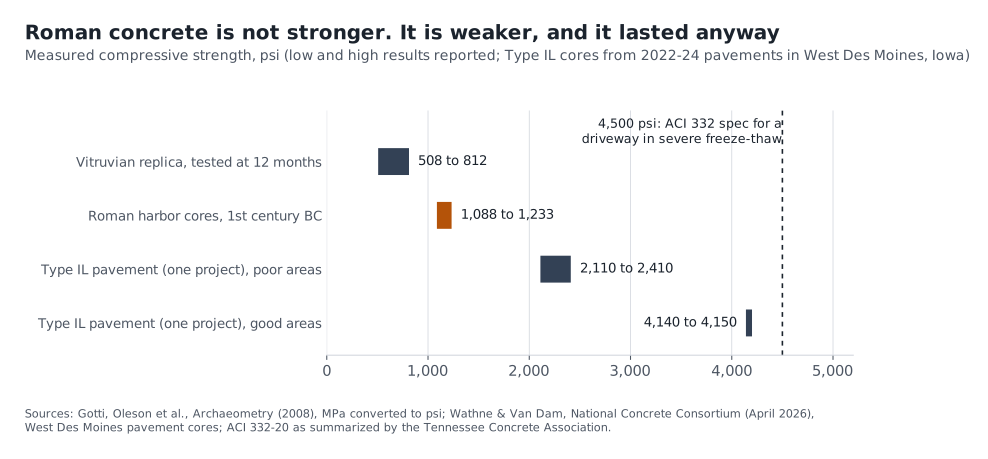
So why does it last? Three reasons have real research behind them.
- Seawater makes marine Roman concrete stronger over time. A 2017 study led by geologist Marie Jackson found that seawater percolating through harbor concrete grows interlocking minerals, aluminous tobermorite and phillipsite, that resist cracking. That depends on specific volcanic ash, and it's slow.
- Lime lumps that heal cracks. An MIT-led team showed in 2023 that Romans likely mixed with quicklime ("hot mixing"), leaving lime clasts that can seal cracks within about two weeks in lab samples. In December 2025 the same group published evidence from an unfinished construction site at Pompeii confirming the method, which departs from what Vitruvius described.
- No steel and compression-only shapes. Arches and domes keep the material squeezed, which is what concrete is good at, and there's nothing inside to rust.
Why don't we just use it? Because it's weak, it gains strength slowly, it needs particular ash, and it can't carry the tension that modern slabs, beams and bridges need. MIT's Admir Masic, who led both studies, has said the aim is to borrow a few ideas from the Roman approach, not to copy it.
One more myth to retire. You'll often read that modern concrete "only lasts 50 years." The phrase seems to trace to a 2013 Berkeley Lab news release noting that many mid-century structures were designed to last 50 years. That's a design target for those structures, not a measured lifespan for concrete in general.
What modern concrete does better
Nostalgia makes this easy to forget, so here it is plainly. In several ways, today's concrete is the better material.
- Air entrainment. The microscopic air bubbles in modern exterior concrete give freezing water somewhere to go. The discovery came by accident in the early 1930s, when engineers noticed that cement contaminated with grinding aids like beef tallow scaled less, according to a Texas Transportation Institute literature review. Most WPA concrete predates it. In a freeze-thaw climate, an air-entrained modern slab has a real advantage over a 1937 one poured the same way.
- Consistency. The tighter quality control that lets producers trim cement also means fewer truly bad loads. You're less likely to get a dud batch than your grandparents were.
- Strength. As the chart above shows, modern concrete is far stronger, and it can be designed to a target.
- Knowledge. We know why concrete fails now: salt, freeze-thaw, corrosion, poor base, bad joints. The FHWA describes concrete highway pavements built to last 40 years or more when they're designed and built for it.
The problem usually isn't that we can't make durable concrete. It's that most residential concrete isn't ordered, placed or cured as if durability were the goal.
Where today's complaints are fair
Mixes are designed to the minimum. This is the pros' own top complaint, and it's real. A mix that just meets 3,000 psi at 28 days on paper has little margin for a hot day, an extra splash of water or a skipped cure.
Type IL made finishing less forgiving. The cement swap is the newest suspect, and the evidence is mixed rather than damning. The FHWA found Type IL performs comparably to ordinary portland cement at 28 days when it's ground to the right fineness, with similar freeze-thaw and scaling results, but it may bleed more slowly, which can trap water under a surface finished too early. About half the contractors in ASCC's 2023 surveys reported no new problems with interior slab mixes. The best measured field data we found, from 2022 to 2024 pavements in West Des Moines, included one project where cores from poor areas came in at roughly half the strength of cores from good areas, and the researchers concluded the cement wasn't "wrong" but that finishing and curing practice has to adapt. Indiana has since capped limestone at 10% on state work, and the American Cement Association says the cap lacks technical justification. Our Type IL post goes through all of it.
Residential slabs are thin and fast. A WPA sidewalk carried feet. Your driveway carries cars, delivery trucks and sometimes a loaded concrete truck. It's often poured 4 inches thick over a base nobody compacted, finished the same afternoon, and salted within months.
Base and joints get skipped. Remember Bellefontaine's Main Street: its concrete didn't fail, its gravel base settled. Base prep and joint spacing are where a lot of modern slabs are won or lost.
How to pour a slab that lasts like 1937
You can't un-invent road salt or order 1930s cement. You can recreate most of the SLOWS advantages with a few lines on your concrete order and a few rules on pour day. For an exterior slab in a freeze-thaw climate, the American Concrete Institute's residential code, ACI 332, as summarized by the Tennessee Concrete Association, calls for 4,500 psi concrete, 6% air content (plus or minus 1.5%) and a maximum water-cement ratio of 0.45.
- Order air-entrained, low-water concrete. Put the strength, air content and maximum water-cement ratio in writing. Our concrete psi guide explains the numbers. (Answers the L and W.)
- No water at the truck unless it's on the ticket. If the crew needs more workability, a water-reducing admixture is the usual fix, and it doesn't carry the strength penalty. (W)
- Build a real base. Compacted, well-drained granular base under the whole slab. Our gravel under slab calculator works out the tonnage. (The lesson of Main Street.)
- Cut joints on time and close enough. NRMCA's guidance on joints in slabs on grade is spacing of 24 to 36 times the slab thickness, 15 feet at most, cut at least a quarter of the way through.
- Finish at the right time, then cure it. Don't finish while bleed water is still on the surface, and make sure the slab is thoroughly cured, per the Pennsylvania Aggregates and Concrete Association. Our cure time guide covers wet curing and curing compounds. (W)
- No salt the first winter. The Tennessee Concrete Association's ACI 332 summary and the PACA both say no deicers in year one. Use sand for traction. (O)
- Decide on steel deliberately. Rebar or mesh holds cracks tight but can corrode if it ends up near the surface. If you use it, make sure it's supported in the slab, not stepped into the dirt. See our rebar and reinforcement guide and rebar calculator. (S)
Sizing a pour? The sidewalk calculator and driveway calculator give you yards to order, with the extra you'll want so nobody is tempted to stretch a short load with water.
How we built the pro tally
We pulled the full comment tree of the r/Concrete post "(Opinion) Why is old concrete so much more resilient than modern concrete?" (August 21, 2026, 522 points) from the Arctic Shift Reddit archive on October 6, 2026, merging oldest-first and newest-first pages to about 160 unique comments (more than the 111 the archive recorded when it first captured the post). We dropped bot notices, images, pure jokes, agreement-only replies and off-topic tangents, which left 97 comments that gave at least one explanation. Each was coded into one or more categories, so the bars add up to more than 97. Roman-concrete asides (16), rebuttals of other commenters (7) and miscellaneous causes such as tree roots (5) are counted but left off the chart. Scores are as archived and may be lower than live values. This is a snapshot of practitioner opinion in one thread, not a survey, and we treat it that way.
Salt figures are from TRB Special Report 235, which gives tons without specifying the type; the late-1960s point is the report's "nearly 10 million tons less than 15 years" after 1955. Roman strengths were converted from MPa at 145 psi per MPa.
Last updated October 6, 2026. We'll revisit this when the USGS publishes 2026 cement-type shares, when the National Concrete Consortium releases its Type IL survey of state DOTs, and when The History of Concrete goes to streaming.
Frequently asked questions
Is old concrete stronger than new concrete?
Usually not. Modern mixes are designed to higher strengths, and measured Roman harbor concrete comes in around 1,100 to 1,230 psi. Old slabs that are still around tend to have survived for other reasons: they are the survivors of their era, their cement gained strength slowly, they spent decades before road salt was common, and most had no steel inside to rust.
Why do old sidewalks have WPA stamps?
Works Progress Administration crews often stamped the agency's name and the year into new sidewalk, and private contractors did the same with their own names. In Chicago, WBEZ found contractor stamps going back to 1904 alongside WPA stamps from the late 1930s. A stamp that survives today has often been protected by an overpass or a quiet location.
Is Roman concrete really self-healing?
In a limited sense. MIT-led research published in 2023 found lime lumps left by "hot mixing" with quicklime can seal small cracks, and cracked lab samples healed within about two weeks. That doesn't make Roman concrete stronger, and it doesn't stop it cracking in the first place.
Does modern concrete only last 50 years?
No. That figure appears to come from a 2013 Berkeley Lab release saying many mid-century structures were designed to last 50 years, which is a design target, not a lifespan. The Federal Highway Administration describes concrete pavements built to last 40 years or more when they are designed and built for it.
Should my driveway have rebar?
It's a trade-off. Rebar or mesh holds cracks tight, but it can rust if it ends up close to the surface where salt reaches it. If you use it, make sure it is supported in the slab rather than stepped into the base. See our rebar and reinforcement guide.
Why do concrete truck drivers add water?
To make a stiff load easier to place, usually because it lost slump on the drive or the crew asked for it wetter. NRMCA guidance says about a gallon per cubic yard raises slump by roughly an inch, and no water should be added once the mix's maximum water-cement ratio or slump is reached. Every extra gallon costs strength and durability.
What is The History of Concrete movie about?
It's John Wilson's first feature, a comic documentary that premiered at Sundance in January 2026 and opened in US theaters through Magnolia on September 18, 2026. Along the way it visits America's oldest concrete street in Bellefontaine, Ohio, and Roman concrete in Italy, but it's more about life than materials science.