Face of Curb vs Back of Curb
The face of curb (FOC) is the street side of a curb, the surface a tire would hit, and the back of curb (BOC) is the sidewalk or lawn side behind it. On a drawing the two are only a curb-width apart, usually 6 inches, but which one a dimension is measured to decides where the whole curb lands, so mixing them up shifts the curb by its own width.
This is a spoke of our concrete curb guide; for every profile side by side see types of curbs, and to turn a section and length into concrete use the concrete curb calculator.
What face of curb and back of curb mean
A curb has two vertical sides, and a plan names each one. The face of curb is the street side, the steep face that meets the gutter and the line most roadway plans dimension from. The back of curb is the opposite side, the one the sidewalk, planter strip or lawn sits against. Between them is the flat top of curb, commonly 6 inches wide: Oregon DOT's ADA feature definitions draw a typical 0.5 foot connection from the top face of curb to the top back of curb, which is that 6 inch top.
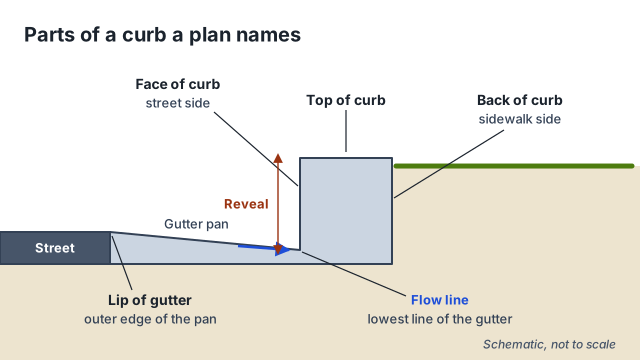
The distinction only matters because the two faces are not in the same place. A 6 inch top means the face and the back are 6 inches apart, so a curb drawn to the wrong line is built 6 inches off. That is enough to narrow a travel lane, pinch a sidewalk or throw off a curb ramp, which is why the reference is spelled out rather than assumed.
The other parts a plan labels
Face and back of curb are two of a handful of reference lines a curb-and-gutter detail calls out. The rest describe the gutter in front of the face.
- Top of curb
- The flat top between the face and the back, usually 6 inches wide. Plans often give its elevation as "TC".
- Flow line
- The lowest line of the gutter pan, where water collects and runs to the inlet. The Town of Paradise, CA curb and gutter standard labels it on its section, and it is the point most curb elevations are set from.
- Lip of gutter
- The outer edge of the gutter pan, away from the curb, where the concrete meets the roadway pavement. The same Paradise detail requires the asphalt paving next to the gutter to finish 1/4 inch above the lip of gutter.
- Reveal
- How much of the face shows above the gutter once the curb is built, measured from the flow line up to the top of curb.
Oregon DOT's definitions tie these together: a short 0.097 foot connection runs from the gutter line up to the top face of curb, then the 0.5 foot top crosses to the top back of curb. So on a plan the flow line, the face of curb and the back of curb are three stacked references, not one.
Why face of curb and back of curb matter
The reference line is not a detail only surveyors care about. Three everyday dimensions hang off it.
Street width
Roadway plans are dimensioned either face to face (F-F) or back to back (B-B) of curb. North Carolina DOT's modeling guidance says plainly that the two conventions are "detailed on the Typical Sections and on each plan sheet."
Sidewalk and setback
What sits behind the curb is referenced to the back of curb. Oregon DOT defines its curb lines for "curb in front of walk or at back of walk," so the walk, planter strip and right-of-way line are placed off the BOC, not the face.
Curb ramp details
At a crossing the detectable-warning domes go "at the back of curb" under the 2023 PROWAG, and the gutter is held flush at the face. Both call out the exact edge. See our curb ramp guide.
Curb face height, or reveal
The height of the face itself has its own name: the reveal, the part of the face of curb that shows above the gutter once everything is poured. It is measured on the face, from the flow line up to the top of curb, so it is a face-of-curb dimension by definition. A standard street curb shows about a 6 inch reveal, and federal guidelines put the range at 3 to 9 inches. The full agency-by-agency numbers, and why 6 inches is the convention, are in how tall is a curb.
Reveal is worth separating from the overall curb height. A barrier curb cast with its gutter can be 18 inches deep in total yet show only a 7 inch reveal, because most of the section is buried. Order concrete for the whole buried section, not the reveal you see. The barrier curb guide works through a section like that.
How to read FOC and BOC on a site plan
Before you scale anything, find the note that says which edge the widths are measured to. North Carolina DOT puts it on the typical section and repeats it on every plan sheet, because a width means two different curbs depending on the convention.
- Read the typical section first. It states whether the plan is dimensioned face to face or back to back of curb, and the plan sheets carry the same note.
- Match the callout to the line. A width labeled "F-F" runs between the two curb faces; a "B-B" width runs between the two backs, which is wider by one curb top at each side.
- Check which line carries the elevation. Top of curb (TC) and flow line (FL) are usually both given; set grade from the flow line and build the reveal up from it.
- Set your forms to the right edge. A curb staked to the back when the plan meant the face lands 6 inches into the street, so confirm the edge before the pour.
Worked example. NCDOT's guidance walks through an 18 inch (1 foot 6 inch) curb and gutter whose line is copied 1.5 feet from the edge of pavement. Say a plan shows a 30 foot roadway. If the typical section notes the width is face to face of curb, the 30 feet is measured between the two faces and the curbs sit outside it. If it notes back to back, the same 30 feet runs between the backs, so with a 6 inch top on each side the drivable face-to-face width is a foot narrower, about 29 feet. Same number on the sheet, two different streets, which is exactly why the convention is printed on every sheet.
Once you know the section and the run length, the concrete curb calculator turns it into cubic yards and bags, and the curb and gutter calculator handles a section poured with a pan.
Frequently asked questions
What is the face of curb?
The face of curb (FOC) is the street side of the curb, the vertical or near-vertical surface a tire would hit. It is the line most roadway plans dimension from, and the reveal, the exposed face height, is measured on it.
What is the difference between the face of curb and the back of curb?
The face of curb is the street side and the back of curb (BOC) is the sidewalk or lawn side. They are one curb top apart, usually 6 inches, so a curb built to the wrong line lands 6 inches out of place. Street widths are usually dimensioned to the face; sidewalks and setbacks are referenced to the back.
What is the flow line on a curb?
The flow line is the lowest line of the gutter pan, where water collects and runs to the inlet. Curb elevations are usually set from it, and the reveal is measured from the flow line up to the top of curb.
What is the lip of gutter?
The lip of gutter is the outer edge of the gutter pan, away from the curb face, where the concrete meets the roadway pavement. The Town of Paradise, CA standard detail requires the adjacent asphalt to finish 1/4 inch above the lip of gutter.
Are street widths measured to the face of curb or the back of curb?
Either, depending on the plan. Roadway plans are dimensioned face to face (F-F) or back to back (B-B) of curb, and the convention is noted on the typical section and each sheet. North Carolina DOT spells this out in its roadway modeling guidance, so read that note before scaling a width.