Quikrete Mix Types: Which Bag to Use
The types of Quikrete you'll use most are four concrete mixes: Concrete Mix for general slabs and footings, Fast-Setting for posts, QUIKRETE 5000 for high early strength, and Crack Resistant for fewer shrinkage cracks. Pick by set time, strength and thickness, not by the name on the bag. Sand/Topping Mix, Mortar Mix and Mason Mix look similar on the shelf but aren't concrete, so don't pour a slab or set a post with them.
The four everyday Quikrete concrete mixes
Concrete Mix No. 1101
4,000 psi
at 28 days, the default bag
- Bags
- 40, 50, 60, 80, 90 lb
- 80 lb yields
- 0.60 ft³
- Min thickness
- 2 in
- Best for
- Slabs, footings, steps, curbs
Fast-Setting No. 1004
20 to 40 min
to set hard
- Strength
- 4,000 psi; 1,000 at 1 day
- Bags
- 50 and 60 lb
- Heavy load
- After 4 hr
- Best for
- Posts, poured dry into the hole
QUIKRETE 5000 No. 1007
5,000 psi
at 28 days, 1,500 at 1 day
- Walk on
- 10 to 12 hr
- Bags
- 50, 60, 80 lb
- Min thickness
- 2 in
- Best for
- Aprons, cold weather, quick return
Crack Resistant No. 1006
4,000 psi
at 28 days, with fibers
- Bags
- 50, 60, 80 lb
- 80 lb yields
- 0.60 ft³
- Min thickness
- 2 in
- Best for
- Patios and walks, less shrinkage cracking
Figures are from the Quikrete data sheets for Concrete Mix, Fast-Setting, QUIKRETE 5000 and Crack Resistant. The 90 lb Concrete Mix bag is regional. Crack Resistant isn't stronger than plain Concrete Mix; its synthetic fibers reduce drying shrinkage cracks, and Quikrete says it reduces the need for rebar and wire mesh on slabs if your local code allows.
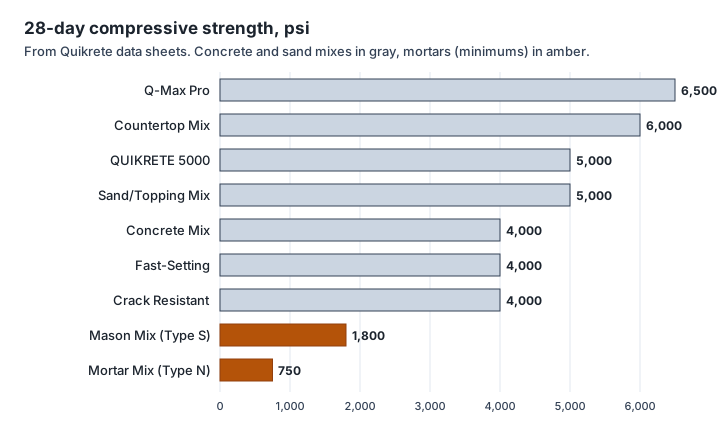
Which Quikrete to use for the job
| Job | Bag to buy | Why |
|---|---|---|
| Slab, patio, footing, steps | Concrete Mix or Crack Resistant | 4,000 psi with normal working time to finish |
| Fence, mailbox or deck post | Fast-Setting | Pour dry, add water, sets in 20 to 40 min |
| Driveway apron, cold weather, needs to be used soon | QUIKRETE 5000 | Higher early strength, walk on in 10 to 12 hr |
| Structural work on a tight schedule | Q-Max Pro | 6,500 psi, walk on in 3 hr |
| Resurfacing or patching | Sand/Topping Mix | No coarse stone, made for 1/2 in up to 2 in |
| Countertop | Countertop Mix | Flowable, 6,000 psi |
| Laying brick, block or stone | Mortar Mix or Mason Mix | Masonry mortar, not concrete |
Concrete Mix vs Fast-Setting
Use Fast-Setting for posts. Use Concrete Mix for slabs and footings.
For a post, Quikrete's Fast-Setting product page says to "pour dry mix into hole and soak with water," and the data sheet says to wait 4 hours before putting heavy weight on it. No wheelbarrow, no mixing. The Quikrete fence post guide walks through it.
Quikrete does list Fast-Setting for slabs 2 inches and thicker, steps and small pads. On anything bigger, a 20 to 40 minute set leaves little time to screed, float and finish, which is why standard Concrete Mix is the better slab bag. Hand-mixing it? See how to mix Quikrete.
When a stronger mix is worth it
QUIKRETE 5000
Quikrete lists it for driveway aprons, deck supports, patios and sign footings, and calls it "ideal for cold weather application" because it gains strength early. The data sheet still says to protect it from freezing for the first 48 hours. For a shed pad or walkway, plain Concrete Mix is enough.
Q-Max Pro
The strongest Quikrete concrete mix at 6,500 psi, with 1 hour of working time and walk-on at 3 hours, per its data sheet. It comes in 50 and 80 lb bags yielding 0.375 and 0.60 ft³, for structural work 2 inches or thicker.
Countertop Mix
No. 1106 is a flowable mix that reaches 2,000 psi at 24 hours and 6,000 at 28 days, per its data sheet. An 80 lb bag yields 0.6 ft³, enough for 3.6 sq ft at 2 inches thick or 7.2 sq ft at 1 inch.
The Quikrete bags that aren't concrete
| Product | What it is | Strength | Use it for |
|---|---|---|---|
| Sand/Topping Mix 1103 | Cement and sand, no coarse stone | 5,000 psi | Overlays and repairs, 1/2 in up to 2 in |
| Mortar Mix 1102 | Type N mortar | 750 psi min | Brick, block and stone; walls, planters, tuck-pointing |
| Mason Mix 1136 | Type S mortar | 1,800 psi min | Structural masonry, above and below grade |
| Portland Cement | Cement only | Depends on the mix | Making your own concrete, mortar or stucco |
Sand/Topping Mix
Its 5,000 psi rating fools people. It's made for overlays 1/2 in up to 2 in thick, so 2 inches is its maximum where it's the minimum for concrete mix. It also yields more per bag: 0.33, 0.50 and 0.66 ft³ for 40, 60 and 80 lb. See concrete resurfacing.
Mortar Mix vs Mason Mix
An 80 lb bag of either lays up to 37 standard bricks or 13 standard 8 × 8 × 16 inch blocks. Mortar Mix is Type N for general brick and block work; Mason Mix is Type S, which Quikrete lists for structural masonry above and below grade. Count bags with the mortar calculator.
Portland cement recipes
By volume, Quikrete gives 1 cement : 2 sand : 3 gravel for concrete, and says five to six 94 lb bags of cement make about a cubic yard. Type S mortar is 1 : 1/2 lime : 3-1/2 to 4-1/2 sand. The concrete mix calculator splits any ratio.
Worked example: a patio and a row of posts
A 10 × 12 ft patio, 4 inches thick, with fence posts along one edge:
- Patio: 10 × 12 × 0.333 = 40 ft³. At 0.60 ft³ per 80 lb bag of Concrete Mix or Crack Resistant, that's 66.7, so 67 bags before waste. It's foot traffic only, so 5000 isn't needed.
- Posts: Fast-Setting, poured dry. Size each hole with the fence post concrete calculator.
Sixty-seven bags is over 5,000 lb to mix by hand, so price ready-mix too. The Quikrete calculator gives the count for any bag and mix.
Does the brand matter?
Not much. The matching Sakrete bags publish the same strengths: High-Strength is 4,000 psi like Concrete Mix, and 5000 Plus is 5,000 like QUIKRETE 5000. Sakrete Fast Setting is a 50 lb, 4,000 psi bag that sets in about 30 minutes and needs no mixing for posts, so it does the same job as Quikrete's. Buy what your store stocks. The details are in Sakrete vs Quikrete, and Sakrete's own range is in Sakrete mix types.
If Sakrete is what's on the shelf, the Sakrete concrete calculator gives the bag count for its mixes.
Frequently asked questions
What are the main types of Quikrete?
The four concrete mixes most people need are Concrete Mix (No. 1101, 4,000 psi), Fast-Setting (No. 1004, sets in 20 to 40 minutes), QUIKRETE 5000 (No. 1007, 5,000 psi with high early strength) and Crack Resistant (No. 1006, 4,000 psi with fibers). Q-Max Pro and Countertop Mix are stronger specialty mixes. Sand/Topping Mix, Mortar Mix and Mason Mix are in the same aisle but aren't concrete.
Which Quikrete should I use for a slab or driveway?
For a slab, patio or footing, use Concrete Mix or Crack Resistant, both 4,000 psi. For a driveway apron, a cold-weather pour or anything you need back in use quickly, QUIKRETE 5000 reaches 5,000 psi at 28 days and 1,500 psi at 1 day, and you can walk on it after 10 to 12 hours.
What is the difference between Quikrete Concrete Mix and Fast-Setting?
Both are 4,000 psi at 28 days. Fast-Setting sets hard in 20 to 40 minutes and is poured dry into a post hole and soaked with water. Concrete Mix sets on a normal schedule, which gives you time to screed and finish a slab, so it's the better choice for flatwork.
Do you have to mix Quikrete Fast-Setting concrete?
Not for posts. Quikrete says to pour the dry mix into the hole and soak it with water. It sets in 20 to 40 minutes, and the data sheet says to wait 4 hours before putting heavy weight on the post.
Can I use Quikrete Sand/Topping Mix to pour a slab?
No. Sand/Topping Mix has no coarse aggregate and is made for overlays and repairs 1/2 in up to 2 in thick. Its 5,000 psi rating doesn't make it a slab mix. Use a concrete mix for anything 2 inches or thicker.
What is the strongest Quikrete concrete mix?
Q-Max Pro, at 6,500 psi at 28 days, is the strongest of the concrete mixes. It also has 1 hour of working time and a 3 hour walk-on time. Countertop Mix is next at 6,000 psi.