How Long Does It Take Quikrete to Cure?
Quikrete reaches full strength in 28 days, but you can use it much sooner. Depending on the bag, you can walk on it in 3 to 48 hours, and a car can go on a normal slab after about 7 days. The fast mixes set in under an hour.
Quikrete cure times by product
The bag decides the clock. Here are the four concrete mixes most people buy, fastest first, with the numbers from each Quikrete data sheet. If you haven't picked a bag yet, our guide to Quikrete mix types matches each one to the job.
Q-Max Pro No. 1004-81
3 hr
to walk on
- Working time
- 1 hr
- 1 day
- 3,000 psi
- 28 days
- 6,500 psi
- Use it for
- Slabs and repairs you need back the same day
Fast-Setting No. 1004
4 hr
to walk on or load a post
- Sets in
- 20 to 40 min
- 1 day
- 1,000 psi
- 28 days
- 4,000 psi
- Use it for
- Fence, mailbox and deck posts
Quikrete 5000 No. 1007
10 to 12 hr
to walk on
- Sets in
- Not published
- 1 day
- 1,500 psi
- 28 days
- 5,000 psi
- Use it for
- Cold weather and early strength
Concrete Mix No. 1101
24 to 48 hr
to walk on (general practice)
- Sets in
- Not published
- Posts
- Wait 24 hr before any strain
- 28 days
- 4,000 psi
- Use it for
- Slabs, sidewalks, footings
These figures come from the Q-Max Pro, Fast-Setting, Quikrete 5000 and Concrete Mix data sheets. Quikrete doesn't publish a set or walk-on time for standard Concrete Mix, so that figure is the usual practice for a slab.
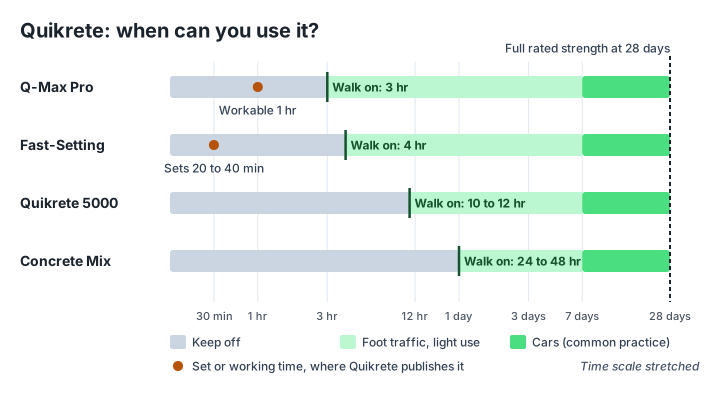
Set, dry and cure are three different clocks
Set
The mix stops being workable and goes firm. Minutes for the fast mixes, a few hours for standard ones. Firm doesn't mean strong. The clock starts when water hits the bag, so read our guide to mixing Quikrete before you open one and mix only what you can place.
Ready to use
Strong enough for feet, a post load or the forms coming off. That's the walk-on time on the cards, from 3 to 48 hours.
Cured
At 28 days it reaches the psi printed on the bag. Most of that gain happens in the first week, then it creeps up slowly.
Concrete doesn't really "dry" into strength. It cures through a reaction that needs water, so letting it dry out early makes it weaker. All four data sheets give the same schedule: keep it moist for 5 days at 70°F or warmer and 7 days in cooler weather, using plastic sheeting, wet burlap, a sprinkler or a cure-and-seal product.
When can you drive on it or pull the forms?
| Job | Wait | Why |
|---|---|---|
| Pull side forms | 24 to 48 hr | The concrete only has to hold its own shape |
| Pull forms that carry weight | A week or more | Step undersides and anything spanning need real strength |
| Drive or park a car | 7 days | Concrete Mix is at 2,500 psi, over 60 percent of rated |
| Trucks, RVs, heavy loads | 28 days | Full rated strength |
Say you pour a driveway apron with Concrete Mix on a warm Saturday morning. You can walk on it Sunday, pull the edge forms Sunday evening and park on it the next Saturday. The 7 day and 28 day rules are common practice rather than Quikrete figures. Our concrete cure time guide covers where they come from.
Quikrete strength by age
| Mix | 3 hr | 1 day | 3 days | 7 days | 28 days |
|---|---|---|---|---|---|
| Q-Max Pro | 1,000 | 3,000 | 5,000 | 6,500 | |
| Fast-Setting | 1,000 | 2,500 | 4,000 | ||
| Quikrete 5000 | 1,500 | 2,500 | 3,500 | 5,000 | |
| Concrete Mix | 2,500 | 4,000 |
What speeds it up or slows it down
Cold
The reaction slows a lot near freezing. Quikrete says to protect new concrete from freezing for the first 48 hours, with plastic and insulating blankets if it will drop below 32°F. See cold weather concrete.
Heat and wind
Hot, dry or windy weather pulls water out of the surface, which weakens it and causes cracking. Keep it covered or damp. Quikrete suggests cold or iced mix water in severe heat.
Thickness
A deep footing holds heat and moisture and stays on schedule. A thin, feathered edge dries out fast and ends up weaker than the rest of the pour.
Fence posts: how long before you hang the gate?
With Fast-Setting, wait 4 hours. You pour the dry mix into the hole and add about 1 gallon of water per 50 lb bag, no mixing. With standard Concrete Mix, wait 24 hours before the post takes any strain. Both go on gaining strength for 28 days, so hold off on a heavy gate for a few days if you can.
The Quikrete fence post guide covers hole size and bag counts. For why pouring dry works in a post hole but not across a slab, see dry pour concrete. To figure how many bags you need, use the Quikrete calculator.
Frequently asked questions
How long does Quikrete take to set?
Fast-Setting Concrete sets in 20 to 40 minutes and Q-Max Pro gives you about 1 hour of working time. Quikrete does not publish a set time for standard Concrete Mix or Quikrete 5000, which take a few hours. Set only means the mix has gone firm, not that it is strong.
How fast does Quikrete set for posts?
Fast-Setting Concrete sets in 20 to 40 minutes. Pour the dry mix in the hole, add about 1 gallon of water per 50 lb bag, and wait 4 hours before the post takes any strain. With standard Concrete Mix, Quikrete says to wait 24 hours.
How long does Quikrete take to dry versus cure?
The surface looks dry within hours, but concrete gains strength by curing, a reaction that needs water. Quikrete says to keep it moist for 5 days at 70°F or warmer and 7 days in cooler weather. It reaches its rated strength at 28 days.
How long until I can walk on Quikrete?
About 3 hours for Q-Max Pro, 4 hours for Fast-Setting, 10 to 12 hours for Quikrete 5000, and 24 to 48 hours for standard Concrete Mix, which is the usual practice since Quikrete does not publish a walk-on time for it.
When can I remove the forms from Quikrete?
Pull side forms that only hold the shape after 24 to 48 hours for standard mix. Leave forms that carry weight, like the underside of steps, in place for a week or more.
How long before I can drive on new Quikrete?
Wait about 7 days before parking a car on a standard-mix slab. By then Concrete Mix is at 2,500 psi, over 60 percent of its rated 4,000 psi. Wait the full 28 days for trucks and heavy loads.
Does a bigger bag of Quikrete take longer to cure?
No. Cure time depends on the mix, not the bag size. An 80 lb bag of Concrete Mix cures on the same schedule as a 40 lb bag; it just makes more concrete, 0.60 cubic feet against 0.30.