Heated Concrete Floors
A heated concrete floor has hot-water PEX tubing or electric cable cast into the slab, so the whole floor slowly warms the room. In a structural slab the tubing needs at least 2 inches of concrete over it, which puts a heated slab nearer 5 inches thick than 4. The energy code also wants R-5 insulation under the whole slab, and the loops must pass a 100 psi pressure test before the pour.
Hydronic or electric
| Factor | Hydronic (water) | Electric (cable or mat) |
|---|---|---|
| How it works | A boiler or water heater pumps warm water through PEX loops in the slab | Resistance cable heats the slab or a thin layer on top of it |
| Best for | Whole houses, shops and new slabs | Single rooms and bathrooms |
| Existing slab | Hard: the loops go in before the pour | Mats can go on top under self-leveler and tile |
The Department of Energy calls hydronic systems "the most popular and cost-effective radiant heating systems for heating-dominated climates," and says electric radiant floors are usually only cost-effective if they include a significant thermal mass. A thick concrete slab is exactly that.
How deep the tubing goes
| Source | Cover over the tube | Applies to |
|---|---|---|
| ACI 302.1R-04 | 2 to 3 in | Slab floors, with about 2 in (not less than 1 in) under the pipe |
| REHAU | 2 in | A structural slab |
| REHAU | 3/4 in | A non-structural slab or overpour of gypsum or lightweight concrete |
ACI's floor and slab guide describes pipe placed "with approximately 2 in. (50 mm) of concrete cover (not less than 1 in. [25 mm]) under the pipe and with 2 to 3 in. (50 to 75 mm) of concrete cover over the pipe." REHAU's installation guide splits it by slab type. The 3/4 inch figure is for a thin topping; a slab on ground is structural, so plan on 2 inches.
What that does to slab thickness
No code sets a thicker slab for tubing, but the arithmetic does. Half-inch PEX is 5/8 inch outside (ASTM F876):
- Least ACI allows: 1 in under + 5/8 in tube + 2 in over = 3-5/8 in
- ACI's recommended stack: 2 in under + 5/8 in tube + 2 to 3 in over = 4-5/8 to 5-5/8 in
That's our arithmetic on ACI's figures, not an ACI statement. The structural side of the decision is on concrete floor thickness.
Control joints and the tubing
Contraction joints are cut to at least 1/4 of the slab depth and not less than 1 inch, per NRMCA's Concrete in Practice sheet on joints (CIP 6). That's deeper than 3/4 inch of cover in any slab thickness:
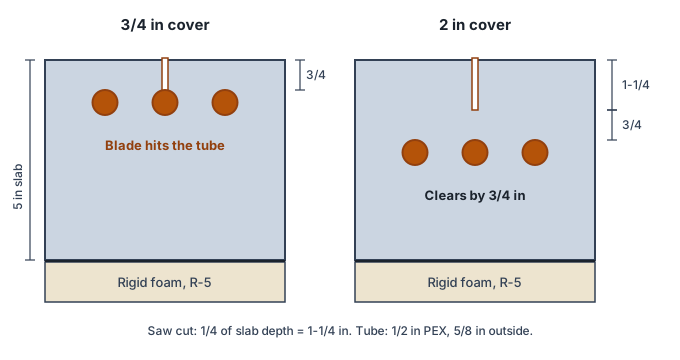
| Slab | Cut, 1/4 of depth | Tube at 3/4 in cover | Tube at 2 in cover |
|---|---|---|---|
| 4 in | 1 in | Blade reaches it | Clears by 1 in |
| 5 in | 1-1/4 in | Blade reaches it | Clears by 3/4 in |
| 6 in | 1-1/2 in | Blade reaches it | Clears by 1/2 in |
REHAU's guide covers both halves of the fix: circuits "must also be planned and installed to minimize passes through" saw-cut control joints, and pipes passing through a joint must be "installed low enough that they are below the blade of the saw when the cut is made." It also recommends protecting the pipe 15 inches on both sides of a joint. Lay out the joints first, then the loops.
Insulation under a heated slab
Without insulation, much of the heat goes down into the ground. Under the 2018 and 2021 IECC, "R-5 insulation shall be provided under the full slab area of a heated slab," per PNNL's summary of the code. The slab edge still gets R-10: under the 2021 IECC, 2 feet deep in climate zone 3 and 4 feet in zones 4 to 8; under the 2018 IECC, 2 feet in zones 4 and 5, 4 feet in zones 6 to 8 and none in zone 3. For a heated slab, the edge insulation doesn't have to extend below the slab.
- R-5 is about 1 inch of XPS. Owens Corning rates FOAMULAR 150 at R-5.0 per inch.
- What counts as heated. Washington's energy code, following the IECC, defines it as a slab where the heating elements or tubing are "in contact with, or placed within or under, the slab" (WAC 51-11R-20208). Tubing under the slab still makes it a heated slab.
Vapor retarder
The IRC (R506.2.3, as adopted in Oklahoma's code) requires 6 mil polyethylene or an approved vapor retarder, joints lapped at least 6 inches, between a house slab and its base. Retarder classes, thicker sheets and the layer order are on the under-slab insulation and vapor barrier page.
Laying and testing the loops
- Insulate and lay the retarder over the compacted base.
- Lay out joints, then circuits, so loops cross joint lines as few times as possible.
- Tie the tubing to rebar or wire mesh. REHAU says to secure it every 24 to 36 inches and at the start, midpoint and end of each bend, so it can't float or sink during the pour.
- Pressure test before the pour (below), and keep it pressurized: REHAU says "Pipe should be under pressure with no loss during the pour."
- Pour, finish and cut joints with the tube at least 2 inches below the surface.
Pressure test
IRC M2103.4, as printed in Seattle's adoption of the 2018 IRC: "Piping or tubing to be embedded shall be tested by applying a hydrostatic pressure of not less than 100 psi (690 kPa). The pressure shall be maintained for 30 minutes, during which the joints shall be visually inspected for leaks." REHAU's own air test runs the greater of 1.5 times operating pressure or 100 psig for 30 minutes, then a main test of at least 2 hours, never above 150 psig. Run the test your inspector asks for, and keep a gauge where the crew can see it during the pour.
Can a water heater run the floor?
Yes, if the heater is listed for it. International Mechanical Code 1002.2, shown in this copy of IMC chapter 10, says water heaters used for both potable hot water and space heating "shall be listed and labeled for such applications by the manufacturer." Check the data plate.
- Size: it must be sized "to prevent the space-heating load from diminishing the required potable water-heating capacity" (1002.2.1).
- Temperature: if the heating side needs water above 140°F, an ASSE 1017 mixing valve must temper the household hot water to 140°F or less (1002.2.2).
What you can put on top
DOE calls ceramic tile "the most common and effective floor covering for radiant floor heating," and notes that anything that insulates the floor from the room lowers the system's efficiency, so thick carpet and pad work against it. REHAU's guide says not to exceed the temperature limit of the finished covering, so use your flooring maker's rating for wood or vinyl. It also says to run pipe perpendicular to hardwood flooring.
Planning to polish a heated slab? Grinding removes concrete from the top, which comes straight out of the cover over the tube. Start with extra cover and see polished concrete floors.
New slab or existing floor
Hydronic loops are cast into a new pour; you can't add them to an old slab without breaking it out or pouring a topping over it. On an existing slab, electric mats are the usual route: WarmlyYours' installation guide shows a mat fixed to the subfloor and "installed under self leveling underlayment and tile." The new layers raise the floor, so check door clearances and the first stair. If the slab is uneven, see floor leveling first.
Cost of a heated concrete floor
We found no independent or public installed price for radiant floor heating in a slab, so this page doesn't quote one. The figures that circulate come from sellers and cost aggregators. Get quotes that list the tubing or cable, insulation, manifold, controls and the boiler or water heater separately, and see concrete floor cost for the slab and finish.
For hydronic, the heat source, manifold, pumps and controls are part of the price. If you're pouring the slab anyway, the extra is the tubing, insulation and heating plant; a retrofit adds a new topping. Size the pour with the concrete floor calculator. For a heated shop or house slab, see barndominium slabs.
Frequently asked questions
How deep should PEX be in a concrete slab?
Plan on at least 2 inches of concrete over it in a slab on ground. REHAU requires 2 inches of cover in a structural slab and allows 3/4 inch only in a non-structural overpour, and ACI 302.1R-04 describes 2 to 3 inches over the pipe with about 2 inches under it. Following ACI puts a heated slab at roughly 4-5/8 to 5-5/8 inches thick.
Can you cut control joints in a slab with radiant tubing?
Yes, if the layout allows for it. Joints are cut at least 1/4 of the slab depth and not less than 1 inch, so tubing under only 3/4 inch of cover will be hit. REHAU says to plan circuits to cross joints as few times as possible and to run any crossing low enough to clear the saw blade.
Do I need insulation under a heated slab?
Yes. The 2018 and 2021 IECC require R-5 insulation under the full area of a heated slab, which is about 1 inch of XPS, plus R-10 at the slab edge (under the 2021 IECC, 2 feet deep in zone 3 and 4 feet in zones 4 to 8). The edge insulation for a heated slab does not have to extend below the slab.
Do I have to pressure test the tubing?
Yes. IRC M2103.4 requires embedded tubing to be tested at not less than 100 psi hydrostatic, held for 30 minutes while the joints are checked for leaks. REHAU also says the pipe should stay under pressure with no loss during the pour, so a damaged tube shows up right away.
Can a water heater heat a radiant floor?
Yes, if it is listed and labeled for combined potable and space heating, per International Mechanical Code 1002.2. It must be sized so the heating load does not cut into the hot water supply, and if the heating side runs above 140°F, an ASSE 1017 mixing valve must temper the household hot water to 140°F or less.
Can I add radiant heat to an existing concrete floor?
Electric, yes: mats or cable go on top of the slab under a self-leveling underlayment and tile, which raises the floor. Hydronic loops are cast into a new pour, so adding them means breaking out the slab or pouring a new topping over it.