Best Concrete Driveway Sealer
The best concrete driveway sealer for most driveways is a breathable penetrating sealer: a siliconate, siloxane or silane that soaks into the concrete, leaves no film and does not make the surface slippery. NRMCA, the ready-mix producers' association, recommends silane and siloxane sealers of this kind against salt scaling. Choose an acrylic only if you want a wet look or deeper color and are willing to reseal every 1 to 3 years.
How we picked. We compared product labels and data sheets, read on Nov 21, 2026, against NRMCA, the Decorative Concrete Council and state DOT research. We did not test these sealers ourselves. Links to Concrete Sealers USA are affiliate links and we may earn a commission; other brands are named and compared but not linked.
Best concrete driveway sealer by situation
Start with your driveway's finish and what you want it to look like afterward. Getting the type right matters more than the brand: an acrylic on a slab that needed a penetrating sealer is a film you will be stripping later.
Most broom-finished driveways: a water-based siliconate
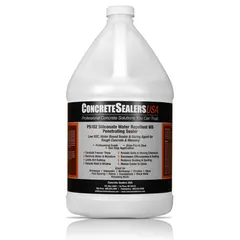 A siliconate reacts inside the surface pores and repels water without changing how the concrete looks. Concrete Sealers USA's PS102 is made for rough and broom-finished concrete, lists driveways by name, and states 8 g/L VOC, far under even the strictest state limit. One application covers 200 to 250 sq ft per gallon, it dries flat and clear, and it can go on a new slab as soon as the surface bears your weight, so it doubles as a curing aid. It costs $39.95 a gallon. The label makes no claim about how long it lasts.
Salted roads or a porous older slab: a water-based silane/siloxane
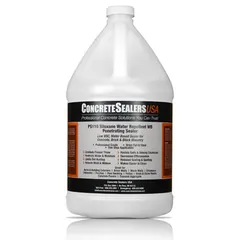 Silane and siloxane are the two chemistries NRMCA's scaling guide names when it advises a breathable sealer for slabs exposed to deicers. Concrete Sealers USA's PS110 is a water-based siloxane/silane blend for porous concrete, block and exposed aggregate. Its label gives 150 to 200 sq ft per gallon, under 100 g/L VOC, and asks for concrete at least 28 days old. It costs $39.95 a gallon or $169.95 for 5.
Dense concrete and large jobs: a solvent-based silane
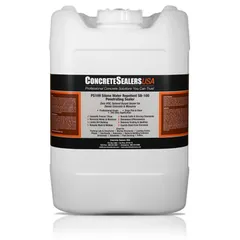 PS109 is a solvent-based alkyltrialkoxysilane that Concrete Sealers USA describes as 100 percent reactive and recommends for dense concrete, from driveways to bridge decks. One saturating coat covers 200 to 350 sq ft per gallon on dense surfaces. It has no 1 gallon size: it comes in 5 gallon pails at $399.95 or 55 gallon drums, which is why it is the most expensive choice on a small driveway and one of the better values on a long one. At under 250 g/L it is above the 100 g/L cap some states set, so check before you order (see VOC limits).
Stamped, colored or exposed aggregate: an acrylic
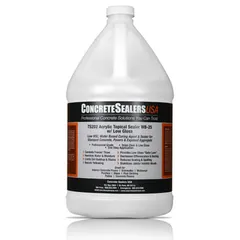 An acrylic sits on the surface as a film, which is what brings out color and gives a satin or wet look. Concrete Sealers USA's water-based TS202 is a 25 percent solids pure acrylic that dries to a low-gloss satin, under 100 g/L VOC. Its label gives 300 to 400 sq ft per gallon on stamped concrete and 175 to 225 on exposed aggregate and pavers, at $39.95 a gallon. The solvent-based TS200 gives a high-gloss wet look at $199.95 per 5 gallon pail, but at up to 700 g/L it cannot be shipped to much of the country. The TS200 label warns that slip resistance can drop with each application. The Decorative Concrete Council says exterior public walkways should always get an anti-slip additive made for the sealer, and warns that plain sand can make the sealer deteriorate.
Driveway sealers compared, from their own labels
Every figure below is what the maker publishes. We did not measure any of them. Concrete Sealers USA product names link to the product page through our affiliate link.
| Product | Type | VOC | Coverage per gallon | Slab age |
|---|---|---|---|---|
 Concrete Sealers USA PS102 | Siliconate, water-based | 8 g/L | 200 to 250 on broom finish, 1 coat | Once it bears weight |
 Concrete Sealers USA PS110 | Siloxane/silane, water-based | Under 100 g/L | 150 to 200, 1 coat | 28 days |
 Concrete Sealers USA PS109 | Silane, solvent-based | Under 250 g/L | 200 to 350 on dense concrete, 1 coat | 28 days |
 Concrete Sealers USA TS202 | Acrylic, water-based, low gloss | Under 100 g/L | 175 to 400 by surface, per coat | Once it bears weight |
 Concrete Sealers USA TS200 | Acrylic, solvent-based, wet look | Under 700 g/L | 175 to 400 by surface, per coat | Once it bears weight |
| Foundation Armor SX5000 | Silane/siloxane, solvent-based | Under 250 g/L | Up to 175 porous, 200 to 225 smooth, per coat | 28 days |
| Ghostshield Siloxa-Tek 8500 | Silane/siloxane, water-based, 40% actives | Not stated | Not stated on the product page | Not stated |
| Seal-Krete SS-10 | Silane/siloxane, 10% solids, soap and water cleanup | Under 100 g/L | 150 to 400, two coats recommended | 30 days |
| Eagle Supreme Seal | Acrylic, solvent-based, high gloss | Under 700 g/L | 200 on broom finish, 100 on exposed aggregate, for two coats | See label |
Three things the table shows that a product page will not tell you:
- Strength is not comparable across brands. Ghostshield quotes 40 percent actives, Seal-Krete 10 percent solids and PS109 100 percent reactive silane, and the labels we read give no penetration depth to compare, so a higher number on the jug is not proof of a longer-lasting seal.
- Some coverage figures look like templates. Foundation Armor prints the same "up to 175" and "200 to 225" sq ft per gallon for its SX5000 silane siloxane and its AR350 acrylic, two chemistries that cannot cover identically. Plan on the low end of any range.
- Longevity claims come from sellers. Foundation Armor's data sheet promises 7 to 10 years before a recoat. Seal-Krete offers a limited 5-year warranty on SS-10. We found no independent side-by-side test of driveway sealers.
Penetrating vs acrylic sealer on a driveway
| Penetrating (siliconate, siloxane, silane) | Acrylic (water or solvent-based) | |
|---|---|---|
| How it works | Lines the pores below the surface | Forms a film on top |
| Look | No visible change | Darker color, satin to high gloss |
| Slip when wet | Same as bare concrete | Can get slick; consider an anti-slip additive |
| Breathes | Yes, vapor passes through | Less so, and less with every extra coat |
| Life between coats | Years; bridge deck silane data below | 1 to 3 years |
| Weak against | Acids | Gasoline and other petroleum solvents |
The acrylic life comes from the Decorative Concrete Council's sealer selection guide: 1 to 2 years for water-based acrylics and 1 to 3 for solvent-based. The weak points come from the Carolinas Ready Mixed Concrete Association, which notes acrylics can be weakened by petroleum distillates and penetrating sealers by acidic chemicals. On a driveway, that suggests an acrylic is the more likely of the two to soften where a car drips fuel.
For penetrating sealers, the best independent evidence is from bridge decks, which take far more salt and traffic than a driveway. An Oklahoma DOT study found silane still deeper than the specified 1/8 inch on every sampled deck up to 12 years old, falling to 16 to 21 percent of decks at 17 to 20 years.
Can you buy it in your state? VOC limits
Federal rules set a floor that most driveway sealers clear easily. The EPA's architectural coatings table allows 600 g/L for waterproofing sealers and treatments, 400 for sealers and 700 for concrete curing and sealing compounds. Stricter rules cut that hard: the California Air Resources Board's suggested control measure and the Ozone Transport Commission's Phase II model rule cap concrete and masonry sealers at 100 g/L. Maryland adopted that limit, and Delaware's 2016 update to the current OTC model rule sets the same 100 g/L.
In practice, Concrete Sealers USA will not ship its 700 g/L TS200 wet-look acrylic to California, Colorado, Connecticut, DC, Delaware, Illinois, Indiana, Massachusetts, Maryland, Maine, New Hampshire, New Jersey, New York, Ohio, Pennsylvania or Rhode Island, or to Maricopa County, Arizona, and listed counties in Utah and Virginia. If you live in one of those places, a water-based sealer under 100 g/L, such as PS102, PS110 or TS202, is the simple answer. PS109 at under 250 g/L sits between the two limits, so ask the seller before you order.
How much sealer a driveway takes, and what it costs
For a 20 by 24 ft two-car driveway, 480 sq ft of broom finish, at the low end of each label and Concrete Sealers USA list prices:
| Sealer type | Coats | Gallons | Buy | Cost | Per sq ft |
|---|---|---|---|---|---|
| Siliconate, water-based (PS102) | 1 | 2.4 | 3 jugs | $119.85 | $0.25 |
| Silane/siloxane, water-based (PS110) | 1 | 3.2 | 4 jugs | $159.80 | $0.33 |
| Silane, solvent-based (PS109) | 1 | 2.4 | 1 pail | $399.95 | $0.83 |
| Acrylic, water-based (TS202) | 2 | 3.84 | 4 jugs | $159.80 | $0.33 |
| Acrylic, solvent-based (TS200) | 2 | 3.84 | 1 pail | $199.95 | $0.42 |
The acrylics are priced at two coats, because that is how most people apply them for an even finish, and at 250 sq ft per gallon, the low end of their cure-and-seal rate, since their labels give no separate rate for broom finish. The solvent silane looks expensive here only because it comes in 5 gallon pails; on a 1,500 sq ft drive the pail gets used up. Run your own size, finish and prices through the concrete sealer calculator.
When to seal a new concrete driveway
It depends on the chemistry. The Carolinas RMCA says most acrylics and certain reactive penetrating sealers, siliconates and silicates, can go on as soon as new concrete will hold the installer's weight, while silanes and siloxanes should wait until the concrete is fully cured, generally 28 days. The labels agree: PS102 and both acrylics allow fresh concrete, while PS110, PS109 and Foundation Armor SX5000 ask for 28 days and Seal-Krete SS-10 for 30.
Whichever you use, seal a dry slab. NRMCA calls late summer, after a few dry days, the ideal time, and the Michigan Concrete Association recommends a silane or siloxane after at least 30 days. NRMCA also advises keeping deicing salt off newly placed concrete where you can, using clean sand for traction instead. Our guide to sealing concrete covers cleaning, the moisture test and application step by step.
How often to reseal a concrete driveway
When water stops beading, not on a calendar. Sprinkle water on the driveway: if it darkens the concrete and soaks in within a few minutes, the sealer has worn off. The Decorative Concrete Council's 2025 best practice says reseals should be done as needed rather than on a set number of years, and warns that resealing too often builds up a film that is costly to remove.
Reseal with the same type you used before; the Decorative Concrete Council's selection guide says matching the original sealer gives the best results. Concrete Network warns that a solvent-based sealer over a water-based one can soften both coats. If you do not know what is on the driveway, test a small patch first. For a slab that is not a driveway, our wider guide to choosing a concrete sealer by surface names a pick for garages, basements, smooth floors and stamped concrete.
Frequently asked questions
What type of sealer is best for a concrete driveway?
A breathable penetrating sealer, a siliconate, siloxane or silane, for most driveways. It repels water and salt without forming a film, so it does not peel, change the color or get slippery. NRMCA recommends silane or siloxane sealers against freeze-thaw scaling. An acrylic is the better pick only for stamped or colored concrete where you want the color to stand out.
How long does a concrete driveway sealer last?
An acrylic lasts about 1 to 3 years, per the Decorative Concrete Council. Penetrating sealers last longer, though the long-life claims come from sellers: Foundation Armor promises 7 to 10 years for SX5000. Independent bridge deck data from Oklahoma DOT found silane still deeper than the specified 1/8 inch on every deck up to 12 years old. Reseal when water stops beading.
Can you seal a brand new concrete driveway?
With some sealers, yes. Siliconates such as PS102 and acrylics can go on as soon as the concrete bears your weight, and help it cure. Silane and siloxane sealers need the slab at least 28 days old; Seal-Krete asks for 30 days on SS-10. Check the label of the product you buy.
Will sealing my driveway make it slippery?
A penetrating sealer will not, because it leaves no film on the surface. An acrylic can, especially a high-gloss solvent-based one, and the TS200 label warns slip resistance can drop with each coat. On an acrylic-sealed driveway or walk, consider an anti-slip additive made for that sealer; the Decorative Concrete Council warns that plain sand can make sealer deteriorate.
Is water-based or solvent-based driveway sealer better?
Water-based is the safer default. Water-based sealers under 100 g/L meet even the strictest state VOC limits and have little odor. Solvent-based acrylics give a deeper wet look and color, but Concrete Sealers USA will not ship its 700 g/L wet-look sealer to 15 states, parts of 3 more, and DC. Avoid putting a solvent-based sealer over a water-based one, which can soften both coats.