Best Concrete Sealer
Picked by surface: the right sealer for outdoor slabs, salt, garages, basements, smooth floors and stamped concrete.
The best concrete sealer for most outdoor slabs is a water-based siliconate that soaks into the surface and beads water without leaving a film, such as Concrete Sealers USA's PS102. It does not change how the concrete looks or make it slick underfoot, and it can go on a slab as young as a few weeks. The right sealer depends on the surface, though: a garage floor, a salted driveway, a basement slab and a stamped patio each want a different chemistry, which is what the picks below sort out.
How we picked. We read each maker's own product page and data sheet on Nov 21, 2026 and checked their claims against NRMCA, the Decorative Concrete Council and state transportation research. We did not test these sealers ourselves. Links to Concrete Sealers USA are affiliate links, so we may earn a commission at no cost to you; the other brands are named and compared from their own labels but not linked.
Best concrete sealer by surface
Match the sealer to the slab, not to a brand. The single choice that matters most is penetrating versus film-forming: a penetrating sealer lines the pores and leaves the surface looking and feeling like bare concrete, while a film-forming acrylic sits on top to add color or shine and has to be recoated. Everything below follows from what the surface is and what you want it to look like afterward.
Most outdoor slabs: a water-based siliconate
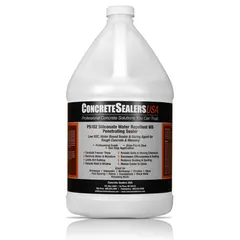 For an ordinary broom-finished driveway, sidewalk, patio or shed pad, a siliconate is the low-risk default. It reacts inside the surface pores and repels water with no film to peel, yellow or turn slippery. Concrete Sealers USA's PS102 lists broom-finished concrete at 200 to 250 sq ft per gallon and concrete block at 125 to 175, states 8 g/L VOC (under even the strictest state cap), and can go on once a new slab bears your weight, so it doubles as a curing aid. It lists at $39.95 a gallon. If you want the look of the slab to deepen, that is a job for an acrylic instead; our best driveway sealer guide weighs the two for drives specifically.
Road salt and freeze-thaw: a silane or siloxane repellent
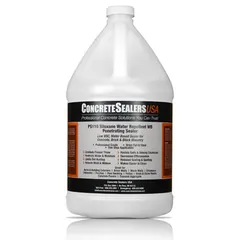 Where winters bring deicing salt, the damage to watch is surface scaling, and NRMCA's guidance on scaling points to breathable silane and siloxane sealers to keep salt-laden water out of the top of the slab. Concrete Sealers USA's PS110 is a water-based siloxane and silane blend for porous concrete, block and exposed aggregate, rated 150 sq ft per gallon, under 100 g/L VOC, on concrete at least 28 days old. It lists at $39.95 a gallon or $169.95 for 5. On a large, dense job the solvent-based PS109 silane covers 200 sq ft per gallon and sells by the pail at $399.95, but at under 250 g/L it is above some state VOC caps, so check before you order.
Garage and shop floors: an oil and salt repellent
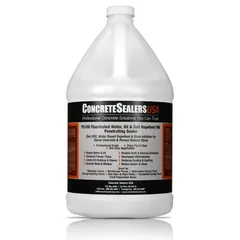 A garage floor takes dripped oil, tracked-in road salt and hot tires, so it wants a penetrating repellent that beads oil as well as water. Concrete Sealers USA's PS100 is a fluorinated water, oil and salt repellent made for hard-troweled floors, rated 300 to 450 sq ft per gallon on troweled concrete, 40 g/L VOC, on a floor cured about 28 days. It lists at $104.95 a gallon. If you specifically want a glossy, wipe-clean film rather than an invisible treatment, Concrete Sealers USA's TS210 is a water-based two-part polyurethane floor coating for bare cured concrete; it is sold as a kit after a short phone check and is not something you drop in a cart, so we have left it off the comparison below and out of the links here. A repellent only protects clean concrete, so clear any existing stains first; our guide on how to get oil out of concrete covers that, and our garage floor guide covers coatings in more depth. For a dedicated garage floor sealer comparison, including how PS100 lines up against Ghostshield and Foundation Armor, see the separate garage guide.
Indoor and basement floors: a lithium silicate densifier
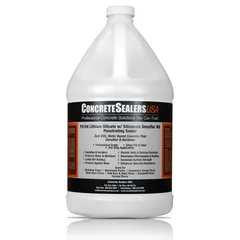 An interior or basement slab is less about shedding rain and more about stopping the surface from dusting and taking up moisture. A lithium silicate densifier reacts with the concrete to harden the surface, and Concrete Sealers USA's PS104 pairs that with a siliconate repellent in one water-based, 0 g/L VOC product that covers 300 to 450 sq ft per gallon on troweled and smooth floors and lists at $39.95 a gallon. There is no film to wear off a basement floor, and nothing to trap vapor coming up through the slab. For the full cleaning, moisture test and application sequence, see our guide to sealing a concrete floor.
Smooth or dense troweled slabs: a concentrated siliconate
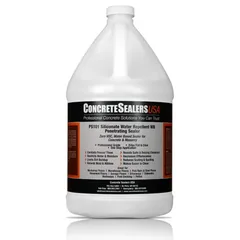 A hard, smooth-troweled slab has less open pore to soak up sealer, so it stretches a gallon much further and takes a siliconate made for that density. Concrete Sealers USA's PS101 is a water-based siliconate rated 300 to 450 sq ft per gallon on smooth or dense concrete, dropping to 175 to 225 on broom finish and 100 to 150 on block, at 0 g/L VOC on concrete at least 28 days old. Its label describes a natural, flat finish with minimal impact on the surface's traction, and it lists at $39.95 a gallon, the same as PS102. On a tight, burnished floor it will go on thin, so measure a test patch before buying in bulk.
Stamped, colored or exposed aggregate: an acrylic
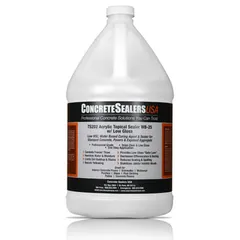 Decorative concrete is the one case where a film is the point: an acrylic brings back the color and pattern and gives a satin to wet-look sheen. Concrete Sealers USA's water-based TS202 dries to a low gloss at under 100 g/L VOC, covering 250 sq ft per gallon on smooth or broom concrete and 175 on exposed aggregate, at $39.95 a gallon. The solvent-based TS200 gives a high-gloss wet look at $199.95 per 5 gallon pail, but at up to 700 g/L it cannot ship to much of the country, so confirm it reaches your state first. The Decorative Concrete Council's sealer selection guide says exterior walkways sealed with an acrylic should get an anti-slip additive made for the sealer, and that water-based acrylics typically last about 1 to 2 years before a recoat. For pool surrounds, our best pool deck sealer guide goes further.
Concrete sealers compared, from their own labels
Every figure in the table is what the maker publishes on its own product page or data sheet. We measured none of them, and a higher number on one jug is not proof of a better seal, because makers state actives, solids and coverage in ways that do not line up. Concrete Sealers USA product names link to the product through our affiliate link; the other brands are named but not linked.
Open the full comparison table
| Product | Type and base | VOC | Coverage per gallon | Slab age |
|---|---|---|---|---|
 Concrete Sealers USA PS102 | Siliconate, water-based, penetrating | 8 g/L | 200 to 250 broom, 125 to 175 block, 1 coat | Once it bears weight |
 Concrete Sealers USA PS101 | Siliconate, water-based, penetrating | 0 g/L | 300 to 450 smooth, 175 to 225 broom, 1 coat | 28 days |
 Concrete Sealers USA PS110 | Silane/siloxane, water-based, penetrating | Under 100 g/L | 150, 1 coat | 28 days |
 Concrete Sealers USA PS109 | Silane, solvent-based, penetrating | Under 250 g/L | 200 on dense concrete, 1 coat | 28 days |
 Concrete Sealers USA PS100 | Fluorinated water, oil and salt repellent, water-based | Under 50 g/L | 300 to 450 troweled, 600 to 1000 polished, 1 coat | About 28 days |
 Concrete Sealers USA PS104 | Lithium silicate densifier with siliconate, water-based | 0 g/L | 300 to 450 troweled or smooth, 1 coat | Cured interior slab |
 Concrete Sealers USA TS202 | Acrylic, water-based, low gloss topical | Under 100 g/L | 250 smooth or broom, 175 aggregate, per coat | Once it bears weight |
 Concrete Sealers USA TS200 | Acrylic, solvent-based, wet-look topical | Under 700 g/L | 250 smooth or broom, 175 aggregate, per coat | Once it bears weight |
| Foundation Armor SX5000 | Silane/siloxane, solvent-based, penetrating | Under 250 g/L | Up to 175 porous, 200 to 225 smooth, 1 coat | Not stated |
| Foundation Armor AR350 | Acrylic, solvent-based, wet look | 50, 350 or 700 grade options | 175 to 225 porous, 250 to 325 smooth, per coat | Not stated |
| Ghostshield Siloxa-Tek 8500 | Silane/siloxane, water-based, penetrating | "Low VOC" (no g/L stated) | 150 to 400 one coat, 75 to 200 two coats | About 80% strength, 14 to 28 days |
| Ghostshield Siloxa-Tek 8505 | Fluorocarbon, water-based, penetrating | Up to 90 g/L | 150 to 400 one coat, 75 to 200 two coats | About 80% strength, 14 to 28 days |
| Ghostshield Siloxa-Tek 8510 | Fluorocarbon, solvent-based, penetrating | Not stated | 150 to 400 | About 80% strength, 14 to 28 days |
| MasonryDefender Concrete Driveway Sealer | Silane/siloxane, water-based, penetrating | 50 g/L | 90 to 150 | 28 days |
| EcoProCote Eco-Tuff Clear Coat | Acrylic and bio-polyurethane hybrid, water-based, topical | 0 g/L | 350 to 450, per coat | Not stated |
| RadonSeal Deep-Penetrating | Reactive sodium silicate, water-based, penetrating | Zero | 175 to 200 outdoor, 200 to 225 indoor | Not stated as a day count |
Two things the labels will not tell you on their own. First, coverage is set far more by the slab than by the brand: the published rates above span from 90 to 1000 sq ft per gallon, and most of that spread is surface porosity, not chemistry, so plan on the low end of any range. Second, longevity claims come from the seller. Foundation Armor states up to 2 to 5 years for its AR350 acrylic; RadonSeal describes its reactive silicate as a permanent, one-time application. We found no independent side-by-side test that ranks these products, which is why this guide sorts them by what the surface needs rather than crowning one winner.
Penetrating vs film-forming: which to choose
If you remember one distinction, make it this one. It decides how the slab looks, how it feels wet, and how much work it is to keep up.
Penetrating sealers
Siliconates, silanes, siloxanes and reactive silicates soak in and line the pores. The concrete looks and feels unchanged, it stays as grippy as bare concrete when wet, and vapor can still pass through, which suits slabs on grade and basements. You reapply when water stops beading, not on a schedule. The trade-off is that they add no color or shine, and acids can break them down.
Film-forming sealers
Acrylics, and heavier epoxies and polyurethanes, dry as a layer on top. That film is what deepens color, gives a satin or wet-look gloss and wipes clean, so it is the choice for stamped and decorative concrete and for showroom garage floors. In return it can get slippery when wet unless you add a grit, it has to be recoated every year or few, and petroleum drips can soften it.
For outdoor and below-grade slabs that spread tips toward penetrating. Film-forming earns its upkeep only when the look, or a wipe-clean surface, is worth recoating for. The two also fail in different ways: an acrylic film can be softened by the petroleum distillates in some cleaners and driveway drips, while a reactive penetrating sealer is vulnerable to the acids that etch concrete.
How much sealer you need
Once you have picked a type, the amount comes down to area, coats and the coverage on the label. Enter your slab below and this runs the same math as our full concrete sealer calculator, giving the gallons, the cheapest mix of jugs and pails, and the material cost at each type's published rate.
With JavaScript off, divide the slab area by the coverage per gallon on the label, then multiply by the number of coats. A 480 sq ft broom-finished slab sealed with a water-based siliconate at 200 sq ft per gallon takes 2.4 gallons for one coat, about $119.85 at Concrete Sealers USA list prices. A film-forming acrylic at two coats and 250 sq ft per gallon takes 3.84 gallons for the same slab.
What if the slab is already sealed?
The best sealer for a previously sealed slab is usually the same kind that is already on it. A penetrating sealer cannot soak through an acrylic film, so putting one over a shiny or wet-look surface just leaves it sitting on top. Recoat a filmed slab with a compatible acrylic, and avoid putting a solvent-based acrylic over a water-based one, which can soften both coats.
Not sure what is on the slab, or whether anything is left? Splash a little water on it and wait a minute. If it beads or sits on the surface, a sealer is still working and you can either leave it or match what is there. If it soaks in and darkens the concrete, the slab is reading as bare and is ready for whichever penetrating sealer suits the surface. When you do need to start over, our guide to how to seal a concrete floor covers stripping an old film, cleaning and the moisture test before you reseal.
Frequently asked questions
What is the best concrete sealer?
There is no single best; it depends on the surface. A water-based penetrating siliconate is the lowest-risk pick for most outdoor slabs, because it repels water with no film to peel and no change in color. For roads that get salted, a silane or siloxane is better, NRMCA names both against freeze-thaw scaling. For stamped or colored concrete where you want the look to stand out, an acrylic topical is the right type.
What is the best sealer for outdoor concrete?
A breathable penetrating sealer for most outdoor concrete: a siliconate on a broom-finished slab, or a silane or siloxane where winter deicing salt is a factor. NRMCA recommends silane and siloxane sealers against the freeze-thaw scaling that salt causes. Use an acrylic outdoors only for stamped or decorative concrete, and plan to recoat it every few years.
Is a penetrating or a film-forming concrete sealer better?
Neither is better outright; they do different jobs. A penetrating sealer, siliconate, silane or siloxane, lines the pores below the surface, leaves no film and does not change how the concrete looks or feels. A film-forming acrylic sits on top, brings out color and gloss, and needs recoating every 1 to 3 years, per the Decorative Concrete Council. Pick penetrating for protection with no change, acrylic for looks.
How long does concrete sealer last?
An acrylic lasts about 1 to 3 years, per the Decorative Concrete Council. Penetrating sealers last longer, though most long-life claims come from sellers. The best independent evidence is from bridge decks: an Oklahoma DOT study found silane still deeper than the specified 1/8 inch on every sampled deck up to 12 years old. Reseal when water stops beading, not on a set schedule.
Does sealing concrete make it slippery?
A penetrating sealer does not, because it leaves no film on the surface. An acrylic or polyurethane topical can, and the TS200, TS202 and TS210 labels all warn that slip resistance can drop with each coat. On an acrylic-sealed walk or deck, mix an anti-slip additive made for that sealer into the last coat; the Decorative Concrete Council warns that plain sand can make the sealer deteriorate.
Is a water-based or solvent-based concrete sealer better?
Water-based is the safer default. Water-based sealers under 100 g/L meet even the strictest state VOC limits and have little odor. Solvent-based sealers can give a deeper wet look, but Concrete Sealers USA will not ship its 700 g/L wet-look acrylic to 15 states, parts of 3 more, and DC. Avoid putting a solvent-based sealer over a water-based one, which can soften both coats.