Best Concrete Sealer for Pool Decks
The best concrete sealer for a pool deck is usually a penetrating silane or siloxane. It keeps water out without leaving a film, so it does not make the deck any more slippery under bare feet, and it is the type the American Society of Concrete Contractors recommends around saltwater pools, where film sealers keep delaminating. Use an acrylic only on stamped or colored decks, keep it thin, and mix an anti-slip additive into the last coat.
How we picked. We compared product labels and data sheets, read on Nov 21, 2026, against the pool code, the tile industry's slip standard and the American Society of Concrete Contractors' guidance on saltwater pools. We did not test these sealers ourselves. Links to Concrete Sealers USA are affiliate links and we may earn a commission; other brands are named but not linked.
Best pool deck sealer by type of deck
Two questions decide it: is the pool saltwater, and is the deck plain concrete or stamped and colored? Everything else is detail.
Plain broom-finished deck, salt or chlorine: a water-based silane/siloxane
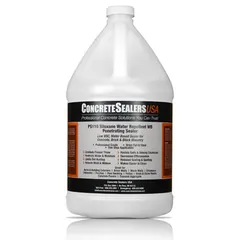 A penetrating sealer lines the pores below the surface, so there is no film for salt to get under and nothing to change the grip under bare feet. Concrete Sealers USA's PS110 is a water-based siloxane/silane blend, and the company lists it on its patio and pool deck page. Its label gives 150 to 200 sq ft per gallon, under 100 g/L VOC, a flat, clear finish and a 28-day wait on new concrete. It costs $39.95 a gallon or $169.95 for 5. On a chlorine pool, the water-based siliconate PS102 is a cheaper per-foot option made for broom finishes, at 200 to 250 sq ft per gallon.
Natural stone coping or travertine surround: a fluorinated stone sealer
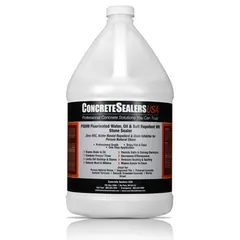 Many concrete decks meet a stone coping, and stone wants a different product. PS099 is a water-based fluorinated sealer made for porous natural stone, unglazed tile and smooth or polished concrete. It lists pool surrounds by name and claims water, oil and salt repellency. The label gives 300 to 500 sq ft per gallon on porous surfaces and 600 to 1,000 on dense ones, under 50 g/L VOC, at $104.95 a gallon. It costs more per gallon than the concrete sealers but goes further on dense stone.
Stamped or colored deck: penetrating first, then a thin acrylic
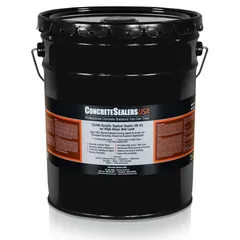 A stamped deck needs a film sealer to bring the color back, but film is what fails around salt. The American Society of Concrete Contractors' answer for saltwater pools is a penetrating sealer first, then a solvent-based acrylic over it. It has to be solvent-based, because a water-based acrylic will not stick over a penetrating sealer. Concrete Sealers USA's solvent-based TS200 lists pool decks, but at up to 700 g/L it cannot be shipped to 15 states, parts of 3 more, and DC (see VOC limits). In those states, or on a chlorine pool, the water-based TS202 low-gloss acrylic is the option, applied straight to the clean concrete with no penetrating coat under it.
Why saltwater pools wreck acrylic sealers
Rich Cofoid, writing as a council director for the American Society of Concrete Contractors in July 2024, says summer brings a run of calls about delaminating pool deck sealers, and that his first question is whether the pool is saltwater. His point is that it is less a sealer failure than a concrete one: salt water dripping off swimmers works into control joints, cracks and pinholes in the film, attacks the concrete underneath, and the concrete takes the sealer with it as it goes.
- Where it starts: at control joints and where the deck meets the coping, the places swimmers drip as they climb out.
- What to use: a penetrating silane or siloxane, or a penetrating sealer with a solvent-based acrylic over it.
- What not to do: put a water-based acrylic over a penetrating sealer; it will not bond.
If you are building a new pool, settle this before the deck is poured and colored. A saltwater system under a glossy stamped deck is the exact combination the ASCC article describes failing.
Slip resistance: the part labels do not cover
The International Swimming Pool and Spa Code, section 306, requires decks, ramps and coping around a pool to be slip resistant and cleanable, and limits the slope of a deck other than wood to 1/2 inch per foot. The 2012 edition named no test. Newer code text, such as the version Oklahoma reviewed for adoption, adds one: where a surface is tested, it needs a wet dynamic coefficient of friction (DCOF) of at least 0.42 under ANSI A326, or a pendulum rating of P4.
ANSI A326.3-2021, the tile industry's standard, puts exterior pool decks in its Exterior Wet category but leaves the friction value for that category for the manufacturer to declare. It is written for hard-surface flooring such as tile, and none of the Concrete Sealers USA labels we read publishes a friction figure. One pool deck sealer that does, SlipDoctors Deck Grip, lists 0.53 wet DCOF on its data sheet, above the code's 0.42.
- Penetrating sealers leave no film, so the deck keeps the grip it had.
- Acrylics add a film that gets slicker as it builds; the TS200 and TS202 labels both warn that slip resistance can drop with each application.
- Grit additives go into the last coat of an acrylic. W. R. Meadows SURE-STEP calls for no more than 8 oz per gallon, and Expressions' No-Slip Grit and Direct Colors OxiGrip both work out to about 3 oz per gallon. The Decorative Concrete Council says exterior public walkways should have enough grit to feel with a bare hand, and warns that plain sand can make the sealer deteriorate, even though both TS labels suggest sand as an anti-skid.
Concrete Sealers USA does not list an anti-slip additive, so buy one made for the sealer type you are using and stir it often while you roll, especially after a pause, because grit settles.
Pool deck sealers compared, from their own labels
Every figure below is what the maker publishes. We did not measure any of them. Concrete Sealers USA product names link to the product page through our affiliate link.
| Product | Type | VOC | Coverage per gallon | Look |
|---|---|---|---|---|
 Concrete Sealers USA PS110 | Siloxane/silane, water-based | Under 100 g/L | 150 to 200, 1 coat | Flat, unchanged |
 Concrete Sealers USA PS102 | Siliconate, water-based | 8 g/L | 200 to 250 on broom finish, 1 coat | Flat, unchanged |
 Concrete Sealers USA PS109 | Silane, solvent-based | Under 250 g/L | 200 to 350 on dense concrete, 1 coat | Flat, unchanged |
 Concrete Sealers USA PS099 | Fluorinated, water-based, for stone | Under 50 g/L | 300 to 500 porous, 600 to 1,000 dense | Flat, natural |
 Concrete Sealers USA TS202 | Acrylic, water-based | Under 100 g/L | 300 to 400 stamped, 175 to 225 aggregate, per coat | Low gloss, satin |
 Concrete Sealers USA TS200 | Acrylic, solvent-based | Under 700 g/L | 300 to 400 stamped, 175 to 225 aggregate, per coat | High gloss, wet look |
| Foundation Armor SX5000 | Silane/siloxane, solvent-based | Under 250 g/L | Up to 175 porous, 200 to 225 smooth, per coat | Invisible |
| Ghostshield Siloxa-Tek 8500 | Silane/siloxane, water-based, 40% actives | Not stated | Not stated on the product page | Natural flat |
| Seal-Krete SS-10 | Silane/siloxane, 10% solids | Under 100 g/L | 150 to 400, two coats recommended | Dries clear |
| SlipDoctors Deck Grip | Acrylic anti-slip sealer, water-based, semi-gloss | See label | See label | 0.53 wet DCOF listed |
Two cautions. Seal-Krete says SS-10 is for porous concrete and not smooth troweled surfaces, and many pool decks are broom finished, so it fits; check yours. And Foundation Armor prints the same coverage figures for its SX5000 penetrating sealer and its AR350 acrylic, so treat its numbers as a template and plan on the low end.
How much sealer a pool deck takes, and what it costs
A 16 by 32 ft pool with a 5 ft deck on every side is 580 sq ft of deck; call it 600 to cover steps and corners. Here is what that takes on a broom finish, at the low end of each label and Concrete Sealers USA list prices:
| Sealer type | Coats | Gallons | Buy | Cost | Per sq ft |
|---|---|---|---|---|---|
| Silane/siloxane, water-based (PS110) | 1 | 4 | 4 jugs | $159.80 | $0.27 |
| Siliconate, water-based (PS102) | 1 | 3 | 3 jugs | $119.85 | $0.20 |
| Acrylic, water-based (TS202) | 2 | 4.8 | 1 pail | $169.95 | $0.28 |
| Acrylic, solvent-based (TS200) | 2 | 4.8 | 1 pail | $199.95 | $0.33 |
The acrylic rows use the label's cure-and-seal rate of 250 sq ft per gallon, the closest it gives for broom finish, at two coats. For the penetrating-then-acrylic system on a saltwater pool, add the silane/siloxane row to the solvent acrylic row. Grit additive is extra. Run your own deck size and prices through the concrete sealer calculator.
How often to reseal a pool deck
When water stops beading, not on a schedule. Splash some on the deck: if it darkens the concrete and soaks in, the sealer has worn through. The Decorative Concrete Council's 2025 best practice says to reseal as needed, warns that over-resealing builds a film that is costly to remove, and advises not resealing a stamped deck in direct sun, where it can bubble.
Two pool-specific habits help. Reseal with the same type of sealer you used before, and on an acrylic deck, add fresh grit to the new top coat every time, because the old grit is under it. For cleaning, prep and application steps, see how to seal concrete, and for the rest of the outdoor slab, outdoor concrete floors. If you are sealing something other than a pool deck, our guide to the best concrete sealer by surface has a pick for each one.
Frequently asked questions
Should I seal my concrete pool deck?
Usually yes, with a penetrating sealer. Splash-out, pool chemicals and freeze-thaw all work into bare concrete, and a silane or siloxane keeps water out without changing how the deck looks or grips. A film sealer is worth it only on stamped or colored decks where you want the color brought out.
What is the best sealer for a saltwater pool deck?
A penetrating silane or siloxane, or a penetrating sealer with a solvent-based acrylic over it. That is the recommendation in a 2024 American Society of Concrete Contractors article, which traces most pool deck sealer delamination to salt water getting under the film and attacking the concrete.
Will sealing a pool deck make it slippery?
A penetrating sealer will not, because it leaves no film. An acrylic can, and the TS200 and TS202 labels warn slip resistance can drop with each coat. Mix an anti-slip additive made for that sealer into the last coat; common ones dose at about 3 oz per gallon.
How often should you seal a concrete pool deck?
When water stops beading on it, rather than on a fixed schedule. The Decorative Concrete Council advises resealing as needed and warns that resealing too often builds up film that is costly to remove. On an acrylic deck, add fresh grit to every new top coat.
Can you put a water-based acrylic over a penetrating sealer?
No. The penetrating sealer stops a water-based acrylic from bonding, according to the American Society of Concrete Contractors. If you want an acrylic over a penetrating coat, it has to be solvent-based, which rules it out in states with strict VOC limits.