Best Garage Floor Sealer
The best garage floor sealer for most garages is a penetrating oil and salt repellent: a fluorinated sealer like Concrete Sealers USA's PS100 that soaks into the troweled slab, keeps its natural look, and shrugs off the road salt and oil that ride in on tires without a film that can peel. If you want a coated, wipe-clean floor that fully blocks oil, a two-part film kit or an epoxy is the other route, at the cost of surface prep and recoating. What a garage floor almost never needs is a plain water repellent that makes no oil claim at all.
How we picked. We compared product labels and technical data sheets, read on Nov 21, 2026, from Concrete Sealers USA, Ghostshield and Foundation Armor, against salt-scaling guidance from NRMCA, the ready-mix producers' association. We did not test these sealers ourselves; where a real-world result is cited we say whose it is. Links to Concrete Sealers USA are affiliate links and we may earn a commission at no cost to you; other brands are named and compared from their own labels but not linked.
Best garage floor sealer by situation
Start with what your garage floor actually fights: oil, road salt, dusting, or just water. Getting the type right matters more than the brand, and on a garage floor it decides whether oil beads up and wipes away or soaks in and stains. Here are four picks for four situations, all from Concrete Sealers USA so the prices and labels line up, with the competitors compared further down.
Best overall for a garage floor: a fluorinated oil and salt repellent
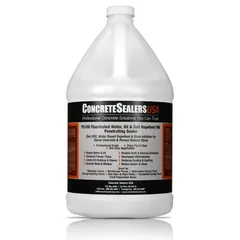 PS100 is a 100 percent fluorinated, water-based penetrating sealer, with no silanes or siloxanes. Concrete Sealers USA labels it an oil and stain repellent and says it gives "excellent 'hold out' and stain resistance for oil and grease" along with dirt buildup and most food stains, while leaving the concrete's natural look. The label gives 300 to 450 sq ft per gallon on machine-troweled concrete, under 50 g/L VOC, and asks for a slab at least 28 days old and fully cured. It costs $104.95 a gallon or $499.95 for 5. Because it soaks in rather than coating the surface, it cannot peel and cannot lift under a hot tire, and the floor stays as grippy as bare concrete. The honest limit: a penetrating repellent slows oil and makes spills far easier to wipe up, but it is not a barrier, so oil left to sit can still stain (more on that below).
Best if you want to fully stop oil: a two-part film kit
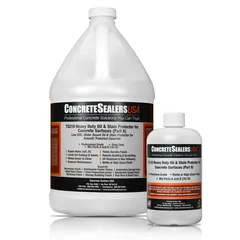 TS210 is a two-component, water-based acrylic-modified aliphatic polyurethane that dries as a thin film on top of the slab. Its label claims "exceptional temporary 24-hour chemical and stain resistance to most common contaminants including oil, grease, and most common food items," which is more than any penetrating sealer can honestly say, but the same sheet adds that "all spills should be wiped up immediately" and that the coating "will act as sacrificial protection and will require reapplication." Coverage is 800 to 1,000 sq ft per gallon on smooth troweled surfaces, mixed 7 parts A to 1 part B with roughly a two-hour pot life, under 50 g/L VOC, slab at least 28 days old. Kits run about $44.95 for a quart, $134.95 for a gallon and $469.95 for 4 gallons. Two warnings come straight from its own data sheet: roll it thin to avoid "micro bubbling, hazing, lines or streaking," and "the coefficient of friction of the surface may decline with each sealer application," so plan to broadcast grit if the floor ever gets wet. Ordering is not add-to-cart either: Concrete Sealers USA lists TS210 "For Business, Professional and Experienced DIYers" and sells it only after a brief phone verification, and the label separately wants a small test patch before you coat the whole floor, so build both into your timeline.
Best add-on for a dusty or soft slab: a lithium densifier
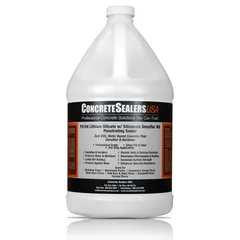 If the garage floor chalks or leaves dust on everything you set down, harden it before you seal it. PS104 is a zero-VOC lithium silicate densifier carrying a siliconate water and salt repellent; it reacts inside the concrete to cut dusting and adds water and salt resistance, with no surface film. The label gives 300 to 450 sq ft per gallon on machine-troweled and smooth surfaces, at $39.95 a gallon or $189.95 for 5. On its own it is not an oil repellent, so the sequence for an oil-prone garage is to densify with PS104, let it cure, then top it with PS100 for oil and stain hold-out. Concrete Sealers USA publishes no incompatibility between the two, but it does tell you to run a small test first, which is worth doing before you commit the whole floor.
Best budget pick, water and salt only: a siliconate
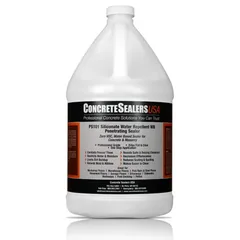 If your garage never sees oil and you only want to keep road salt and water out of the slab, PS101 is the cheapest way to do it. It is a zero-VOC siliconate water repellent at $39.95 a gallon or $179.95 for 5, covering 300 to 450 sq ft per gallon on smooth or dense concrete and 175 to 225 on a broom finish, with "little, or no, noticeable change in appearance" and "minimal impact to traction coefficient." Be clear about its one limit: Concrete Sealers USA states plainly that "PS101 is not oleophobic and is not intended as an oil repellent." Buy it for water and salt, and step up to PS100 if oil stains are the reason you are sealing in the first place.
Garage floor sealers compared, from their own labels
Every figure below is what the maker publishes; we did not measure any of them. The Concrete Sealers USA product name links to its page through our affiliate link, while Ghostshield and Foundation Armor are named and compared but not linked.
| Product | Chemistry | Oil resistance (from label) | VOC | Coverage per gallon | Slab age |
|---|---|---|---|---|---|
 Concrete Sealers USA PS100 | Fluorinated, water-based, penetrating | Slows oil; "hold out" and stain resistance, no film | Under 50 g/L | 300 to 450 on machine-troweled, 1 coat | 28 days |
| Concrete Sealers USA TS210 | Two-part acrylic polyurethane film, water-based | Blocks oil, but temporary and sacrificial | Under 50 g/L | 800 to 1,000 on smooth, per coat | 28 days |
| Concrete Sealers USA PS104 | Lithium silicate densifier, water-based | No; densifier with water and salt repellent | 0 g/L | 300 to 450 on smooth, 1 coat | See label |
| Concrete Sealers USA PS101 | Siliconate, water-based | No; label states it is not an oil repellent | 0 g/L | 300 to 450 smooth, 175 to 225 broom | See label |
| Ghostshield Siloxa-Tek 8510 | Fluorocarbon-modified silane, solvent-based | Slows oil; oleophobic, easier to clean, no film | 300 g/L maximum | 150 to 400, per coat | 14 to 28 days |
| Ghostshield Siloxa-Tek 8505 | Fluorocarbon silane, water-based | Slows oil; same oleophobic chemistry, no film | 90 g/L maximum | 150 to 400 one coat, 75 to 200 two | 14 to 28 days |
| Foundation Armor SX5000 | Silane-siloxane, solvent-based | No; label disclaims gasoline and surface stains | Under 350 g/L | Up to 175 porous, 200 to 225 smooth | 28 days |
| Foundation Armor SX5000 WB | Silane-siloxane, water-based | No; same water repellent, no oil claim | 0 g/L | Up to 175 porous, 200 to 225 smooth | 28 days |
Three things the table shows that a single product page will not:
- The real oil match-up is PS100 against Ghostshield. Both are fluorine-based penetrating repellents: PS100 is a fluorinated water-based sealer, and Ghostshield's Siloxa-Tek 8510 is a fluorocarbon-modified silane that the maker calls oleophobic and says will "resist oil absorption and surface staining from motor oils, grease and other oil based contaminants." Both slow oil and make cleanup easier, and neither forms a film, so oil left to sit can still stain either one. The practical split is carrier and VOC: PS100 is water-based under 50 g/L, while the 8510 is solvent-based at 300 g/L maximum, with a water-based sibling, the 8505, that drops to 90 g/L.
- Foundation Armor SX5000 is the wrong tool for oil, by its own label. SX5000 is a silane-siloxane water repellent whose data sheet states the "Sealer is not resistant to brake fluid, gasoline, and many other similar products" and "will not stop surface stains ... as the surface of the substrate is fully exposed." It is an excellent water and salt repellent for driveways and exteriors, and Foundation Armor itself steers garage oil and gas exposure toward its urethane coatings rather than SX5000. It sells for roughly $50 to $65 a gallon at retail.
- Only a film fully stops oil, and strength numbers do not compare across brands. A coating, the TS210 kit or an epoxy, is the only choice here that blocks oil from reaching the concrete, and it earns that with surface prep, recoating and a chance of hot-tire pickup. A larger "percent actives" figure on one jug is not proof of a better seal, either: the labels give no shared penetration-depth number to line up, so compare chemistry and carrier, not the marketing percentage.
Does a garage floor sealer actually stop oil?
The honest answer depends on the kind of sealer. A penetrating oil repellent like PS100 or Ghostshield's 8510 lowers the surface energy of the concrete so oil beads and sits on top longer, which buys you time to wipe it and makes stains much easier to clean. It is not a barrier, though: park over a slow drip for a week and it can still darken the slab. A film-forming coating, the TS210 kit or an epoxy floor, is the only thing that physically blocks oil from reaching the concrete at all.
Independent testing of garage sealers, as opposed to seller claims, is thin. One independent garage-floor review site that ran an informal oil test on PS100 reported the same pattern we describe here: an oleophobic penetrating sealer slows oil penetration and makes cleanup easier, but oil left to sit will still stain. That is a review site rather than a published standard, so we name it in plain text and do not lean on a number from it. It matches the makers' own wording anyway: even TS210, the film, calls its oil resistance "temporary" and its protection "sacrificial," and tells you to wipe spills immediately.
Oil is only half of what a garage floor fights. Road salt rides in on tires all winter and soaks into the top of the slab, where it drives the freeze-thaw scaling that NRMCA's scaling guide warns about; the association names breathable silane and siloxane repellents as the defense. PS100, PS104 and PS101 all list water and salt resistance, so a penetrating repellent covers the salt, and for the fluorinated PS100 the oil as well, in a single step without a film.
Penetrating sealer vs epoxy on a garage floor
On a garage floor the real fork is a penetrating sealer against a film coating, usually epoxy. It sets how the floor looks, how it handles oil, and how much upkeep you sign up for.
Penetrating sealer
A fluorinated repellent, siliconate or siloxane soaks in and lines the pores. The concrete looks and feels unchanged, it stays as grippy as bare concrete when wet, it cannot peel or lift under a hot tire, and it blocks salt while slowing oil. It is the cheapest route and you reseal when water stops beading, not on a schedule. The trade-offs: it adds no color or shine, and oil left to sit can still stain.
Film coating (epoxy or a kit)
An epoxy, or a two-part kit like TS210, dries as a layer that fully blocks oil and gives a showroom, wipe-clean finish, which is why people choose it for a finished garage. In return it needs real surface prep, it can peel or lift under hot tires if that prep is wrong, it can get slick unless you broadcast grit, and it has to be recoated in time. For the full coating route, see our guide to a garage floor epoxy coating.
How much garage floor sealer you need
Once you have picked a type, the amount comes down to the floor area, the number of coats, and the coverage on the label. Enter your garage below and this runs the same math as our full concrete sealer calculator, giving the gallons, the cheapest mix of jugs and pails, and the material cost at each type's published rate. It is preset to a smooth troweled floor sealed with PS100.
With JavaScript off, divide the floor area by the coverage per gallon on the label, then multiply by the number of coats. A 480 sq ft two-car garage sealed with PS100 at 300 sq ft per gallon takes about 2 gallons for one coat; at $104.95 a gallon that is roughly two jugs at Concrete Sealers USA list prices. A 720 sq ft three-car garage at the same rate takes about 3 gallons.
How to seal a garage floor
The steps are the same whichever penetrating sealer you chose; a film kit adds mixing and a longer wait before you drive on it. The work that decides the result is the prep, not the sealer.
Clear the floor and degrease it
Empty the garage, sweep, and pull up every oil and grease spot first: a penetrating sealer will not bond over a greasy patch, and a film will lift there. Our guide to removing oil stains from concrete covers the poultices and degreasers that lift old, soaked-in stains.
Check the slab's age and how thirsty it is
PS100, TS210 and most repellents want concrete at least 28 days old and fully cured. Splash water on a clean spot: if it soaks in and darkens the slab, the surface is open and ready; if it beads, an old sealer or a hard steel-troweled burnish is shedding it and needs opening up first.
Etch or profile a dense troweled floor if water beads
Many garage floors are hard-troweled and shed water. A mild acid etch or a light grind opens the surface so the sealer can key into it. Rinse well and let the slab dry fully before you seal, since trapped moisture is what clouds a sealer later.
Apply the sealer the way its label calls for
For a penetrating repellent like PS100, flood the surface to an even wet sheen and spread any puddles so nothing dries glossy. For the TS210 film, mix the two parts to the ratio on the kit and roll thin, even coats within the recoat window, keeping it off thick to avoid the hazing and streaking its sheet warns about.
Wait before you walk and park
Give a penetrating sealer the cure time on the label before foot traffic, and give a film longer before you drive on it. Parking a hot tire on a coating too soon is the classic way to lift it, so when in doubt, wait an extra day.
Frequently asked questions
What is the best sealer for a garage floor?
For most smooth troweled garage floors, a penetrating fluorinated oil and salt repellent such as Concrete Sealers USA PS100. It is labeled an oil and stain repellent, resists road salt, and leaves no film, so there is nothing to peel or lift under hot tires. A film-forming coating, a two-part floor polyurethane or an epoxy, is the other route: it is the only thing that fully stops oil, and it suits anyone who wants a coated look and will maintain it.
Does a garage floor sealer stop oil stains?
A penetrating sealer slows oil staining and makes spills easier to wipe up, but it does not stop them completely; only a film does. PS100 claims a stain resistance and hold out for oil and grease and says it will significantly reduce most staining, not block it, so spills still need wiping up promptly. A film coating like TS210 gives what its label calls 24-hour chemical and stain resistance to oil and grease, but it wears as sacrificial protection and has to be reapplied.
Penetrating sealer or epoxy for a garage floor?
Choose a penetrating sealer if you want the bare concrete look with nothing on top to peel, and epoxy or a film coating if you want a finished, fully sealed surface and will prep for it. A penetrating repellent cannot delaminate or suffer hot tire pickup, which is why coatings lift on garage slabs. Epoxy needs a dry slab, a moisture test and the right surface profile, or it peels. See the epoxy floor coating guide for the film route.
How long before you can park on a sealed garage floor?
A penetrating sealer like PS100 dries for foot traffic in a few hours; for vehicles, follow the time on the label. A film coating needs longer: fast-set systems can take cars in about a day, while a standard epoxy usually wants two to three days to cure hard enough for tires. Parking on a film before it has cured is what causes early hot tire pickup.
Is a sealed garage floor slippery?
A penetrating sealer does not change traction, because it leaves no film: PS101 is labeled as having minimal impact on the traction coefficient, and Ghostshield measures no change in skid resistance on troweled concrete. A film can get slippery; the TS210 label warns its coefficient of friction may decline with each coat, so add an anti-slip grit made for the product if you coat a garage floor.
How often do you reseal a garage floor?
Reseal a penetrating sealer when water stops beading on the floor, not on a fixed schedule. A fluorinated oil and salt repellent lasts years between coats. A film is different: TS210 says it acts as sacrificial protection and will need reapplication, so a coated floor is recoated when it dulls or starts to wear through, before the concrete under it is exposed.