Concrete Spalling: Causes, Repair and Prevention
Most of what people call concrete spalling is shallow surface damage you can repair yourself. A true spall is a fragment of concrete that has broken away from the mass, usually because steel rusting below has expanded and pushed it off; the thin flaking you see across a driveway or garage floor after a salty winter is technically scaling, a shallower and separate problem. Either way the fix has the same shape: clean out the damage, patch a deep spall or resurface a scaled surface, then seal the concrete once it has cured. This guide shows how to tell the three defects apart, what causes each, how to repair them, and how much material a given area takes.
Spalling, scaling or popouts? How to tell
Naming the damage correctly decides the repair, so start here. The industry definitions draw a clean line that most web pages blur. The ACI Concrete Terminology defines a spall as "a fragment, usually in the shape of a flake, detached from a larger mass by a blow, the action of weather, pressure, or expansion within the larger mass," scaling as "local flaking or peeling away of the near-surface portion of hardened concrete," and a popout as a "shallow, typically conical, depression" left by "localized internal pressure." In plain terms: a spall is a chunk that comes off, scaling is the surface peeling, and a popout is one bad stone blowing a small cone out of the top.
Scaling
Surface flakes off
The top mortar peels or flakes. NRMCA CIP 2 puts moderate scaling at a loss of 1/8 to 3/8 inch of surface mortar. Cause: freeze-thaw cycles, made worse by deicing salt. This is what most "spalling" photos actually show.
Spalling
A chunk breaks away
A piece detaches, deeper than the mortar skin and often over a rusting reinforcing bar. ACI ties it to "pressure, or expansion within the larger mass." This is the one that can be structural.
Popout
A small cone pops out
A cone-shaped cavity, from 1/4 inch to a few inches across (NRMCA CIP 40), left where one porous aggregate particle fractured near the surface. Almost always cosmetic.
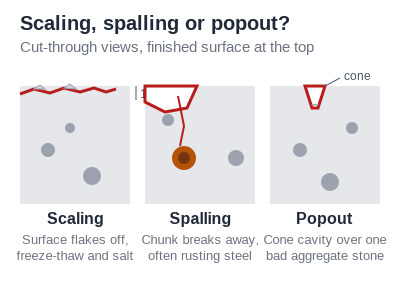
Why this matters: scaling and popouts are surface problems you treat by patching or resurfacing, while a spall over corroding steel is a sign the reinforcement itself is failing and may need an engineer. Get the name right and the rest of the decision follows.
What causes concrete to spall
Four mechanisms account for nearly all of it. Each leaves a different signature, which is how you work backward from the damage to the cause.
Freeze-thaw and salt
Most common
CIP 2 defines scaling as flaking "as a result of exposure to cycles of freezing and thawing." Water in the surface pores freezes, expands and lifts the mortar; deicing salt pulls in more water and forces more cycles, so a salted slab scales faster than a plain one.
A weak surface
Built in
CIP 2 lists too little entrained air at the surface, finishing while bleed water is still on top, over-troweling, and short curing. Any of these leaves a thin, permeable skin that peels "in the absence of freezing and thawing."
Rusting steel
The true spall
When a reinforcing bar corrodes, "the corrosion products of steel occupy several times the volume of solid steel... resulting in cracking and spalling of the concrete cover" (FHWA). The rust ring pushes the cover off from inside.
A bad aggregate
First year
CIP 40 traces popouts to a porous, low-density particle, often chert, that absorbs water and fractures when it freezes, "during the first year after placement." It takes the thin cap of surface above it with it.
The rusting-steel case is the one to respect. As the bar expands it creates "tensile hoop stresses" in the surrounding concrete that exceed its tensile strength, "typically 1 to 2 megapascals" (FHWA), so the cover cracks along the bar and sheets off. Fire and sustained high heat can do something similar from the other direction: pore pressure builds inside heated concrete and can drive explosive spalling (NIST).
When is it structural? Scaling and popouts almost never are: CIP 40 notes that "most popouts are aesthetic defects that do not impact the structural performance." A spall becomes a structural question when it exposes corroding reinforcement, undermines a load-bearing edge, or removes a real share of a slab or step's thickness. Those are the cases to have an engineer look at rather than patch over.
How to repair spalled concrete
There are two repairs, and which one you need depends on the diagnosis above. A deep spall or a hole gets a spot patch with a repair mortar. A surface that has scaled over a wide area gets resurfaced edge to edge. Doing the wrong one, skimming a resurfacer over a deep hole or patching only the worst square of a scaled slab, is why repairs fail.
Spot patch: a deep spall or hole
- Cut back to sound concrete. Chip or saw out the loose and crumbling material until you reach solid concrete, and square the edges rather than feathering them to nothing, so the patch has a shoulder to grip.
- Expose and treat any steel. If a rusting bar caused the spall, clean it back to bright metal and treat it before patching, or the rust will push the new patch off the same way it pushed the old cover off.
- Clean and dampen. Remove dust and debris and dampen the opening so the dry concrete does not pull water out of the mix.
- Fill with a repair mortar in lifts. Sakrete Top 'n Bond builds from a feather edge to 2 inches; Quikrete Quick-Setting Cement builds 1 to 2 inches without sag but needs an acrylic fortifier below 1 inch. For deep holes, build in layers rather than one thick pass.
- Cure, then match the surface. Damp-cure per the data sheet (Quick-Setting Cement asks for at least 48 hours), and broom or float the patch to match the texture around it. A repair will not match the original color exactly; CIP 2 warns that repair material "will not match the color and characteristics of the original concrete."
For a broken step nose or a spalled edge, where the patch has to hold a shape and take a footfall, the guide to resurfacing concrete steps walks through rebuilding the edge and the riser-height rule. A spalled or cracked concrete curb is its own repair.
Resurface: widespread scaling
- Confirm the slab is sound. Resurfacing renews a worn surface; it does not fix a slab that has sunk, tilted, or has moving cracks. If the problem is under the slab, resurfacing only hides it for a season.
- Pressure wash to bare concrete. Strip any sealer, paint or oil and wash the surface clean. A bonded resurfacer grips bare concrete, not a coating.
- Resurface the whole surface. Bagged resurfacers such as Quikrete Re-Cap and Sakrete Flo-Coat go from a feather edge to 1/2 inch. Spread it edge to edge, not just over the scaled patches, so the finish is even.
- Keep off traffic while it cures. Re-Cap takes foot traffic in about 8 hours and cars in 24; protect the new surface from rain and frost while it sets.
A scaled, oil-stained or flaking garage floor follows this same resurfacing path, with the added step of degreasing before you start. The full concrete resurfacing guide compares every overlay type and its thickness limits.
How much repair material you need
Enter the area and depth, pick a product, and the calculator returns the bag count, coverage and material cost from each product's published yield. Use a resurfacer and a thin depth for a scaled surface, or a repair mortar and a deeper setting for a spot patch; the calculator flags a depth a product cannot build.
With JavaScript off: multiply the area in square feet by the thickness in inches, divide by 12 for cubic feet, then divide by the bag's yield. A 200 square foot surface at 1/4 inch is about 4.2 cubic feet, roughly 14 bags of a 0.34 cubic foot resurfacer once you add 10 percent for waste. A 4 square foot spot patch at 1 inch is about 0.33 cubic feet, one bag of repair mortar.
How to stop it coming back
Spalling and scaling are water problems, so prevention is about keeping water and salt out of the surface. The repair buys you nothing if the slab scales again next winter.
- Seal the surface once it has cured. A penetrating silane or siloxane repellent lines the pores so water and dissolved salt cannot soak in. These need a porous, fully cured surface: Concrete Sealers USA's labels for its silane and siloxane repellents call for concrete at least 28 days old and fully cured, so a fresh patch or resurfacing waits out its cure before you seal it.
- Keep deicers off new concrete. NRMCA's CIP 2 is blunt: "Avoid the use of deicing chemicals in the first winter." Use clean sand for traction that first season, then salt in moderation after that.
- Never use aggressive salts. CIP 2 says to "never use ammonium sulfate or ammonium nitrate" deicers, which "are chemically aggressive and destroy concrete surfaces." University extension guidance agrees that ammonium nitrate and ammonium sulfate "damage concrete more than sodium chloride or calcium chloride" (UNL Extension). Plain rock salt and calcium chloride are the safer choices.
- Clear slush and standing water. Shovel wet snow off rather than letting it sit and cycle through freezing and thawing on the surface.
To size up the sealer for your surface, the concrete sealer calculator gives the gallons for your area and coat count, and the guide to the best concrete sealer compares penetrating repellents against film-forming coatings so you choose the right type for a driveway, walkway or garage floor.
When to call a pro or replace
Surface scaling, a small spalled patch and a scatter of popouts are all weekend repairs. The line to a professional, or to replacement, is about depth and reinforcement, not area.
Call an engineer or contractor when the spall reaches the steel or the structure. A spall that exposes corroding reinforcement means the bar itself is losing section, and patching over active rust only hides it. The same goes for a spall that takes out a large share of a slab, step or beam's thickness, or one that keeps coming back in the same spot. Widespread scaling that has eaten well past the mortar into the body of the concrete, rather than the top 3/8 inch, is often cheaper to replace than to resurface year after year. When in doubt about load-bearing concrete, have someone look at it before you patch.
Frequently asked questions
What causes concrete to spall?
Four things cause most of it. Freeze-thaw cycles, made worse by deicing salt, flake the surface; a weak, over-troweled or poorly cured surface skin peels; rusting reinforcing steel expands and pushes the cover off, which is true spalling; and a porous aggregate particle near the surface can fracture and pop out in the first year. NRMCA and ACI tie the shallow flaking to scaling and reserve spalling for the deeper detached fragment.
What is the difference between spalling and scaling?
Scaling is shallow: the near-surface mortar flakes or peels, and NRMCA CIP 2 puts moderate scaling at a loss of 1/8 to 3/8 inch. Spalling is deeper: ACI defines a spall as a fragment detached from the mass by pressure or expansion within it, which on a driveway or wall usually means a rusting bar below. Most of what homeowners call spalling is really scaling.
Can you repair spalled concrete yourself?
Usually, yes. A deep spall or hole gets cut back to sound concrete and filled with a repair mortar in lifts; a widely scaled surface gets pressure washed and resurfaced edge to edge with a bonded resurfacer. The exception is a spall that exposes corroding reinforcement or undermines load-bearing concrete, which is a job for an engineer or contractor.
Is concrete spalling a structural problem?
Usually not. Surface scaling and popouts are cosmetic; NRMCA notes that most popouts do not affect structural performance. A spall becomes structural when it exposes corroding reinforcement, removes a real share of a slab or step thickness, or keeps returning in the same spot. Those cases warrant a professional look before you patch.
Will sealing stop concrete from spalling?
Sealing is the main prevention once the surface has cured. A penetrating silane or siloxane repellent lines the pores so water and dissolved salt cannot soak in to freeze and lift the surface. It needs a porous, fully cured surface, a minimum of 28 days old, so seal a fresh repair only after it cures. Keeping deicers off concrete in its first winter matters just as much.
Can spalling be fixed, or do you have to replace the slab?
Most spalling and scaling is repaired, not replaced. You patch deep spalls and resurface scaled surfaces. Replacement makes sense when the damage runs well past the surface into the body of the concrete, when reinforcement is badly corroded, or when a surface scales again every winter despite repair and sealing. At that point a new pour can cost less than repeated repairs.